
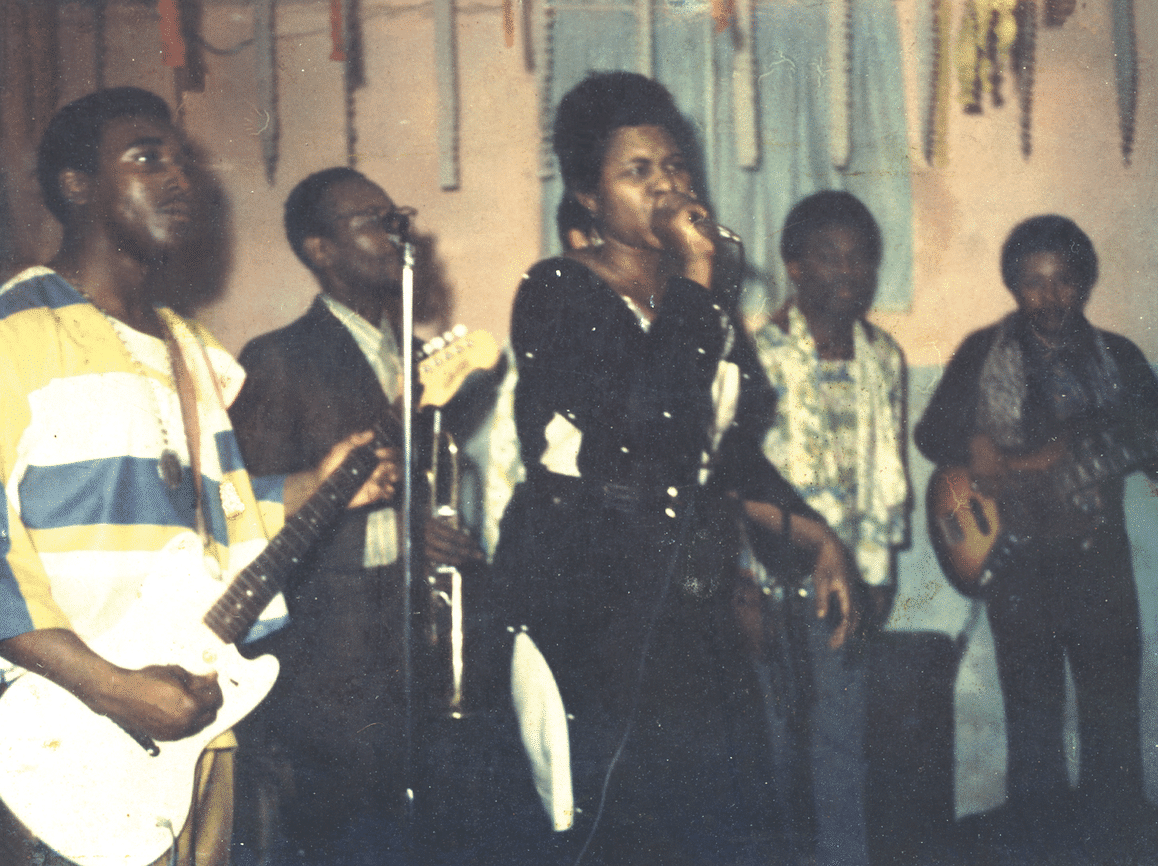
“And an oh-pa-dacious hello to you!” While civil rights protestors across the South were being fire-hosed, attacked by police dogs, and hauled off in paddy wagons, inside the studios of WLAC TV, host Noble Blackwell grinned his trademark opening phrase. In a still-segregated Bible-belt town renown for hillbilly singers in cowboy hats, Night Train featured purveyors of R&B in tight suits, thin ties, and shoe-shined hair a full five years before Soul Train debuted in Chicago.
It was 1964 and the pulsating African-American music scene that had thrived in Nashville for three decades was exhaling its last gasp. Downtown’s historic Bijou Theater, the movie and vaudeville house “exclusively for colored people,” had been razed. Next door, the soon-to-be-destroyed New Era Club squeezed in final appearances by Aretha, B.B. King, Jerry Butler, and Etta James.
As far back as the 1930s, the jumping joints of Jefferson Street, flush with illegal gambling cash, had given local talent steady employment, while drawing acts from the Chitlin Circuit. Little Richard called Club Revillot his favorite tour stop because, “I didn’t make $100 (per week) nowhere but there really.” The house band at Club Del Morocco featured a scrawny, southpaw axeman named Jimmy (not yet Jimi) Hendrix. Nicknamed “Marbles” (because everyone thought he’d lost his …) Hendrix strutted down to The Baron one night in ’63 and challenged bluesman Johnny Jones to a battle of the six-strings. Jones sent “Marbles” slinking away in defeat.
Johnny Jones had been recruited to Music City from Knoxville — where he’d been gigging in a back-up band for female impersonators — by a music-biz Renaissance man named Ted Jarrett. As a boy, Jarrett’s domineering grandfather once threatened him with a beating for even attempting a song lyric. However, the chubby, defiant Jarrett showed ol’ Grandpop! In 1955, Jarrett became the first African-American tunesmith to pen a #1 country song (Webb Pierce’s “Love, Love, Love”) while his production of “It’s Love, Baby (24 Hours A Day)” featuring hometown belter Earl Gaines peaked at #2 R&B. “It’s Love …” charted again with Hank Ballard and the Midnighters, Ruth Brown, and a British beat band called The Knack.
Jarrett went on to discover and produce Gene Allison, for whom he composed the 1958 Top-5 crossover hit, “You Can Make It If You Try” (subsequently covered by The Rolling Stones). Jarrett’s production home was Ernie’s Music Mart, which also housed one of Nashville’s most successful indie R&B imprints, Excello Records. Entrepreneur Ernie Young financed his make-shift studio and label with mail-order record sales generated by the Ernie’s Record Parade broadcast on WLAC AM. Since 1946, that station’s 50,000-watt signal had R&B diehards across the nation dialing in. South Carolina native James Brown recalled, “WLAC was all we ever listened to.”
Although Nashville’s R&B scene never produced a Sam Cook, an Aretha, an Otis, or a Marvin, the local talent, groomed in the nightspots of Jefferson Street and Printers Alley, was undeniably first-class. (The Country Music Hall of Fame hosted an exhibit on Music City’s early R&B scene in 2004-2005.) Nashville native Cecil Gant, who had refined his prodigious piano-vocal stylings on the pre-WWII New Era stage, exploded onto Billboard’s Harlem Hit Parade in 1944 with “I Wonder.” On “We’re Gonna Rock” (1950) Gant attacked no-holds-barred piano rock and roll seven years before Jerry Lee got a whole lotta shakin’ goin’ on. In 1954, Christine Kittrell’s big, sultry voice racked up an R&B hit with “Sittin’ Here Drinkin’.” Jimmy Sweeney’s soaring tenor was at least as sweet as The Platters’ Tony Williams. Jimmy Church combined Jackie Wilson sex-appeal with Sam Cook-ish vocal timbres. Roscoe Shelton wailed with genuine soul. Gene Allison delivered gospel-tinged passion. In 1966, Marion James’ crossed over with “That’s My Man,” the same year another multi-talented Nashville native skyrocketed to momentary stardom.
Born to sightless parents with colorblind musical tastes, Bobby Hebb tap danced on the Bijou stage in a child sibling act, played spoons for Roy Acuff as a teenager at the Grand Ole Opry and, in his 20s, contributed to myriad recording sessions on guitar and trumpet. “Sunny,” which Hebb wrote and recorded in New York, won him an opening slot on The Beatles’ last tour. Hebb’s only hit composition ranks 25th on BMI’s most-played songs of the 20th century.
The entire infrastructure was in place for Nashville to become one of America’s capitals of R&B and Soul — talent, performance venues, studios, labels, radio and TV exposure. So, why did Music City fall so short of Memphis and Motown? Should urban renewal be blamed for knocking down the Bijou and the New Era? Or Mayor Beverly Briley’s axe-wielding anti-gambling reformers who chopped The Baron into toothpicks? Or was Interstate 40 at fault for bulldozing through the once-booming African-American businesses of Jefferson Street?
Certainly, all those factors contributed. Ironically, however, the most glaring missing ingredient is the very product in which Music City takes the most pride — GREAT SONGS! One “Sunny” can’t possibly make up for “Hold On, I’m Comin’,” “Try A Little Tenderness,” “Heard It Through the Grapevine,” and “Baby, Love,” let alone the rest of the astounding songbook authored by Sam Cook, Steve Cropper, David Porter, Isaac Hayes, Otis Redding, Al Green, Holland/Dozier/Holland, Marvin Gaye, Ashford and Simpson, Gamble and Huff, Dan Penn and Spooner Oldham.
Without consistently great songwriting, Nashville’s Night Train was left with no R-E-S-P-E-C- T… and Noble Blackwell signing off with, ‘In the meantime, take especially good care of yourself. And be good to your neighbor!”
More Features
-
American singer and songwriter Bobbie Gentry posed sitting on a park bench in a London square on 13th October 1969. (Photo by Larry Ellis Collection/Getty Images) -
"British singer-songwriter Rod Stewart performing at Sanremo Music Festival. Sanremo, February 1993 (Photo by Rino PetrosinoMondadori via Getty Images)" -
CIRCA 1960: Fred Foster (1931 – 2019), president of Monument Records, poses with his newest signees, Fred Carter (left) and Willie Nelson in circa 1960. (Photo by Michael Ochs Archives/Getty Images) -
NEW YORK, NY CIRCA 1988: George Harrison at the 1988 Rock n Roll Hall of Fame Induction Ceremony circa 1988 in New York City. (Photo by Sonia Moskowitz/IMAGES/Getty Images) -
OAKLAND, CA – CIRCA 1984: Steve Perry and Journey are performing at the Oakland Coliseum in Oakland, California on January 1, 1984. (Photo by Larry Hulst/Michael Ochs Archives/Getty Images) -
Pop group The Byrds (l to r): Chris Hillman; Dave Crosby; Mike Clark; Jim McGuinn; and Gene Clark. (Photo by © Hulton-Deutsch Collection/CORBIS/Corbis via Getty Images) -
An MGM promotional photograph of country western music star Hank Williams who is to appear at the Arena with the Grand Ole Opry troupe on Thanksgiving Day, Cleveland, Ohio, November 15, 1951. (Photo by Underwood Archives/Getty Images)
