
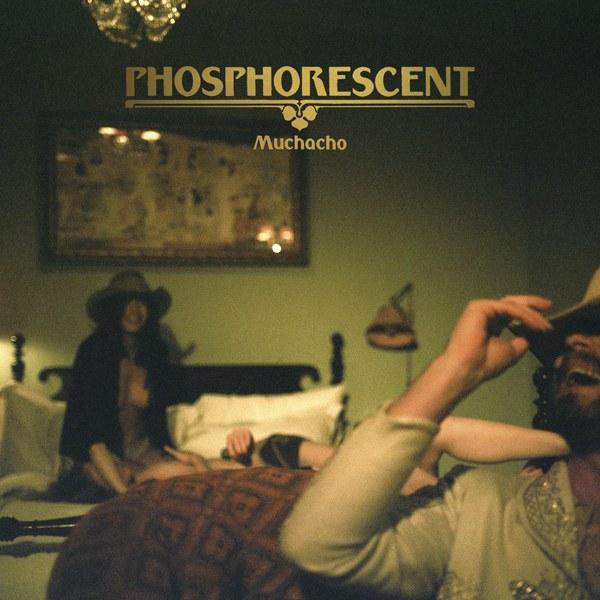
“Song For Zula” by Phosphorescent (Matthew Houck) “is the type of song that makes you sit upright and press repeat,” says Laura Barton of The Guardian (Nov 28, 2018). She goes on to describe “Zula” as “a defiant farewell of a song, a portrait of love as an imprisoning, ferocious creature to be defeated.”
No argument there, nor with Barton’s flair for words. But it was her first statement that really caught my ear: “The type of song that makes you sit upright and press repeat.” Word-for-word, I felt the same way (and so do you, I’ll wager).
“But why?” I wondered. What is it about “Song For Zula” that makes you want to say “Do it again”?
Right away it struck me that “Zula” belongs to an unnamed genre. Several labels sprang to mind — dream songs, hypno-songs — I could go on, but in the end, trance songs sounded best, because all songs in the genre have one trait in common: an ability to cast a hypnotic spell.
And that’s a good thing, as long as it’s understood that “hypnotic spell” doesn’t mean submission to the will of another. On the contrary, it means a state of relaxed clarity, wherein thoughts come and go without attachment, and profound insights often occur without effort. Zen meditation aims for something similar, which suggests that a brain-wave pattern called “gamma synchrony” may be involved. While further research is required, the description given above distinguishes trance songs from instrumentals, such as the droning of a sitar or a didgeridoo. As we’ll see, lyrics are essential.
Now I make no claim to be an expert in meditation, brain waves, or altered states of consciousness. But while in college, I took part in hypnosis experiments at Stanford University, which included lectures on the nature of hypnosis, and I studied the subject at UC Santa Barbara while a Psych major. Later, in Silicon Valley, I took part in group hypnosis sessions for stress relief. So I am familiar, at least, with the effects of hypnosis, which allows me to make some comparisons with trance songs.
Conclusion? Many parallels. Let’s look at a few:
Setting: Hypnosis and trance songs both work best in peaceful surroundings. For example, trance songs can transform a monotonous stretch of highway into a setting for spiritual insight. Once upon a time, while speeding through the Siskiyous on I-5, I put Lindsey Buckingham’s Under The Skin on repeat while forests and mountains flew by, snowflakes swirled across the highway ahead, and Mt. Shasta loomed majestically in the distance, drawing ever closer. In the words of Afroman, “I Got High.”
All kidding aside, however, highway hypnosis is no joke, which brings us to a serious DISCLAIMER: Exercise abundant caution at all times while driving, but especially if you are playing trance songs. Absolutely avoid trance songs while driving in traffic, cities, or on winding roads.
Continuing the parallels:
Intros: Hypnotic induction often begins with a repeating sound or image, such as a swinging watch or a spiraling wheel. In trance songs, the intro — often riff-based — has the same intent. Variety is possible: “Zula” (:00-:32) uses swirling electronic effects, while Buckingham’s “Try For The Sun” (orig. Donovan) enters with an uplifting I-IV-V progression (:00 – :20). Drop-D tuning is a natural for droning rhythms, as we hear in “Going To California” by Plant and Page (:00 – :12).
Verse: Words count! Legendary hypnotherapist Milton Erickson employed metaphor to induce deeper trance states, as does Bob Dylan in “Mr. Tambourine Man” when he sings “Take me disappearing through the smoke rings of my mind, down the foggy ruins of time.”
Erickson also used “confusion” (contradictory suggestions), introducing them with the words “You may [do this or that],” as does David Byrne in “Once In A Lifetime”: “And you may find yourself/ Living in a shotgun shack, And you may find yourself/ In another part of the world…” etc.
Confusion is often seeded by ambiguity. The verses of M83’s “Outro” for example, are all but unintelligible. But it doesn’t matter. Your mind fills in the meaning, the script being written by your higher self, inspired by the exultant music.
Chorus: Often home to a transformational suggestion, such as “This is the day your life will surely change” in “This Is The Day” by Markus Johnson, or “I’ll come following you” in “Mr. Tambourine Man.”
But what about negative lines, such as “It’s bad, you know,” in R.L. Burnside’s song by the same name, or more to the point, “I know love as a caging thing, just a killer come to call from some awful dream” in “Song For Zula”?
In a word, the answer is catharsis. “Zula” may be filled with bitterness, but the mantra-like chords recall Pachelbel’s “Canon,” a wedding piece. Out of this dialectic arises transcendence of the prison of one’s own mind.
Creative challenge: Seek out and study a variety of trance songs, then try to pen one yourself. Suggestions: “Calling Elvis” (Dire Straits), “Orinoco Flow,” “Marble Halls” (Enya), “Tomorrow Never Knows” (the Beatles), “The Mountain” (Derroll Adams), “Summer Day Reflection Song” (Donovan), “Daily Routine” (Animal Collective), “Recharge & Revolt” (Raveonettes).