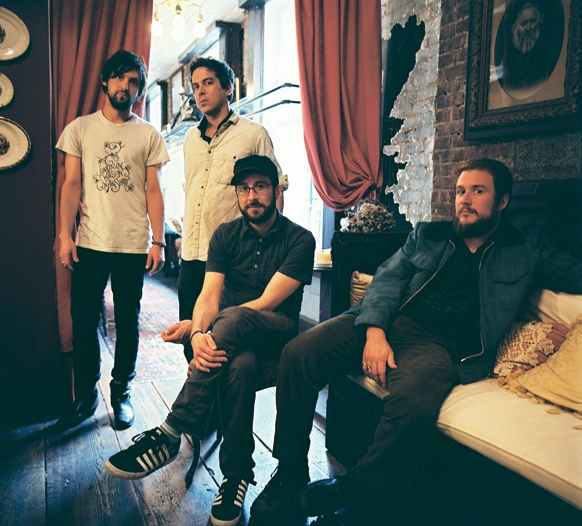
Monsters of Folk, in an East Village hotel. (Photo by Lucy Hamblin)
Sitting in a room with the Monsters of Folk is a rare and privileged experience. Crammed inside a small East Village hotel room sit four guys of tremendous talents; musical Renaissance man M. Ward, postmodern vocal hero Jim James of my Morning Jacket, lyrical wunderkind Conor Oberst, and gifted producer and instrumentalist Mike Mogis. They’ve bonded like The Beatles, intertwining their musical DNA to gift the world with their debut album, the excellent Monsters of Folk. It’s a pretty cheeky name. But then again, they’re pretty cheeky guys. Here’s what we learned. Conor Oberst is a sarcastic bastard (but a friendly one). Jim James is a very down-to-earth dude. M. Ward is thoughtful, reserved and soft-spoken, almost professorial. Only Mike Mogis seems properly caffeinated. The rest of the guys are punchy and giddy from talking about themselves too much. They’ve been doing interviews for three straight days now and, like a bunch of mid-‘60s Bob Dylans, dissolve into laughter early and often.
One second….I’m recording this on Garage Band.
CO: Cool. Can we get a little reverb on this interview?
Let me turn off the metronome.
MW: We could do the interview to a metronome, actually. We….met….on… [the rest of the band pick up the beat, drumming on their knees]
JJ: Crosby….Stills….and Nash….
Nice. So for the Monsters of Folk album, how did you divide the songwriting? Did you write the songs together?
CO: We brought like, ideas and arranged and finished them together. So each person came with ideas, in some cases more fully formed than others, with room to collaborate, I’d say.
JJ: I’d agree.
MW: Little children with room to grow. They’re like little, unclothed children.
[Mike Mogis enters the room with some takeout from the fancy restaurant next door]
MM: Oh, there’s my wallet.
JJ: Don’t let us ruin your dinner or anything, buddy….during the interview….
So you were sitting around with guitars and writing the songs together?
MW: Every day, yeah.
JJ: Yeah, we honed our craft…with the guitars.
And Mike, were you there this whole time, giving feedback?
MM: Well, yes and no. In the beginning I was in more of a technical role, putting mics in front of instruments, and they’d be sitting around while I was doing that. For the most part, it was better to just let them figure things out, honestly.
CO: But eventually, you would get your say…on everything.
MM: Well, yeah. Of course. But letting it develop in a natural way, before I interjected anything.
MW: And Mike had a guitar too. He was sitting around with an acoustic guitar with us.
CO: Yeah, that’s actually true. That isn’t a lie [laughter]. Am I wrong?
So did you practice the songs a lot before you went in to record them?
JJ: We pretty much went into the studio and banged it out.
MM: The first session was like that, where there was exchanging of songs prior. When we got there, we really didn’t know what was gonna happen. I mean, extremely low expectations to make a record. We had talked about it for years about doing an album together, and we finally got into a studio together. It’s one that me and Conor own, so it was a no-pressure situation. No label, no time frame…
JJ: …no rules, baby. Just hot, wild action.
CO: And then we did a session in Omaha and several months passed, and then we did another one in California. And in between there, there was like, e-mailing of the demos, song ideas. So we had a direction we were headed in… or something [more laughter].
Did you have any guidelines going in?
CO: One of our only rules was that we would only be the four of us playing everything. So that was kind of the one rule, if there was a rule.
JJ: It was a regulation.
MM: There were times when we said this one we want to be more of a rock song, or this one we know we want to have drums on, but the general sound of it really took place in the studio.
CO: There wasn’t a lot of plotting. It was more like, “let’s see when we get there.”
So you each play bass and drums?
JJ: I do play bass. But [M. Ward’s] America’s favorite bass player, actually.
Why do you say that?
JJ: Because he was voted America’s favorite bassist three times in a row. [Hysterical laughter]
MW: I play bass on a beautiful song, “Magic Marker” I also play organ on it.
MM: I played drums on that one, actually. I was America’s favorite rhythm section on that day.
JJ: Yeah, you were. One time in a row.
Speaking of “Magic Marker,” that’s a beautiful song.
JJ: Thank you.
MW: That’s because of the bass.
Were those primarily your lyrics?
JJ: Yeah, I wrote it, and I could really picture their voices blending in, and lending a really nice air to it. And then Mogis did some stuff with it that I hadn’t thought of, like adding a dobro and stuff like that. That turned out really nice.
CO: I love the melody of that song, and the outro with the guitar.
MW: I remember Jim taught us the outro of that song. I remember it was hard at first to get it right, you know what I mean? But now it makes absolute perfect sense. That’s all I’m saying.
JJ: That makes sense.
MW: Because when you work with someone else, they all have a different timing in their head, whether you’re talking about lyrical timing, or the guitar progression, or whatever. I just love hearing how these guys…see those changes. [laughter] Sorry.
MM: It’s been a long day. But we’re professionals!
CO: I personally have a great love for the song “The Sandman, The Brakeman, and Me.” I really enjoy that one. Matt’s music has always had a special quality for me. It’s kind of like an audio Xanax. If I ever feel anxiety or something, and I’m like in an airport, or some place I don’t want to be…
JJ: Mmm hmm…
CO: … I can put on, like, an M. record and I’m instantly calmer. And that song has that, that’s like a really beautiful tranquilizer shot. It makes me feel instantly as I’m in like, a wonderful dream.
MM: That was one of the ones that M. brought in a one-track demo of the song, and we were like, “How can we beat that?”
CO: Yeah, it’s one of the ones where we used an element of the demo in the actual song, because the demo was so sweet.
JJ: Every song had a cool kind of set up, and story behind it.
CO: That’s true.
What are some other songs that stand out for you?
JJ: The one that pops in my mind is “Map of the World.” I remember when I first heard that one. We did six songs in the second session. That was in Malibu. And we e-mailed those songs back and forth a little bit. I was on a ferry with My Morning Jacket, somewhere in f***ing Europe, and I remember listening to that song and thinking that I really liked the sentiment of it, and wondering how it would turn out. That was really cool because Mogis and I were kind of America’s favorite percussion section. I got to play some bongos on it, which I’ve never done before.
CO: I think that might have been a djembek.
MM: That was a cool recording, because we all sat around in this little circle on the floor, and these guys were really vibing out on guitar, and I felt like we went into… like a calm spiritual place. And then it got intense for awhile, and it was kind of a neat little pocket of us, the four of us, clued in.
MW: I love the lyrics of that song and the production. There’s this really interesting space on it that’s unlike anything on the record.
CO: The ending of that song was a total surprise, too, because we didn’t make the ending when we recorded it. I was playing guitar, Matt was playing guitar and these guys were playing… bongos. [More laughter] It sounds ridiculous, but, I was like, I’m gonna change in between these chords, like I didn’t think of what chords I was going to play, it’s just gonna be, kinda, some of these chords or some combination. And then we just did it and I started playing, and Matt was doing the lead guitar simultaneously, and he kinda went off and vibed out. That was a true improv. And then Jim put like this insane, super-high falsetto chant at the end. It’s a nice moment that was unexpected.
MM: I have a soft spot in my heart for “Dear God.” Maybe it’s because of my daughter, that’s her favorite. She sings along to the instrumental part, and it makes me happy. She always wants me to put it in when we go to the grocery store. “Can we bring the Monsters record?” And then she wants me to repeat it. Also, “Say Please.” I really like the sentiment in that one, where everybody needs a hand, you know, everybody needs help.
CO: There’s also a sick guitar solo in there.
JJ: It’s up there with the beautiful guitar solos. Give it a couple years, it’ll be in the Guitar Solo Hall of Fame.
MM: America’s favorite guitar solo moment.
On your own, you each have a lot more control over your projects. Did you find it difficult in any way to collaborate with three other people?
JJ: No, not really. It was like…floating in space.
MM: From my perspective, as a guy who’s typically in the control room, it was one of the easier records I’ve made.
CO: You said it was easier than you expected it to be.
MM: Definitely.
CO: Can you explain that? [laughter]
JJ: You thought we’d be fighting.
MM: No, not at all. When we started the first Monsters of Folk [in 2004], we had no plans. We had no idea how it would work out, or what songs to play even. So you go into it thinking, “This might be totally confusing,” but it wasn’t. It seemed clear from the first day, this is how things are gonna play out. You present a song, we’re going to try playing an instrument, and everybody’s good, everybody can pick up something and provide a contribution to the song. And I didn’t think it would be as effortless as that. And recording the vocals, I thought would be a challenge, because it’s three distinct vocal styles and fairly known ones, you know? They have established careers, and I thought it might be tricky to establish a blend that made it seem like they’ve been singing together for a decade.
With harmonies, some people can do them very instinctively. [Everyone looks at Jim James] Is that you?
CO: Yes. He’s really good at it. Matt’s really good at it as well. I have no skill in that, but I must say it was fun, and I learned a lot about that process. Jim would tell me to sing this harmony and this part, and he helped me figure it out and do it, and that was very rewarding.
JJ: You did a great job.
CO: I feel like I learned something, and I became a better singer. Singing harmony is a totally different thing; it’s more like playing an instrument. It’s more of a precision thing.
MW: Yeah. I second that.
CO: And they supported me, when…a lot of people wouldn’t of. [Laughter] You push yourself in that way.
JJ: From now on, I’ve got your back.
CLICK HERE to read part two of this interview.
More Interviews
-

Photo by Stephen Dillon