
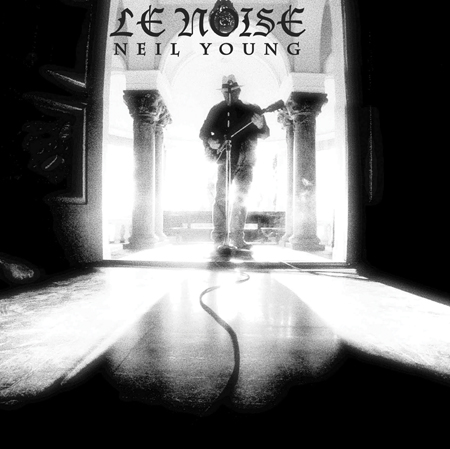
Neil Young
Le Noise
Reprise
[Rating: 4 stars]
Acoustic guitar players try to master his unique, timekeeping faux-clawhammer style. Electric players, whether or not they respect his tone, wish they could solo the same way, with their body language dictating the attack of the notes as much as their picks. Singers who sing a hundred times better than he does wish they had that kind of confidence at the mic.
And people who try to write songs for money – e.g., Nashville writers who are told to stick to a structure and a formula – wish they could get away with writing the way Neil Young has for 45 years.
On his new album, Le Noise, he gets away with it again. Given that he’s such an iconic figure musically and sometimes politically, as well as one of the most recognizable guitarists of his generation, it’s sometimes easy to forget that Young is also one of the purest and most natural songwriters of his era. On Le Noise, he teams with sonic master Daniel Lanois (U2, Willie Nelson, Bob Dylan) to produce yet another album of material that follows nobody’s rules. With Young simply pounding out eight songs on electric and acoustic guitars with no band, and Lanois providing some of his wildest sonic experimentation yet, these two veterans have created a highly satisfying listening experience.
Opening the album with the bottom notes of a single distorted dropped-D chord, “Walk with Me” is an unlikely song of love that rumbles and screams its way into a feedback and special-effects laden trip that works beautifully with the prosody of the song. But it works only because this is Neil Young: nobody else could record this song this way.
The structure and feel of “Sign Of Love” hearken back to the songs of Neil Young, the singer’s first album after leaving Buffalo Springfield. It’s as if “The Loner” has returned after more than four decades. On “Love And War,” Young pretty much sums up his career when he sings, “I sang for justice and I hit a bad chord/but I still try to sing about love and war.” This song finds Young combining his trademark acoustic playing style with a Spanish feel, playing licks that are almost flamenco, and more derivative in nature, than anything else on the album. Except for when he and Lanois take off on ‘60s feedback and effects-generated flights that would make Hendrix take notice.
A version of Young’s legendarily unreleased “Hitchhiker,” essentially a re-written “Like An Inca” (from his Trans album), is included here. It’s another autobiographical hippie drug song, and Lanois gives it a treatment here that makes it pop. With the album’s closer, “Rumblin,” lines like “When will I learn how to listen?/When will I learn how to feel?/When will I learn how to give back?/When will I learn how to need?” show that Young, approaching 65, is still asking himself the same tough questions he asks our politicians.
There are no enduring classics here like the songs on 2007’s Live At Massey Hall, or anything to rival the material that helped define late ‘70s AOR from, say, American Stars ‘n Bars or Rust Never Sleeps. But this is a record well worth having, and it’s a blessing that we still have enduring artists like Neil Young creating such vital music.
More Reviews
-

John Oates performs with The Good Road Band on March 15, 2026, at The Cabaret Theatre at Mohegan Sun in Uncasville, Connecticut (Photo by Khoi Ton/Courtesy of Mohegan Sun)