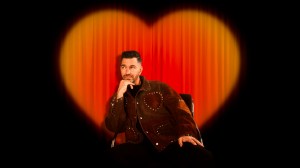
Rapper, Nissim Black (born Damian Jamohl Black), is a deep-thinking, philosophical artist with a wide range of experience, interests and fans. Black, who was born and raised in Seattle, Washington, had gone through a number of transitions in his life, from religious to professional to even moving from the United States to live today in Israel. Black, who, smirking, refers to himself as “Hitler’s Worst Nightmare,” is an important person in today’s rapidly changing world. A devout Orthodox Jew, Black is a student of theology as much as he is a student of raps and lyricism. Part-RUN DMC, part-Rabi, Black, who recently released songs like “Mothaland Bounce” and “Best Friend” that have earned over five-million YouTube views combined, has a voice worth listening to in many arenas and on many stages.
When did you first come to music, when did music enter your sphere as a young person?
Videos by American Songwriter
My parents were rappers. My mother and my father started hip-hip, actually, in Seattle. They were part of the Emerald Street Boys and Emerald Street Girls rap groups. So, quite honestly, from every picture or video or anything that I’ve seen, I have always been in music. Professionally, I worked for the first time when I was 13 with my uncle, whose name is R.C., who’s a producer, and also with Vitamin D from Seattle, who is an amazing producer. So, I got my first time inside the studio, I was 13. Officially, the first thing I ever recorded, I wrote when I was 12-years-old. That was in ’99.
You released your first record at 13-years-old. And you’ve worked with Jake One and, as you said, Vitamin D. What inspired that early work ethic?
Yeah, I don’t know what it was, man. I think it was just in my genes, the music. My grandfather, all his brothers were, you know, world-class musicians. And even when my mother – my father’s side, too. All my uncles, my great uncles, my grandfather’s brother – so, on both my parents’ side. And then, if that doesn’t do it, my mother remarried and I had a stepfather and all his uncles were musicians, playing with Quincy [Jones] and everybody else. So, there has never been a time that I can think that I was breathing without the love of music inside of me from since I was a kid. It’s really one of those things where it’s not like – you know, especially in hip-hop guys just pick it up after a while. They get inspired because they hear rap. For me, it didn’t matter, singing, rapping, dancing or whatever. If it had anything to do with entertainment, I’m game. Let’s do it! Ever since I was a kid.
This is a personal question and I don’t ask for the salacious aspect of it. Rather, more for what happened following – but when you were 13-years-old, you brought a gun to school and the school expelled you. What did that moment teach you about the idea of forgiveness?
That’s a very good question. It didn’t really. Well, I guess it did a little bit because that was a tough year for me. The whole next year, fighting, trying to get back into a regular school, you know what I mean? And nothing that I did – even though that, you know, behaving the way that I was. By that time, I had already started running around with gang members. I still knew myself very well, tough, you know what I mean? And I knew the good guy that I really was, who I wanted to be. And I felt like nobody would give me a chance. So, I think it did affect the way – at least I saw forgiveness in other people’s eyes, I guess. I ended up going to an alternative school, Seahawks Academy [now closed]. That place, I thrived. They had a hip-hop program there, they had beat making. It was like a perfect rebound for me to be able to express myself. We had a hip-hop workshop in school, we’re making beats in the school. A lot of healing took place that next year.
As we mentioned, your family has long musical roots in Seattle music. Can you talk about what it’s like for you to carry on that lineage?
Today is so amazing because my whole relationship, because of my spiritual journey, shifted. So, it’s been a whole hard tug-of-war really, honesty, trying to reconcile, you know, these two things. Because in my initial thoughts, when I was making music, I stopped. When I started my conversion to Judaism, I stopped because I was like, “There’s no way in the world I can make this work.” One is one direction and the other is another direction. But it wasn’t until after learning more inside the spiritual and religious texts on how amazing and how high of a spiritual item that music is – it’s the highest of the highest. So, for me to leave the very thing that is the axis point that we believe is the highest place in the divine, would be, like, sacrilegious, you know what I mean? So, I’ve had to reshape my relationship with it because of that journey. Especially, as myself, I always view myself as a story writer, whether I’m writing my story or somebody else’s. It’s put me in contact with so many different types of people that my message and my understanding in the power of story is so much stronger than it’s ever been. So, I feel like I’m carrying it on, but it’s morphed in a major way. Some elements are the same, but it’s definitely morphed in a major way.
You are a very unique person in the worlds you travel. Does that mean you have to have thick skin when people might, say, point? And, if so, how did you develop that patience?
Absolutely. It’s a very interesting thing because it’s a place where you go where you’re liable to make everybody feel uncomfortable, you know what I’m saying? Not just uncomfortable – the curiosity, it’s very hard for people to hide. [Laughs] Not too many people can put on too good of a game face when they see me because everybody has to have questions, you know what I’m saying? But I think the fact that my general personality is such that I’m a people person. I’m also just as interested in people. And because I’ve had to have – just the way things were designed in life for me, I had to have a story, a journey. I know that everybody has journeys, you know? As much as I get the opportunity to share mine, I know it offers fresh perspectives for other people. One of my biggest things – because my life has been, the way that the book starts doesn’t mean that’s the way that is has to end – I enjoy sharing my journey for other people to think outside of the box. Because I remember when I was a kid feeling like I would be stuck forever. So, it gives me an opportunity more than I look at it like a burden.
In a way, you’re also a lens through which Israeli and Jewish folks can participate in American and hip-hop culture. What is that responsibility like?
It’s huge. Because to a major degree, I hold a position in the Jewish community that’s like a Rabi, some would say, you know what I mean? It’s not because of the music it’s just because of the figure that I’ve become inside of the overall community. So, sometimes it’s very tough because you have to be very careful, quite honestly, with the things you do and everything you say. It’s actually funny, I was just writing a song about this idea. There’s a lot of calculation of your steps and seeking a lot of council and guidance from people that you feel are very qualified. You really have to rely on advice. Not people to live your life for you, of course. But definitely a lot of council and soul searching. And the true ingredient is that I have a great wife and a great best friend, who are two great people to run things by. So, that’s been huge.
Continuing on the personal questions, you also survived COVID-19 recently. What was that experience like for you?
That experience was crazy, man. It’s one of those things where everybody can say whatever they want until they get it, you know what I’m saying? Everybody’s got all these ideas, whether you’re a conspiracy theorist, whether you’re a realist, whatever your opinion is doesn’t really matter until you’ve contracted the virus. You don’t really know how the virus works until it does. The virus is no joke, in my opinion. I didn’t have such an easy ride. I didn’t have the craziest ride but I definitely did not think I would be here at some point during that time with the virus. It was very scary for me. Yeah, my breaths. I couldn’t breathe. And I didn’t know – the technology, whatever protocols they’re following are amazing, whether it was the medication or what they did for me there. It was, like, a miracle and I didn’t even know any of it existed. I wasn’t paying attention, I knew the numbers were going up but that’s all I knew. It was a very, very frightening experience.
But it was humbling and I’m so thankful for it because the amount of reflection and thought that I was able to put in and to be able to categorize – when you don’t know if you’re coming home, you start thinking about anything that could have been a waste of time! You start thinking about, “Was this worth putting my energy into this?” This conversation or these ideas or this thing, you know? And really I was thinking like that. It was hard for me to look at pictures of my family those days in the hospital, you just didn’t know. It’s so up and down. One day you can be great and feeling much better and the next day you feel like, “Oh my goodness, what just happened?” It’s very unpredictable, it’s crazy.
I’m glad you made it!
Yeah, thank God.
You are famously Orthodox but you’ve also participated in two other religions previously, Islam and Christianity. So, more than any specific religion, where do you think your search for home within religion comes from?
You know, as a kid, in addition to the music side, I was also very spiritual for no reason at all. I didn’t have any – there wasn’t a lot of spirituality going on around me. But, you know, sometimes people get drunk and they start talking about God and all of that and so, as a kid, I’d just sit around and listen to people sometimes. But I didn’t – there wasn’t, I can’t think of an event or anything that happened but I remember especially right around the age of 13 when I really started to feel a major, like, lacking. There was something I was missing, that connection to Godliness or spirituality. That sort of search, I would say, happened at the highest.
Now, Islam – originally, my grandfather, who is Muslim, he came to live with us when I was very young, so I started practicing because my grandfather was the only religious person I knew in my life at that point. Simultaneously, or shortly after this, maybe by ’98, my biological father – my parents had been split – had become a minister and started school in ministry. Today, he’s a professor in religion and Christianity. He’s a pastor and runs an addiction program. This is a guy who used to sell big drugs back in the day. Now, you know, he’s a director of a faith-based drug program and a pastor – a major turnaround! So, I think that also inspired me. Although it’s a different religion, I’m a Jew today and he’s a Christian, he sold out for what he believes. He sold everything, his apartments, cars. He lived in a studio apartment and really focused himself on his spirituality and built himself up. It was so, like, “What just happened!?” [Laughs] He was a big drug guy back in the day. And to see that type of transformation, I think, for me, as I was going into my teenage years, was something that gave me something to look to. So, I think it had an effect on me maybe indirectly. But it definitely had an affect on me.
Later, I ended up going to another hip-hop program – it’s always music that draws me in. There was this music program when I was 13 – my boy, Fatal, brought me to this hip-hop program. That’s what started to introduce me to Gospel missions. We did a play about somebody who was on his deathbed and the prayers were going up to heaven and I was on the “dark” side and my friend was on the “light” side and it was good versus evil. There were things that happened inside that play, man, that made me so – you get vulnerable, spiritually. That led to great relationships with the people with the missionary. And that’s the thing, they’re working to bring you to religion. So, I ended up going to camp with them and that was a place for me because I had a lot of mess going on at home and everyday I lived there. It was the place for me to get away. So, that was that.
The Judaism thing, which is much more complex and very much more owned, I would say. I was searching on my own and I got into this altercation with another rapper that, you know, led to beef that led to an either a kill or be-killed situation. It’s one of those crazy situations, another reflection moment [Laughs]. Like, “What am I going to do? Am I going to live this life?” But I was spared in the sense that the beef didn’t continue. We were able to squash everything and put it behind us. From that point on, I was just, like, “I’ve got to figure out who I am?” And I started searching, really just digging up religion to the core, you know what I mean? On my own. Nobody was there, no influences. No grandpa, no friends, no mission. I just want to sit with the text, let me go back, I’m going to get dictionaries. I was doing, like, eight hours a day. I started fasting. I was going three days in a row with no food. Going out crying. I had developed a very sensitive spiritual heart that really opened me up.
Judaism was screaming to me. The text and the honesty of it. The biggest thing for me was just, like, seeing how they kept messing up. Man, that whole Bible is about mess-ups! [Laughs] Everybody’s a screw up, the nation’s a screw up. You want to know what you are? And to see how much that didn’t deter God from his love, and the whole integrity of the Old Testament, the integrity of it is on the fact that God is saying, “No matter what I’ll never leave you.” And that was just something for me, I wanted to be a part of that relationship, you know?
As a musician and an artist, how have you gotten better at your craft or refined yourself over the years while using such deep, thoughtful references?
My personality type is that I’m a people person. So, I think one of the biggest things that makes a great artist is not necessarily how well you say what you say, right? But it’s the impact of what you say. And knowing what that’s going to do to a person’s emotions when you say it. So, I listen to my music so much afterwards. I don’t think I listen to anybody else, you know what I mean? It’s because I’m constantly putting myself in different scenarios and for different listeners to listen back to myself to see if I’m convincing or not. Do I feel what I’m talking about? So, I think that’s been one of my strengths as a writer and a song creator – the fact that I’m very heavily involved in trying to reach to the core or soul with how a person may feel when they hear that record and to be able to take that emotion and lift them to what I hope is a better place after they hear the music.
I think because I’m thinking that way and because I’ve had those years of experience – Vitamin D, after I recorded with him, he ended up having to move his studio. So, he and my dad – my step-dad but I call him my dad – moved him into our basement for free for, like, five years. And the deal was all he had to do was teach me anything that he knew. I learned how to record, I learned engineering, I learned how to mix, I learned how to produce. So, not only am I thinking of the story when I write, but I got a very clear picture of how I want this to sound, how I want it to feel. So, I sort of have some cheat codes, you know what I’m saying, from the inception of the song that other people don’t have.
Get WIN and learn more about Nissim from this smartlink.
More Interviews
-

Photo by Stephen Dillon