If Talking Heads hadn’t arranged a meeting with an underground alt-rock icon of the 1970s New York City scene, the classic album they released on September 16, 1977, might not have looked or sounded the way we know it today.
The fact that one of the band’s first encounters with their new producer was unexpectedly over multiple containers of ice cream was one of the odder developments of the night. But given all the musicians’ taste for the avant-garde and unusual, we suppose ice cream is relatively tame, all things considered.
Videos by American Songwriter
Talking Heads Released This Classic Album in 1977
Clocking in at No. 97 on the U.S. Billboard 200 chart upon its September 1977 release, one wouldn’t necessarily classify Talking Heads: 77 as a smash hit. But for the circles in which Talking Heads and their eccentric contemporaries ran, that’s precisely what it was. Like many seminal albums, the true impact of (and appreciation for) the record was realized decades after the band first released it. Talking Heads: 77 might not have entered the Top 40 in the charts. But over four decades later, nearly everyone can recognize “Psycho Killer”.
These days, music historians consider Talking Heads: 77 to be one of the defining albums of the new wave and art rock movements. The New York City band’s blend of punk, funk, and world music ushered in countless bands like Franz Ferdinand, LCD Soundsystem, the 1975, and St. Vincent, the last of which has since collaborated with Talking Heads frontman David Byrne. Even Radiohead took their name from the 1986 Talking Heads track. What Talking Heads’ debut lacked in commercial performance, it certainly made up for in longevity and influence.
The Underground Icon Who Helped the Band Along Their Way
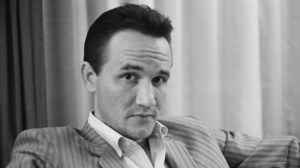
Not every person who plays a role in creating an album sticks around for the final distribution, and such was the case for Lou Reed. The Velvet Underground guitarist and singer-songwriter was a key member of the New York City art punk scene, which meant his path inevitably crossed with Talking Heads early in the band’s career. At that time, Reed was an established scene veteran, and Talking Heads were still finding their footing. So, Reed offered some advice.
Speaking of their first meeting, David Byrne told Rolling Stone, “We were playing through some of our songs, just strumming a guitar. I remember he was showing us how if you slowed some of them down a little bit, that might not be the worst thing in the world, rather than trying to blurt out all the words really quickly. So, yeah. He had some good ideas. I remember when we met, he was eating an incredible amount of ice cream. I think he went through two of those quart containers of Häagen-Dazs ice cream in one sitting. We were like, ‘Woah.’”
Ice cream habits aside, the relationship between Reed and Talking Heads didn’t last long. Although Byrne and the rest of his bandmates were big fans of The Velvet Underground, the management-production deal Reed was offering them “was a little bit too much,” Byrne explained to Rolling Stone. Neither he nor his bandmates felt they were ready for something like that in that stage of their career. “John [Cale] introduced us to Brian Eno on our first trip to London, and that proved to be a big deal for us. All these people that we were in awe of.”
Both for their musical and ice cream-eating abilities, apparently.
Photo by Linda D. Robbins/Getty Images
-
American country comedienne Minnie Pearl (1912 – 1996) performing, circa 1970. (Photo by Silver Screen Collection/Getty Images) -
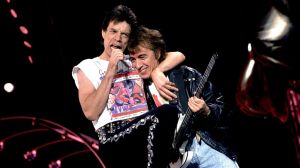
British musicians Mick Jagger (left) and Bill Wyman of the Rolling Stones performs on stage during the band's 'Steel Wheels' tour, late 1989. (Photo by Paul Natkin/Getty Images) -
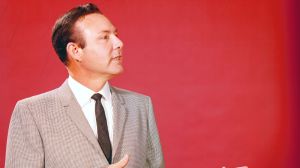
UNSPECIFIED – CIRCA 1970: Photo of Jim Reeves Photo by Michael Ochs Archives/Getty Images -
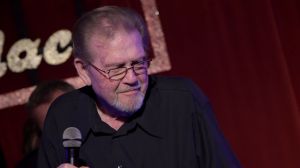
NASHVILLE, TN – Singer/Songwriter Whitey Shafer performs during the All-Star Whitey Shafer Benefit, Hosted By Moe Bandy at The Nashville Palace on March 18, 2015 in Nashville, Tennessee. (Photo by Rick Diamond/Getty Images for Webster PR) -
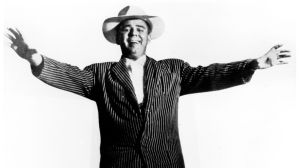
American singer, songwriter and disc jockey The Big Bopper, circa 1955. (Photo by Michael Ochs Archives/Getty Images)