Neil Young was undoubtedly pondering the Icarian trajectory of a young star gone too soon when he wrote this two-part track on Rust Never Sleeps, but even he could not have known the full impact of what would become one of his most evocative and controversial lyrics. His words’ effects on the general public unsettled even him, especially after they became associated with a rockstar 22 years his junior.
Nevertheless, he’s stood by his poetic sentiments many times over the years, whether in the final months of 1979 following its release to his 2012 memoir, Waging Heavy Peace, despite the fact that he himself hasn’t lived by this same ethos.
Videos by American Songwriter
Neil Young Releases Evocative, Controversial Two-Part Song
Neil Young released Rust Never Sleeps in late June 1979, shortly followed by a two-part single, “Hey Hey, My My (Into the Black)” and “My My, Hey Hey (Out of the Blue)”, in August. In the latter track, Young sings, “My, my, hey, hey / rock and roll is here to stay / It’s better to burn out than to fade away.” He explained the lyric in his memoir, writing, “I wrote it referring to the rock and roll star, meaning that if you go while you are burning hottest, then that is how you are remembered, at the peak of your powers forever. That is rock and roll. I wrote that song right after the death of Elvis Presley.”
His line touting the upside of dying at the peak of your fame is somewhat ironic decades later. That wasn’t lost on him, either. “At sixty-five, it seems that I may not be at the peak of my rock and roll powers. But that is not for sure. The idea that I should have died earlier is not the point. There really is more to life than its charged peak. Other things continue to grow and develop long afterward, enriching and growing the spirit and soul.”
Other rock stars, like John Lennon, also noticed the irony. “If Neil Young admires that sentiment so much, why doesn’t he do it? Because he sure as hell faded away and came back many times, like all of us. No, thank you. I’ll take the living and the healthy,” he said in one of his final interviews in 1980.
The Lyrics Have Rippled Far Past the Reach of His Song
It isn’t often that a song’s lyrics will become so ubiquitous with pop culture that they could reasonably outshine the legacy and reach of the track itself, but Neil Young’s “My My, Hey Hey (Out of the Blue)” was a notable exception. Countless artists have referenced the controversial lyrics, including Def Leppard, Hole, Panic! at the Disco, and others. “It’s better to burn out than to fade away” has appeared in films. Bands like Oasis and Lana Del Rey have incorporated it into their live sets.
In 1994, a tragic connection was made between Young’s 1979 track and the death of Nirvana frontman Kurt Cobain, who included Neil Young’s lyrics in his suicide note. Young wrote about the experience in his memoir, saying, “When he died and left that note, it struck a deep chord inside of me. It f***ed with me.” Young said he had been trying to get in touch with Cobain in the months leading up to his death because he wanted to encourage the Nirvana frontman not to let the industry wear him down. “I wanted to…tell him only to play when he felt like it. And that would be good enough,” Young recalled.
Photo by Michael Ochs Archives/Getty Images
-
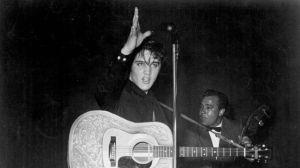
1956: Rock and roll singer Elvis Presley performs on stage with his Martin acoustic guitar with Bill Black on upright bass in 1956. (Photo by Michael Ochs Archives/Getty Images) -

Al Casey, October 26, 1936 – September 17, 2006 (Photo courtesy of Fervor Records) -
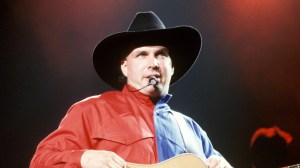
Garth Brooks, who had a major hit with the Dewayne Blackwell song "Friends in Low Places" -
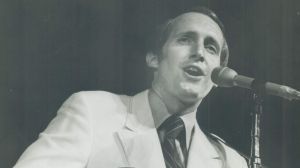
CANADA – SEPTEMBER 03: Country Singer George Hamilton IV (Photo by Harold Barkley/Toronto Star via Getty Images) -
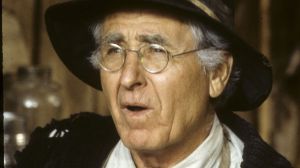
THE DOLLMAKER – Walt Disney Television via Getty Images Theater TV Movie – Airdate: May 13, 1984. (Photo by ABC Photo Archives/Disney General Entertainment Content via Getty Images) SHEB WOOLEY