
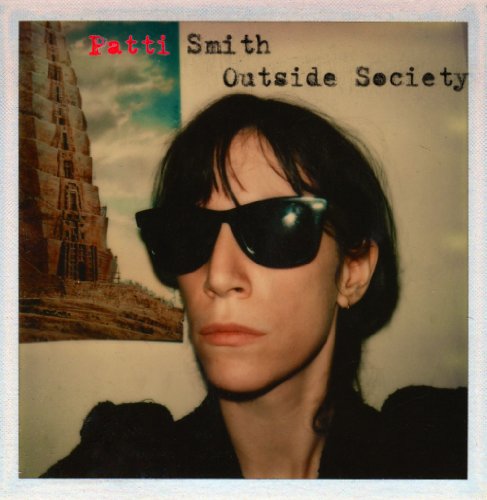
Patti Smith
Outside Society
(Arista/Columbia/Legacy)
[Rating: 3.5 stars]
Has rock ever produced an artist more in the moment than Patti Smith? In her late 70s prime, she didn’t write or record songs so much as she documented performances—live-in-the-studio jams with all the grit and danger of a darkened alley or graffiti’ed subway car in pre-Guiliani New York. Spontaneity rules over all, defines all, allows seemingly endless possibilities, which makes each song sound completely different with each performance. Smith wasn’t afraid to make a big mess out of rock and roll, which meant taunting kitsch (“Rock N Roll Nigger”) and steamrollering her own and others’ songs (“Gloria,” a song Van Morrison no longer owns). Her music bursts the confines of rock and roll to expand what the medium could say and how it could say it.
Each song becomes a high-wire act, which makes the excitement occasionally grim (what would it sound like if she fell off the wire?). But it’s excitement nevertheless—visceral, personal, often raggedly beautiful. What’s remarkable about the one-disc retrospective Outside Society is how invigorating and brave these performances still sound more than thirty years later, especially compared to her studied, calm, wistfully reminiscent memoir Just Kids, which stands as one of the best chronicles of a creative coming-of-age ever committed to paper.
At least that’s how the collection begins. As the ‘70s were drawing to a close, Smith was cleaning up her sound considerably, settling down as a performer, and writing songs instead of scrawling them. Especially after her eight-year hiatus during the 1980s, her songs sounded more measured and more produced, lacking the fire and menace of her earliest material. Instead of trying to incite revolution, songs like the ridiculous “People Have the Power” and “Glitter in Their Eyes” simply stand by and watch the demonstrations, as if her music has moved inexorably from participatory to passive.
The arc of Outside Society might sound utterly depressing if Smith didn’t give the impression that such intensity was impossible to sustain without burning out violently. Besides, “So You Want to Be a Rock n Roll Star” retains a powerful righteousness and “Dancing Barefoot” is perhaps Smith’s greatest evocation of the sexual/spiritual. Her vocal style remains unpredictable, moving from the screeches and grunts of “Summer Cannibals” to the croon of “Lo and Beholden,” which showcases the unexpectedly deep grain of her voice.
Outside Society is necessarily uneven, but it’s persuasive nevertheless, if only because it tells a clear story of an artist who fought to define and redefine herself constantly. One minute she’s a proto-punk scourge, the next a rock activist; one song reveals a sad-hearted poet, the next an Americana goddess. There are eighteen songs on this collection, but so many more Patti Smiths.
More Reviews
-

Lower Town Arts and Music Festival, 2026 (Photo by Paducah Convention and Visitors Bureau) -

John Oates performs with The Good Road Band on March 15, 2026, at The Cabaret Theatre at Mohegan Sun in Uncasville, Connecticut (Photo by Khoi Ton/Courtesy of Mohegan Sun)