The first, whispered “Shoot me,” followed by Paul McCartney’s iconic bass line, makes the Beatles’ 1969 hit “Come Together” undeniably recognizable within seconds. However, the song’s compositional origin is as cloudy as its lyrics, which Lennon once described as “gobbledygook.”
“Come Together” is the opening track off ‘Abbey Road,’ setting the signature tone for the Beatles’ eleventh and highly acclaimed album. But before it served as the ‘Abbey Road’ opener, a much different version of the track was used for a political campaign.
A Favor For A Famed Friend
The origins of “Come Together” stretch back to psychedelic advocate and 1970 gubernatorial hopeful Timothy Leary. The Harvard University psychologist spent the early 1960s testing and promoting the beneficial qualities of marijuana, LSD, and psilocybin mushrooms. At a time when recreational drugs like marijuana were largely vilified, Leary gained a reputation in some circles as a dangerous criminal. In others, he was a revolutionary.
Videos by American Songwriter
John Lennon leaned toward the latter camp. When Lennon and Yoko Ono held their famous 1969 Montreal bed-in, they invited Leary and his wife, Rosemary, to attend. The Learys sang a chorus of “Give Peace a Chance,” which Lennon recorded and later released with “Timmy” and Rosemary’s name listed under the featured musicians. At the time, Timothy was in the process of running for governor against California’s incumbent Republican Governor Ronald Reagan.
As a thank you for participating in his and Ono’s bed-in, Lennon asked Leary if he could do anything to support his race for governor. Leary asked Lennon to write a song for his campaign, which used the slogan, “Come together and join the party.” Lennon obliged.
According to Steve Turner’s book A Hard Day’s Write, the original chorus was as follows:
Come together right now, don’t come tomorrow, don’t come alone
Come together right now over me, all that I can tell you is you gotta be free
Marijuana Charges Marked The End Of The Rally Song
Lennon recorded a rough demo of his campaign song for Leary, who then submitted it to alternative radio stations in California to promote his campaign. However, his campaign would come to a halt one year later after he was arrested for marijuana possession in December 1969. The California penal system denied Leary bail until the election was over. His race to the governor’s seat had ended, but the life of “Come Together” was just beginning.
Lennon took the scraps of his original rally song and brought them into the Abbey Road studio for a rewrite. No longer bound by the parameters of a singable, universally likable campaign tune, Lennon and the rest of the Beatles began breathing new life into the track. Leary first heard the latest rendition of his campaign song in prison. Leary told author Steve Turner that, at first, he was upset that Lennon had taken the song for his own.
“When I sent a mild protest to John, he replied with typical Lennon charm and wit that he was a tailor, and I was a customer who had ordered a suit and never returned. So, he sold it to someone else,” Leary recalled (via Beatlese Books).
Dissecting The Lyrical Meaning Of “Come Together”
One of the most notable features of the Beatles’ 1969 hit is the apparent absurdity of the lyrics. Here come old flat-top, he come grooving up slowly, Lennon begins. He got ju-ju eyeball, he one holy roller, he got hair down to his knee. Got to be a joker, he just do what he please. And indeed, Lennon did exactly what he pleased. Free from the obligation to an imprisoned Leary, Lennon transformed “Come Together” into a different groove and feeling altogether.
Some writers have speculated that each “Come Together” verse refers to a specific Beatle, though Lennon never confirmed or denied this. The song’s first lyric, here come old flat-top, was a direct reference to Chuck Barry’s “You Can’t Catch Me,” which starts with the line, here come a flat-top, he was moving up with me. Lennon originally included the lyric as an homage to his musical icon. However, the creative choice landed him in hot water when the song’s publisher, Morris Levy, sued Lennon for plagiarism in 1969.
From Campaign Jingle to Classic Rock Hit
Besides commenting on the years-long legal battle with Levy and his denial of plagiarizing Barry’s work, Lennon remained somewhat vague about his lyrical inspiration.
“The thing was created in the studio. It’s gobbledygook,” Lennon recalled in David Sheff’s book All We Are Saying (via Beatles Bible). “‘Come together’ was an expression that Leary had come up with for his attempt at being president or whatever he wanted to be, and he asked me to write a campaign song. I tried and tried, but I couldn’t come up with one. But I came up with this…which would’ve been no good to him. You couldn’t have a campaign song like that, right?”
Given Leary’s definitive affiliation with psychedelics, perhaps Lennon’s trippy, final product would’ve been suitable after all. Nevertheless, one thing is for certain: Lennon’s ‘Abbey Road’ version of “Come Together” would long outlast the fleeting political run of the man who first commissioned the song.
More Behind The Song
-
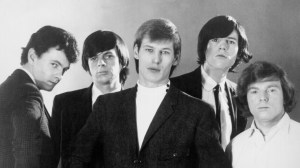
LONDON – 1965: Rock band "Them" featuring Van Morrison (right) and an ever changing line up of session musicians pose for a portrait in 1965 in London, England. (Photo by Michael Ochs Archives/Getty Images) -
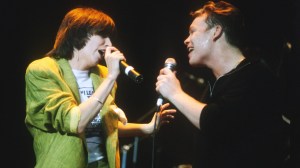
Pretenders, Chrissie Hynde and UB40, T/W, Torhout/Werchter, Belgium, 5th July 1986. (Photo by Goedefroit Music/Getty Images) -
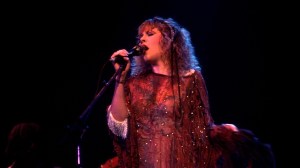
American musician Stevie Nicks performs onstage at the Rosemont Horizon, Rosemont, Illinois, July 18, 1983. (Photo by Paul Natkin/Getty Images) -
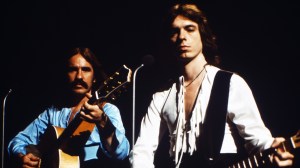
Bellamy Brothers, amerikanisches Country Duo, bestehend aus den Brüdern Howard und David Bellamy, singen ihren Song 'Let Your Love Flow' bei einem Auftritt, Deutschland 1976. (Photo by Arthur Grimm/United Archives via Getty Images) -
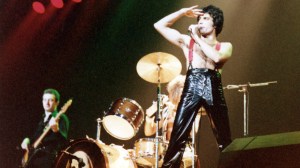
DETROIT – NOVEMBER 18: British singer-songwriter and lead vocalist for the rock band Queen, Freddie Mercury (1946-1991), alongside bassist John Deacon, onstage at Cobo Arena, on November 18, 1979, in Detroit, Michigan. (Photo by Ross Marino/Getty Images) -
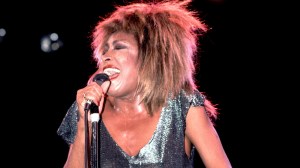
Tina Turner performing, Chicago, Illinois, June 12, 1984. (Photo by Paul Natkin/Getty Images) -
Photo by Gary Gershoff/Getty Images