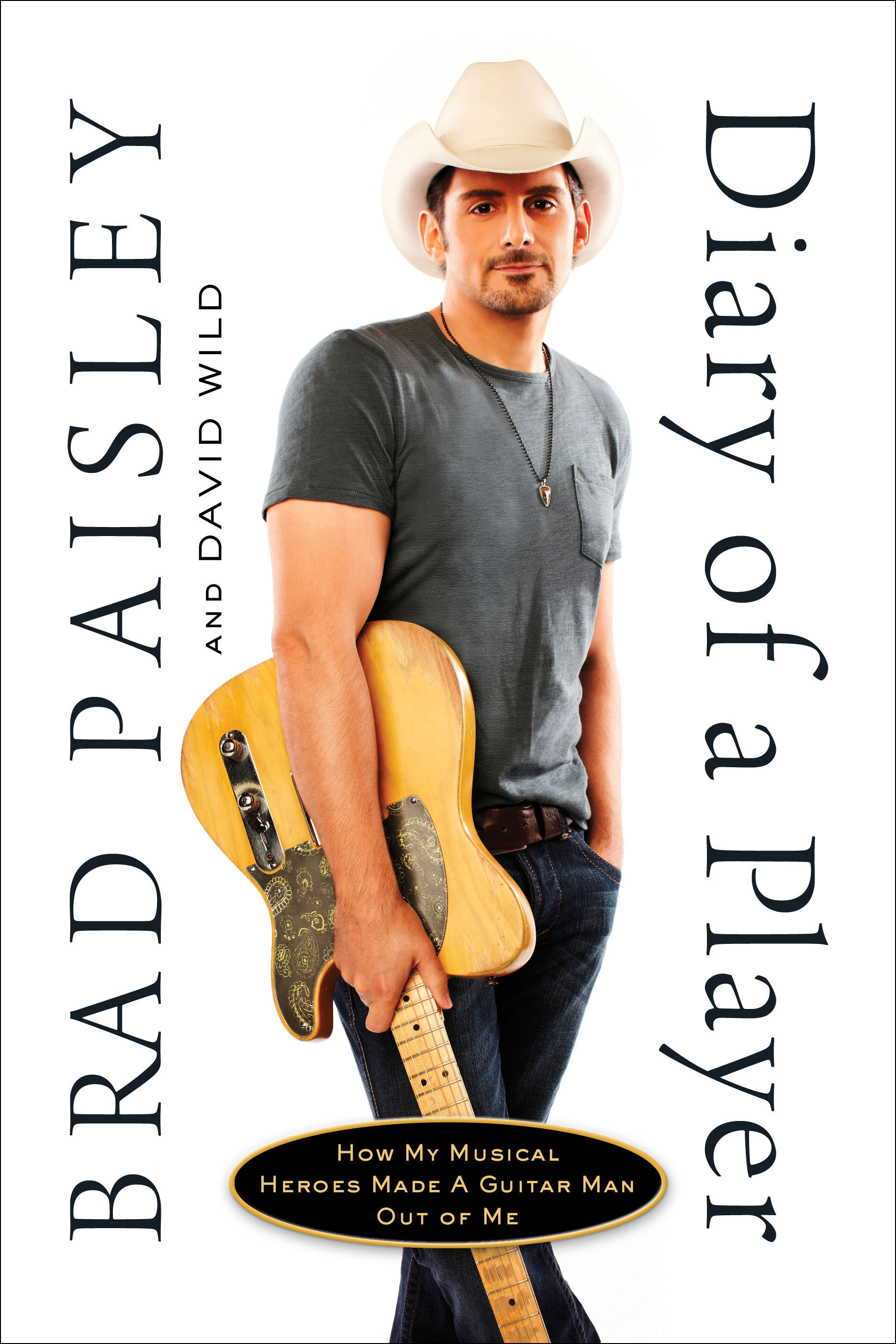
On November 1, Howard Books will publish Brad Paisley’s Diary of A Player, which charts his evolution from country music hopeful to Music City megastar. In this exclusive excerpt, Paisley writes about his college days at Nashville’s Belmont University, and the great lengths he went to trying to get his foot in the door of the music biz. Pre-order Diary Of A Player at Amazon here.
* * * *
Other than in jazz guitar that first semester, I worked diligently during my time at Belmont, especially in my internships. I knew enough to know that I needed to know more. I interned as many places as possible—ASCAP, Fitzgerald Hartley management, and Atlantic Records. I decided I would be discreet at my internships and not be too outspoken about my aspiration to be an artist. I realized that anybody hiring someone for a position, albeit a nonpaying one, didn’t want to think the person they’re hiring really wanted to be doing something else. I also had just enough sense to realize that just like in any business, I needed to meet the right people, and maybe a few of the wrong people too. I was most excited about that.
My first internship was my best. That was at ASCAP—the American Society of Composers, Authors and Publishers, one of the leading performing rights organizations on earth. I found myself working with John Briggs, an important membership representative, and Connie Bradley, who was the head of ASCAP’s Nashville office. There could not have been a better place for me to learn about music publishing and songwriting.
When I first started at ASCAP, I didn’t tell anybody I played or wrote. I just absorbed everything going on around me. John Briggs had gone to Belmont himself and had been an intern too, so he knew what I felt like. Early on, John took me to every showcase and every board meeting. He had me go as his stenographer to some meetings, even introduced me as his assistant at others. That was the best education I could have ever received. I met people I still see now and who still remember me as John’s intern.
Eventually at ASCAP, a few people figured out that I wrote songs—mostly because they started asking me, and I didn’t want to lie. One day, Tom Long—another member’s rep and great guy—asked me to play him one of my songs in his office, and I said, “That’s not why I am here.”
Tom replied, “Don’t be modest—play me a damn song!”
I said, “I don’t—“
“Play me a song or you’re fired,” he said jokingly. I reminded him I was working there for free. But in the end, how was I to refuse?
I played Tom a song called “Before I Heard Your Name.” It was kind of a schmaltzy love song but heartfelt. Tom heard me sing and play this little number, and he flipped out. He said, “Play me another.” I did. He went and got John Briggs and said, “John, get in here. Have you heard your intern sing yet?” John admitted that he had not. He then proceeded to listen and quickly said he thought I had what it took. After that day, these great people at ASCAP began to unashamedly cultivate my writing ability. They set me up co-writing with some great writers, and they even put me in the coveted songwriter workshop they offered, where top writers like Gary Burr, Pat Alger, Mike Reid, and Tim DuBois would come in, speak, and critique. Looking back now, I know for a fact that the path I wound up taking was due to ASCAP. They would eventually send me to meetings, which led to my first publishing deal at EMI. They allowed me to actually observe the way business was done, as opposed to merely fetch coffee and make copies. And they accidentally introduced me to the most talented song guy I would ever meet—Chris DuBois.
Chris DuBois was roughly my age, had just graduated, and got hired as a new-membership rep at ASCAP about three months after I started my internship. Our similar sense of humor was obvious right away, and we really hit it off. When he found out I wrote songs, he wanted to hear them. So I would frequently go into his office and play him what I was working on. His advice was always amazing; he really had a knack for knowing the best way to make a song better. One time, I went in with a half-done song, and he had a hundred suggestions on how to improve it. I said, “Why don’t you just write it with me?” He said, “Hmm. All right. Maybe I could.” And just like that we sat down after work and began the first composition of what would be a hugely successful songwriting team. The amazing thing is, Chris had never even tried to write a song prior to that night. Years later he would win the ASCAP country songwriter of the year award.
Next I interned for Atlantic Records. I interned in record promotion and worked with a woman named Debbie Bellin, who was an excellent promoter. It was all part of my plan to try to cover every aspect of the business. The way I saw it, I couldn’t believe they were going to let me walk into a record company like Atlantic Records every day (free of charge) and watch what a record company does. Why wouldn’t you do that if you want to be in the music business?
I remember driving around these buildings on Music Row when I first arrived in Nashville and thinking, What’s going on in there? Is Alan Jackson inside there right now recording some hit song? Is Joe Galante planning the launch of the next big band? I have a feeling that today people walk into record company buildings asking, “Can I see Brad Paisley, please? Where do you keep him?”
Finally, there was my most bizarre internship—with the very successful management company Fitzgerald Hartley. This was my only bad experience as an intern. It just wasn’t a good situation, and I didn’t feel needed and didn’t really learn anything. They had nothing for me to do, and I wasn’t invited to any events—I didn’t get any respect from the other interns who had been working there for years. I basically just moved paper from one folder to the next. I even quit two weeks early. I left that internship having learned only one thing—that these Fitzgerald Hartley people would never ever get to manage me.
Fast-forward to now. Bill, Larry, and Mark at Fitzgerald Hartley have been managing me since 2003. Oh well. Nevermind.
At Belmont, during those years, I was really known as a guitarist. I lived and breathed the instrument. I briefly worked at Corner Music in Nashville, stringing and selling guitars, and I played every session I could. I befriended some engineers and producers at school, like Frank Rogers, who would later produce me, and a great kid named Doug Sadler, who was into learning studio engineering as much as I was studio guitar. I was fascinated by the process of getting guitar on tape. That magical cauldron that took these temporary vibrations out of thin air and captured them forever on a disc. From the Beatles to Buck Owens, I wanted to do that very thing. Make some sounds that would live on, be unique, and be me.
The great thing about school was the studio. Open to students between the hours of seven thirty a.m. and ten p.m. Well, in theory. If you’re creative, and if I’m anything I’m creative, you could get away with much more.
Because Doug was a studio student adviser, he had the keys. So we would book the last session of the day, the evening. This meant that when a teacher came by at the end they would just see Doug and say, “Hey, lock up, will ya?”
“Sure thing,” Doug would say, “about done.” We weren’t. We were just getting started.
We would work all night. We’d record guitar, bass, piano tracks; then we’d listen down and usually try it again. Over and over, trying to beat what we had and find some magic. I would have my old AC30s in a booth, trying tone settings, and Frank would bring in an acoustic, and we’d mess with mics. By sunrise, when we could barely keep our eyes open any longer, we’d start packing up. We needed to be outta there before faculty came in.
I remember one day the dean, Bob Malloy, came around the corner of the storage room at seven a.m. or so as we were putting the last speakers away. We stopped dead in our tracks, one guy on each side of these amp cabinets, halfway through the door of the storage room, thinking, Oh shit! We’re caught. But in a moment of brilliance, we started backing out with the cabinets like we were setting up for a session. Bob took one look and said, “You boys sure are off to an early start today. Good job! The early bird gets the worm, you know.”
After I graduated, I heard they installed surveillance cameras in the studio, making that sort of all-nighter impossible. That’s too bad. I learned more before seven a.m. than most kids learned all day.
More Latest News
-

Photo by John Atashian/Getty Images) -

Photo by Terry Wyatt/WireImage -

Photo by Frazer Harrison/Getty Images for Stagecoach -
THOMPSON, CONNECTICUT – The Capulet Fest was scheduled to be held at the Thompson Speedway Motorsports Park in June 2024 in Thompson, Connecticut. (Photo via NBC Connecticut) -

INGLEWOOD, CALIFORNIA – JANUARY 30: Jelly Roll performs onstage during the FIREAID Benefit Concert for California Fire Relief at Intuit Dome on January 30, 2025 in Inglewood, California. (Photo by Amy Sussman/Getty Images for FIREAID) -

Kolbi Jordan auditioned for season 23 of 'American Idol.' (Photo via Instagram)