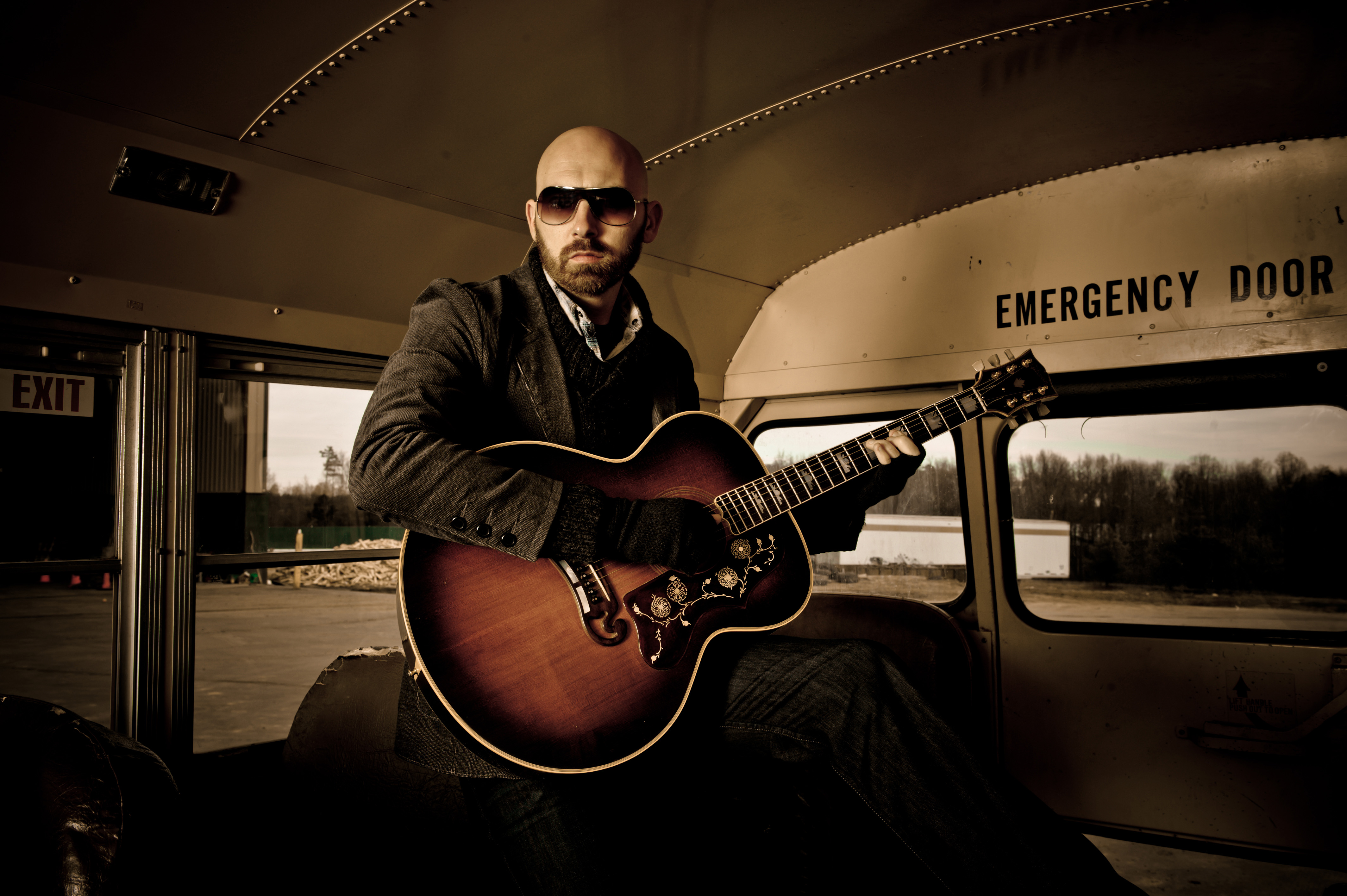
Georgia-born country rocker Corey Smith has six full-length albums to his name, through which he’s explored the different corners of country, blues and rock. His latest, The Broken Record, which features the previously released single “Twenty-One,” runs in a decidedly more consistent country vein.
For Smith, most of his songwriting experiences involve a certain amount of conflict. Here he discusses some of the constant pulls he experiences, whether it’s between rock and country influences, or maintaining the integrity of his art while going “mainstream,” and how The Broken Record embraces that conflict. “I’m a little crazy,” says Smith, “and writing is my therapy.”
It’s been said you’re breaking into the “mainstream” with the record. Do you think of The Broken Record as mainstream?
No. I like the idea of “mainstream,” because it means a larger audience and more people listen to your songs, and that’s certainly a goal, but I didn’t conceive the record as, “I’m going to make a mainstream record.” I conceived of it more as continuing to walk the tightrope that I’ve been walking the past seven, eight years.
What’s the story behind the album title/title track?
The title track was written probably a year or a year and a half ago. It originally wasn’t the title track, but it’s definitely somewhat of an autobiographical song about the tension that artists face – the tension between art and commerce that’s always there, and I think artists have to be mindful of it. It’s sort of a tension between giving people what they want or doing what you want and hoping that people will want it.
Originally, I went into the album wanting to do something called The Rialto Sessions. I wanted to do an organic, live sounding album. We went to this place in Athens called the Rialto Room, which is an acoustic listening venue, turned it into a makeshift recording studio, and the band all set up in one room. I wanted to make an album entirely taken from those sessions that sounded like one big performance. We spent a week there, and I went through the stuff that we had. And we failed. Some things worked out better than I thought they would work out, and other things didn’t work out as well.
I had to accept that we had failed in many respects and go, “Okay, now what?” There were times when I thought we were just going to have to scrap it all and go back to square one. What saved the project for me was this notion of a broken record, and why did it fail? Because I’m torn between putting out something I think is cool, that maybe no one else thinks is cool, or doing something I know might work.
The Broken Record has several short clips like “Hey Corey,” which has recorded voices telling you how to make your album. What was the idea behind that?
That was my “eureka” moment for the record. I had these two distinct sounds going on – there were these songs that were really organic and live, and the ones that were bigger sounding and layered. I didn’t know how to put them side by side on an album. Then I thought, “No, what the album is about is tension, and I need to convey that in the album.” When I got that idea, I called Rick [Beato], who I was co-producing the album with, and said, “Dude, I got it. This is it.” So that was that. It was more than a song – it was the linchpin of the album for me.
You’ve built a rabid fan base that can sing along to every word. What do you attribute this to?
I don’t know exactly. I know it has something to do with the songs. Obviously they’re resonating with people, and they’re singable songs. Another thing has to do with the nature of how the music has spread over the years. With a more traditional approach, where you do the radio thing and have a single, they learn singles on the radio, because they listen to the radio all the time, and they don’t necessarily dig into the catalog. That’s a more mainstream act. I play a lot of cover songs at my shows. That’s just the nature of it. With my past, though, it’s been different. I haven’t had, until recently, a single. It’s like, different strokes for different folks. Some people like certain types of songs and certain people like others, so there’s more a familiarity with the entire catalog.
I’ve noticed the lyrics are very accessible. Do you write about experiences you’ve had, or do you invent?
It’s a little bit of both. I try to paint realistic pictures. When I was a kid, I really loved to draw. My goal was always to create a picture that looked close to reality so that when people looked at the page, they were like, “Wow, that looks like a photograph of whatever.” I think that’s sort of what I apply to my songwriting. The main thing is, I think I’m a little crazy, and writing is my therapy. It’s like sitting on a shrink’s couch and talking about my problems. I think that all art in its truest sense is conflict. That’s what my songs are – me resolving some sort of conflict. When I’m finished with a song, I feel relief. Sometimes it involves me being really literal about an experience, and sometimes it’s about someone else’s experience and relating it to myself. Sometimes I make up stories entirely. Each one is a little different, but the process is the same.
Topics like age, youth, time passing – they reoccur in your songs. How do these themes inspire you?
I think that they’re always relevant. Change is the one constant in our lives, and it’s hard to cope with, so that’s my way of coping with it. I will say that it’s not as difficult to cope with now. I’m at a place in my life where I’m very content. I’m at peace, and making The Broken Record was sort of my way of moving on, I guess, and getting beyond some of the things that were so important to me early on.
You’ve been incredibly successful as an independent musician. What advice would you give to others who want that kind of success?
I think the key is being healed by the process of making music. If you can’t find joy in the process in and of itself, I think it’s difficult to go on and make a living. Odds are, if you’re not finding joy in what you’re doing for its own sake, other people are going to have a hard time finding joy in it to. Nothing in my career started until I got to that place.
Which songs are most important to you on The Broken Record?
I really love “I Love Everyone.” I think it makes a really powerful statement and it can make people smile, it can make people laugh, it can make people scratch their heads and think. There’s a lot of layers to that song. I really am happy with the way it turns out. I like the song “New Day” as well. It has so much hope and optimism. I hope it’s the kind of song that when people are having a bad day, maybe in the morning on their way to work, maybe they can turn that song on, and it will give them a little boost throughout their day, and that’s a pretty cool thing.
You’ve got both country and rock influences in your music. Does one inspire you more than the other?
I would say that artistically rock inspires me more. I don’t even know if it’s rock. Paul Simon, Randy Newman – those guys do it for me from an overall production standpoint in the way that they just own every element to their music. But country inspired me from an idealistic standpoint. The idea of country is what pushed me forward, because I come from a small town in Georgia. I still live in a small town in Georgia. That’s as country as it gets. I was raised in a Baptist church and a small school around chicken houses and farms and the racial conflict inherent in the south. All that stuff is my life, and the idea of a type of music that relates to the working class – it’s populist, it’s folk music. Folk music is, ideally, country. That idea is something that has motivated me. It seems like the most appropriate outlet for all this.
So coming from a small town has impacted your songwriting?
That’s definitely the case, and I think it causes me to stand apart in a way. I haven’t been influenced much by Nashville, because I’ve been in my own little world. In some ways, my own little world is much more country influenced than Nashville is.
Do you write music first, or lyrics?
It varies, but in the past few years, it’s been melody first. It might be on the guitar, and it’s usually pretty well developed by the time I start thinking about words. Every once in a while, the melody and the lyrics come together, but seven times out of ten, the melody elicits certain emotions, and the lyrics go from there.
How are you feeling about your upcoming performance on Fox & Friends?
I’m a little nervous [laughs]. I’m not really good with cameras. I just try to focus on the fact that it’s exposing a larger audience, and for years, I’ve stayed with my goal to reach as large an audience as possible without sacrificing the integrity of my art. Even though I’m going to be uncomfortable, it’s about getting heard by more people, and I haven’t had to change anything to really make that happen.
More Interviews
-

Photo by Stephen Dillon