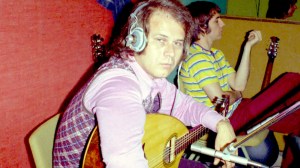
Have you ever had the experience of knowing someone for a long time and finding out after many years that you’ve maybe been underestimating them? Like they have a hidden talent that surprises you somehow?
Alan Parsons can likely relate to that scenario. His longtime musical partner Eric Woolfson finally convinced Parsons that he could do some singing in 1980. It led to a huge hit and the most successful commercial stretch of the Alan Parsons Project’s career.
Videos by American Songwriter
Project Status
Although many musicians came in and out of the Alan Parsons Project over the years, there were essentially only two stalwart members: Alan Parsons and Eric Woolfson. They met in the mid-70s when Parsons was developing an impressive reputation as an engineer and producer, and Woolfson was trying to build a career as a songwriter.
Woolfson soon began managing Parsons, helping him get a string of high-profile producer gigs. Along the way, he was also trying to get an idea off the ground. Woolfson wanted to make an album’s worth of songs based on the work of Edgar Allan Poe. With Parsons collaborating and providing the brand name, the Alan Parsons Project debuted with Tales Of Mystery And Imagination in 1976.
The name they chose was an indication that Woolfson and Parsons didn’t think this was more than a one-off thing. But audiences responded so well to the record that the duo decided to make the APP the focus of their respective careers.
Singers Come and Go
Woolfson and Parsons didn’t do much playing (beyond keyboards and synths) on the Alan Parsons Project’s records. They wrote the songs, produced them, and came up with the conceptual underpinnings. Since they never intended it to be a touring band, they basically used hired hands to bring the song to life in the studio.
That included a bevy of different singers. John Miles sang lead on the band’s debut single (and US Top 40 hit) “(The System Of) Dr. Tarr and Professor Fether”. Other notable vocalists on their first few records included Arthur Brown, Alan Paton of Pilot, and Colin Blunstone of The Zombies.
But all the while, Woolfson, who was, after all, the chief songwriter for the project, kept pestering Parsons that he could handle the lead vocals. Finally, for the 1980 APP album The Turn Of A Friendly Card, Parsons relented. What a wise move that turned out to be.
About “Time”
Woolfson didn’t take over completely as vocalist on the album. In fact, the first single, “Games People Play”, a Top 20 US hit, was sung by Lenny Zakatek. But Woolfson contributed vocals to the title track, a long song suite that dominated Side Two of the album.
And he had the ballad “Time” all to himself. A richly melodic track, Woolfson handled the assignment with aplomb, taking listeners on a spiritual journey of sorts from sorrow to resignation. Released as a single in 1981, “Time” hit No. 15 on the US pop charts.
More than that, it proved to Parsons that Woolfson was more than capable on the mic. In fact, he sang lead on most of the APP’s big hits from that point forward, including “Eye In The Sky”, their biggest ever single, in 1982.
(Photo by Jean-Louis URLI/Gamma-Rapho via Getty Images)
More Features
-
UNITED KINGDOM – JANUARY 01: Photo of Pete SEEGER; Pete Seeger performing on stage at a Paul Robeson benefit concert (Photo by Brian Shuel/Redferns) -
UNSPECIFIED – CIRCA 1970: Photo of Diana Ross Photo by Michael Ochs Archives/Getty Images -

The British singer Kate Bush poses for a photo shoot. Great Britain, 1980 (Photo by Angelo DeligioMondadori via Getty Images) -
American Rock musician John Cougar (born John Mellencamp) performs onstage at Byrne Arena (later known as Meadowlands Arena), East Rutherford, New Jersey, October 7, 1982. It was the first concert of the 'American Fool' tour, in support of headliners Heart. (Photo by Gary Gershoff/Getty Images) -
Photo via NBC/Getty Images -
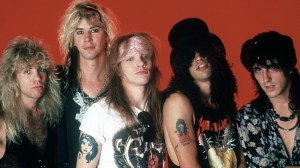
DETROIT, MI – MAY 7: (L-R) Drummer Steven Adler, Duff McKagan, vocals Axl Rose, guitarist Slash and guitarist Izzy Stradlin of the music group Guns N' Roses pose for a portrait on May 7, 1988, at the Detroit State Theater in Detroit, Michigan. (Photo by Ross Marino/Getty Images) -

Bassist Daryl Stuemer, guitarist Mike Rutherford, singer Phil Collins of the band Genesis perform during the Atlantic Records 40th Anniversary celebration called "Its Only Rock and Roll" at Madison Square Garden on May 14, 1988 in New York City, New York. (Photo by Larry Busacca/Getty Images)