
By the mid to late-’60s, Paul McCartney became immersed in the underground scene in London, sparked by the British pop art movement, works coming from the Drury Lane Arts Lab—where John Lennon and Yoko Ono would premiere their joint work Four Thoughts (Build-Around) in 1968—Andy Warhol and David Morrissey’s Chelsea Girls, and other emerging collectives.
After connecting with the design group BEV (Binder, Edwards & Vaughan), McCartney was commissioned to produce a piece for their upcoming exhibition The Million Volt Light and Sound Rave in 1967 and jumped at the opportunity to showcase the Beatles‘ more avant-garde side.
[RELATED: The Unreleased Beatles Song from 1967 That Has Never Seen the “Light” of Day]
Videos by American Songwriter
The Beatles Ride “Carnival of Light”
Recorded on the morning of January 5, 1967, the near-14-minute piece, “Carnival of Light,” was a free-for-all, orchestrated by McCartney of loosely riffed guitars, distorted instrumentation, dense echos, and random phrases blurted: “Barcelona” and “Are you all right?”
“I said ‘All I want you to do is just wander around all the stuff, bang it, shout, play it, it doesn’t need to make any sense,’” recalled McCartney of his instructions to the band for the recording. “’Hit a drum, then wander on to the piano, hit a few notes. Just wander around.’ So that’s what we did and then put a bit of an echo on it. It’s very free.”
After creating a mess of noise for nearly 14 minutes, McCartney pulled the plug on “Carnival of Light” after 13 minutes and 48 seconds. “This is ridiculous,” said producer George Martin. “We’ve got to get our teeth into something a little more productive.” After wrapping up their experimental piece, the band recorded “Penny Lane,” which was initially intended for Sgt. Pepper’s Lonely Hearts Club Band.
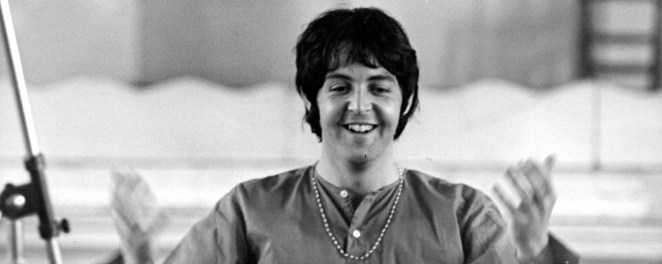
Weeks later, the Beatles’ musical concoction was played during the light show at the Roundhouse Theatre in London on January 28, 1967, with posters advertising “Music composed by Paul McCartney and Unit Delta Plus.” It may have been unbeknownst to some attendees that the sounds they were hearing came from one of the biggest bands in the world at the time.
Unit Delta Plus, which was also part of the exhibit, consisted of synth pioneer Peter Zinovieff, along with Delia Derbyshire, who worked on the Doctor Who theme song, and Brian Hodgson, also from the BBC Radiophonic Workshop.
[RELATED: The Beatles Release ‘Sgt. Pepper’s Lonely Hearts Club Band’ in 1967]
In the Vault
When “Carnival of Light” premiered, McCartney didn’t show up for the event. Instead, he went to see The Four Tops at the Royal Albert Hall with George Harrison. In ’68, the Beatles released another song experiment, the Lennon-led “Revolution 9″ from the White Album.
In 1996, McCartney suggested adding “Carnival of Light” to the Beatles’ Anthology 2, but the idea was declined by Ono, Harrison, and Ringo Starr. “We were listening to everything we’d ever recorded [for ‘Anthology’],” said McCartney. “I said it would be great to put this on because it would show we were working with really avant-garde stuff, but it was vetoed. The guys didn’t like the idea, like, ‘This is rubbish.’”
The song was teased again for the 30th-anniversary remaster of Sgt. Pepper’s Lonely Hearts Club Band in 2017, but stayed in the Beatles vault.
“It does exist,” said McCartney of the song in 2008. “The time has come for it to get its moment.”
Still, the Beatles’ “Carnival of Light” remains in the dark. It has rarely been heard and does not exist on bootlegs.
Photo: The Beatles at Abbey Road Studios, June 24, 1967. (Daily Mirror/Daily Mirror/Mirrorpix via Getty Images)
More Features
-
NAZARETH / Die schottische Rockband NAZARETH, 70er Jahre. Musik, Band, Rock, 70er. (Photo by kpa/United Archives via Getty Images) -
LONDON, ENGLAND – CIRCA 1965: British Rock Group "The Rolling Stones" perform on a TV Show in London, England circa 1965. Left to right: : Bill Wyman, Brian Jones, Mick Jagger, Charlie Watts, Keith Richards. (Photo by Cyrus Andrews/Michael Ochs Archives/Getty Images) -
UNSPECIFIED – JANUARY 01: Photo of Le Roy Van Dyke (Photo by Michael Ochs Archives/Getty Images) -
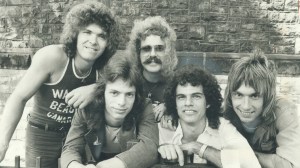
Vancouver-based. Chilliwack – from left; Brain MacLeod; Ab Bryant; Skip Layton; Bill Henderson and Jamie Bowers – were described as taking rock 'n' roll where it's goig back in the San Francisco rock explosion of 1967. but they fizzled because they didn't tour to push record sales. They aren't making that mistake again. -
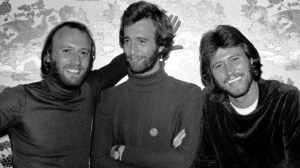
Maurice Gibb, Robin Gibb, Barry Gibb of the Bee Gees in New York City, New York (Photo by Bobby Bank/WireImage) -
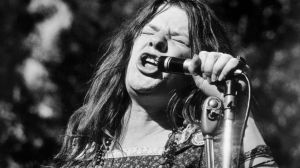
Rock music legend Janis Joplin performs at the free Woodstock Music and Art Fair. The festival took place on Max Yasgur's dairy farm, which he rented to event organizers for $75,000. About 450,000 people attended the three day concert, which turned into chaos due to the crowds, heavy rains, and traffic jams. It is nonetheless romantically remembered as a symbol of the liberal spirit of the hippie generation. (Photo by Henry Diltz/Corbis via Getty Images) -
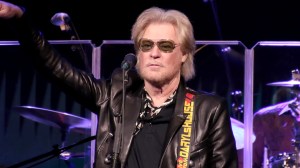
ATLANTIC CITY, NJ – AUGUST 30: Daryl Hall of Hall & Oates performs in concert at Etess Arena on August 30, 2019 in Atlantic City, New Jersey. (Photo by Donald Kravitz/Getty Images) -
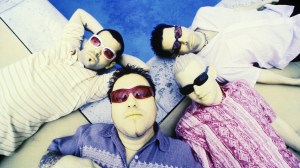
LOS ANGELES – MAY 1999: (EDITORS NOTE: THIS IMAGE WAS CREATED USING COLOR INFRARED FILM) American rock band Smash Mouth (L – R) drummer Kevin Coleman, vocalist Steven Harwell, guitarist Greg Camp and bassist Paul De Lisle pose for a May 1999 portrait in Los Angeles, California. (Photo by Bob Berg/Getty Images)