
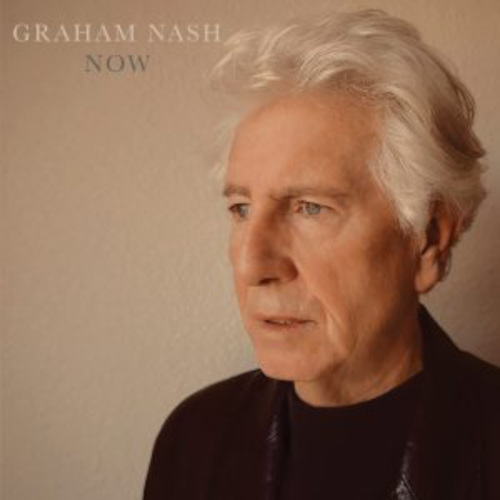
Graham Nash/Now/BMG
Four out of Five Stars
At 81 years of age and a career that ranks as one of the most prolific and influential in the annals of modern music, Graham Nash certainly has nothing left to prove. That may explain his recent absence of late. His last album, This Path Tonight, was released nearly seven years ago and offered the impression he was looking at his life in the rearview mirror. It had been 14 years since the album that preceded that, suggesting that perhaps he was simply weary and reconciled to reflecting on past glories, rather than forging a journey he had so repeatedly traversed before.
Videos by American Songwriter
If, in fact, that was the case, then Now could be considered a resurgence of sorts, one that finds Nash repeatedly celebrating the blessings he’s been bestowed with and keenly aware that he’s been a lucky fellow indeed. Several of the songs—“In a Dream,” “It Feels Like Home,” “Follow Your Heart,” “When It Comes To You” and the candid and confessional “Right Now” in particular— center on gratitude for love and companionship, subjects Nash has repeatedly focused on over the years, particularly in the classic “Our House” (which “It Feels Like Home” closely parallels here) and “Sleep Song,” which shared an intimacy he readily returns to. The material is softly lit and effortlessly assured, conveying the calming and caressing sound that all so frequently added its soothing sobriety to CSN and CSNY (Crosby Stills Nash & Young), respectively.
That’s not to say there aren’t rallying cries included as well. Both “Golden Idols” and “Stars and Stripes” recall the outraged anthem of old, as manifest in the insurgent stance that sparked songs like “Chicago” and “Military Madness” so early on. The references to MAGA, January 6, and political hypocrisy leave little doubt as to where he’s aiming his vitriol. “Stand Up” comes across as a call to arms, a forthright entreaty to everyone everywhere to make their voices heard.
On the other hand, Nash betrays more than a hint of nostalgia as well. His duet with former Hollies’ partner, Allan Clarke, on “Buddy’s Back” fondly recalls the duo’s early delight in making music and the common love of Buddy Holly, who initially inspired their efforts to the point where they appropriated his surname to christen their band. On the other hand, he takes a rather unflattering look at all that’s transpired since, courtesy of the tellingly titled “I Watched It All Come Down.”
I watched it all come down
To a paperweight at the business end of town
Loaded up and loaded down, it’s a mess, a mess
There’s a certain bitterness betrayed there, a marked contrast to the sweet serenity purveyed in the album as a whole. Notably, Nash offers no final thoughts on his longtime comrade-in-arms, David Crosby, with whom he had a very public falling out in recent years. That said, “Follow Your Heart” might be interpreted as a fond farewell (After all these years together, I’ll never forget to say I love you… and after all this time together, I’ll never forget that you love me…)
Whether that song is, in fact, directed to his estranged partner is a matter of conjecture. It could just as easily be a paean to a lost love. It’s hard to say, although one thing is certain. Graham Nash isn’t the type to necessarily relish any remorse.
Photo by Jeff Spicer/Getty Images
More Reviews
-

John Oates performs with The Good Road Band on March 15, 2026, at The Cabaret Theatre at Mohegan Sun in Uncasville, Connecticut (Photo by Khoi Ton/Courtesy of Mohegan Sun)