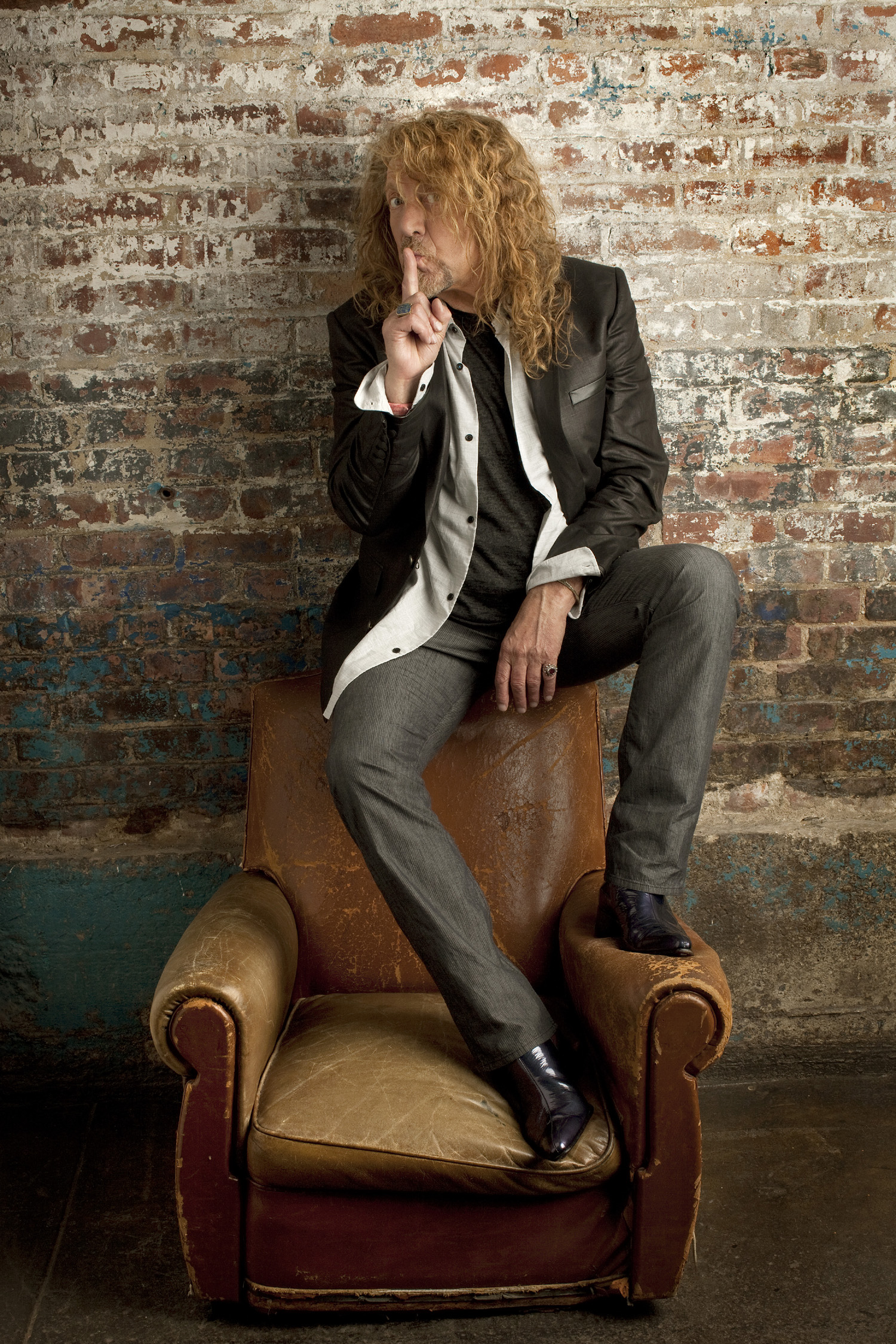
A fiery orange color dominates the sky above Clearwater, Florida, as the sun begins its descent. The air is hot and humid, and it feels kind of like you might imagine it would feel if you wrapped yourself in a dripping-wet thermal blanket and went for a long walk in the heat of the day. Meanwhile, Robert Plant is getting a little ahead of himself. “Goodnight, sleep tight / The big, bright sun has gone away,” he sings on a cover of Los Lobos’ “Angel Dance,” from Band Of Joy, his new album with a literal band of joy for Americana fans: Buddy Miller (production, guitars, vocals), Patty Griffin (vocals), Darrell Scott (multiple instruments, vocals), Byron House (bass, vocals), and Marco Giovino (drums and vocals). Tomorrow, Plant will bring this band to the Tampa Bay area for the first time, to play its eleventh show ever.
Miller, 57, co-produced Band Of Joy with Plant, 61, and talking to the people surrounding the record, including Plant himself, it’s clear that Miller is the man behind the curtain. But to hear him tell it, it’s as if he and Plant got together one afternoon and made Pop Tarts. Asked if the recording process came naturally, he quickly and tersely responds, “Oh, yeah.” Asked for details from the studio, he glosses over it as if they cranked out Band Of Joy’s dozen songs in a single morning.
“Robert pretty much came over armed with a lot of songs and a notebook,” Miller says. “We talked a lot on the phone before he came over. I would suggest songs or send songs over, but he pretty much knew what he wanted. Then we recorded a batch of songs and then rethought it a bit.”
Sending songs over, indeed. Plant speaks with a fond awe of the 86,000 selections on Miller’s laptop, a much-talked about figure that, when brought up, Griffin clarifies has now reached 87,000. Miller interrupts. “Eighty-eight,” he corrects with a satisfied chuckle.
“The word ‘encyclopedic’ comes up a lot on this tour because both [Plant] and Buddy have this mass of knowledge, particularly of American roots music,” Griffin says. “Robert kinda carries his up here [pointing to head], whereas Buddy’s actually got the collection.”
Miller’s vast knowledge and appreciation of music history served him well on tour with Plant and Alison Krauss supporting their 2007 collaboration, Raising Sand. It was those shows that convinced Plant to ask Miller to form a band for his next album – a band that could play a dozen interpretations of some of the best songs bouncing around in Plant’s mind and on Miller’s laptop.
“We had a lot of music in common,” Miller says. “The first Zeppelin tour, I got to see that. I liked a lot of the psychedelic stuff that was going on in the ‘60s that he still loves. We would listen to that and talk about it all through the Raising Sand tour, so we had a common language and points of reference when we approached the songs.”
Following the tour, Plant gave Miller free reign to recruit players for Band Of Joy. The name itself is a reprise of one of Plant’s earliest acts, which he played in with future Led Zeppelin drummer John Bonham in 1967, and the similarly freewheeling nature of that early band and this current one is what led Plant to bring the moniker back. “I think there were only about four or five people who agreed with that at the time,” Plant remembers. “When I started working with Buddy for real, post-Raising Sand, I got the great, expansive feeling that everything was possible, and I had a completely clean and open canvas. It was a joyous experience and I thought, ‘Well, I don’t know how much longer I’m going to be able to do this sort of thing before I implode.’ So it seemed like I had almost the equivalent sensations to what I had when I was 17.”
Plant isn’t the only one feeling young again.
“He has a way of bringing things out of people,” Miller says. “Certainly I can attest to that with guitar playing. I’m going places I haven’t thought about since I was 14.”
***
“Fuck the purists!”
Patty Griffin just perked up. She, Miller and I have been having a pretty reserved chat backstage at Tampa’s Ruth Eckerd Hall, where the band will play in a couple hours, discussing their time working with Plant on the Band Of Joy record and the 10 shows that have happened so far. That is, until they’re asked whether they thought there was a certain weirdness to a British man stepping to the stage to accept an Americana award in Nashville, a weirdness that perhaps wouldn’t sit well with purist appreciators of the genre. It’s at this point that they both get visibly riled.
“[Plant’s] more enthusiastic, too, about [American roots music] than a lot of the purists are,” Griffin continues. “About more of it.”
“Purists are a drag,” Miller piles on. “That’s why bluegrass is a drag and jazz is a drag, unless you get people like Brian Blade or Darrell Scott, who go outside that whole narrow way of seeing everything.”
Regardless of his intentions, and despite how unlikely it may seem, Plant is poised to become the new and perhaps-surprising leader of a rather expansive genre that Jed Hilly, executive director of the Americana Music Association, defines as “contemporary music that honors and/or derives from American roots music.” Those words perfectly describe both Raising Sand and Band Of Joy, the former of which Hilly calls a “major milestone.”
“I think it did something different,” he explains. “O Brother was a significant record, and it established the viability of American roots music as commercial product. It also happened to coincide pretty much with the existence of this organization; we started in ‘99, our first conference or community gathering, if you will… You know, that was a huge boost for us. I’d certainly put Raising Sand up there.”
Hilly considers Raising Sand and its success a major contributor in the tipping point that was the National Academy of Recording Arts and Sciences creating the very first Best Americana Album Grammy award, given to Levon Helm’s Electric Dirt in early 2010.
“I think [Band Of Joy’s] gonna be bigger,” Hilly says. “I think this record is our greatest opportunity to make a dent in the terrible music that the mainstream media has been subjecting us to.”
Plant and Hilly each literally laugh out loud at the prospect of the former’s crowning as the Unlikely King of Americana. But whereas Plant politely demurs, changing the subject to a tricky debate on semantics, Hilly gives it a very real consideration.
“Without question,” he says in response to the possibility. “I think it’s a much broader thing that’s really – I think he could, just as he was in that other world. I don’t think he was trying to be… He knows that he’s been called the king of other things too… [It’s] incredible, too, you know. I mean, Picasso did that, right? He pushed the boundary.”
***
“They got these liberal, low-flow toilets,” a man I’ve never met before in my life is saying to me from somewhere outside my scope of vision as I wash my hands in the men’s room of the Intercontinental Tampa. “Guess Obama is working out.” These are the wonderfully non-sequitur first words I hear as I await my conversation with Robert Plant, and they’re a refreshing blast of randomness amidst the bustle of a very busy establishment. Located in Tampa’s cluttered Westshore district, the Intercontinental boasts a fairly regal lobby, arcing fountains, tall glass columns of windows everywhere, flat-screen televisions and posh seating areas just as ubiquitous. People in suits talk loudly in every corner and drinks start to flow quickly as the six o’clock hour approaches.
Despite the racket of the hotel lobby, the tree-dotted oasis in between its buildings is eerily quiet, scattered marble tables on black metal legs everywhere. The table we’re situated on either side of is positioned too high in proportion to its chairs, and it feels almost as if two youths have chosen this discreet spot to conspire mischief and discuss strategies of fort-building and cootie-avoidance. Plant is chipper and talkative from the moment we sit down in the courtyard and he doesn’t waste a second, starting in before I’ve even turned my recorder on. “I feel like a naughty, naughty boy,” he says, a grin widening across his face as he attempts to position himself above the table with his elbows. Half a moment later, apropos of nothing, he recalls the last time he visited Tampa.
“I was banned from here for life,” he begins. “It was a Zeppelin concert at the stadium and the weather turned. In those days, there were no isolating transformers or anything to stop electrocution from water and power. So we had to stop the show and then the crowd got a little restless, and so the police moved in rather vividly with sort of Perspex, see-through shields. There were 57,000 people. The authorities decided it was our fault and that would be the end of it and we wouldn’t come back together as a group again. But I can creep in on my own now, under cover.”
At no point during our conversation do we discuss mudsharks, the meaning of “ZOSO” or what might prompt a man to utter the words “I am a golden god.” While Plant did, in fact, once write the line: “When your conscience hits you, knock it back with pills,” he’s now the wizened man who says things like, “I traded drugs for Rand McNally. And you know what? It’s better than drugs.” He sounds energized, too, clearly invigorated by the recent direction his career arc has taken him. This direction, two albums in, has consisted almost solely of cover songs, so I ask him why he’s relying on the material of others.
“I’m through with trying to express stuff in three minutes until I’ve got something really interesting, ironic or humorous. I’ve got books and books of anecdotes and one-line quips. Sometimes, I’m so funny, I catch myself going forward and trip over, because I see a lot of funny things and a lot of ironies as I get older. But I was looking for substance to get my head around it and my motive to project into other people’s songs, you know. I just think there’s so many different strains and filigrees in our record, which require a different mind to get into them as a singer, to tell them.”
Band of Joy’s cross-section of music history cuts a wide swath, Richard Thompson (“House of Cards”) making an appearance after Los Lobos (“Angel Dance”), The Kelly Brothers (“I’m Falling In Love Again”) preceding Milton Mapes (“The Only Sound That Matters”). Townes Van Zandt (“Harm’s Swift Way”) gets a treatment, as does Barbara Lynn (“You Can’t Buy Me Love”), a standard or two and a poem put to music. The only act that gets two songs is Minnesota “slowcore” duo, Low.
“They can have two hundred if they like,” says Plant. “They can come and live at my house if they want to. [Laughs] I mean, they’re in my car, they’re in my head and they’re on stage now.”
“He’s an interpreter of song,” says Low’s Alan Sparhawk. “I think it’s a compliment to American songwriters, or at least the history of music in America, that someone of that caliber and that taste keeps coming to that material,” he says. “Specifically pertaining to us, it’s really sort of amazing that he’s not just watching. He’s listening to music, you know? He’s drawing from a lot of things. I don’t know where he picked us up or who handed him our CD or where he got stuck having to listen to us over and over again.”
Indeed, he’s not just cherry picking classics for his albums. As Plant talks in the hotel’s courtyard, it becomes increasingly clear that he’s lived a life of music almost to the point that it’s all he knows. He namedrops like none other, but it’s not exactly namedropping. Nearly every answer is peppered with artists, influences, stops on the never-ending trip through music that his life has been. At one point, during the course of a two-minute answer, he references more than a dozen musical personalities. He’s enthusiastic to a fault, and a conversation with him requires much googling afterward. But he’s not just interested with the past. For every Howlin’ Wolf, there’s an Arcade Fire. For every Chet Atkins, a Low Anthem. He has no use for resting on his laurels or subscribing to any particularly restraining line of thought or path to discovery.
“Raising Sand was great because it swung and it was quite, well, it was dark at times. Pretty dark. Whereas this thing here now, it’s wide open. Its arms are open. It’s just kind of a great exhalation.”
For Plant, it doesn’t matter than he’s a British man in an American man’s genre. It doesn’t matter that he was once the singer of one of the biggest rock and roll bands of the ‘70s. If someone is bothered by his stepping into their territory, they’ll just have to deal.
“All that possible, you know, encroachment,” Plant says. “It doesn’t have to exist in this. Everybody can go back to wherever they come from. You know, I’m not. I’m sticking with this, whatever it is.”
***
The specter of Led Zeppelin hangs heavy over Robert Plant’s current work. A platinum album, a stack of Grammys – these haven’t changed things. Maybe never will. This is unsurprising, but also sad in a very specific, nostalgic way. Yes, Plant once sang for one of the most popular rock bands of all time, but if he’s ready to let it go (unlike, say, The Rolling Stones), why can’t his fans? As I circle Ruth Eckerd Hall a few hours before show time, I come upon a small mass of them, awaiting with a mixture of hope and exhaustion.
It’s troublesome, though, going to a show like this one where so much of the audience and appreciation is based on something that is so clearly long gone. Plant, a thoroughly professional interviewee after 40 plus years of answering people’s questions, refers to the idea of Led Zeppelin playing more gigs together as something that’s “not even a talking point,” quickly taking the opportunity to steer the conversation to a talking point of his own, songwriting, and how he’d like to get back to it someday with the help of his new friends from Nashville. And yet, that legendary band is seemingly all anyone in this part of Florida cares to talk about today.
“First time seeing Zeppelin?” a man in line for beer asks me. At first, I think he’s looking for a year, perhaps to compare notes. But then I realize his actual question. “Tonight, you mean?” I respond, and he smiles, eagerly nodding. “We’re not seeing Zeppelin tonight,” I say cautiously, hoping I don’t upset whatever it is he’s expecting. He looks a little embarrassed and a little disappointed. “This is about as close as it gets,” he says, resigned.
Plant, Miller, Griffin, Scott, House and Giovino will play seven Zeppelin selections tonight, spread throughout a 20-plus song set that also includes solo Plant material from the ‘80s as well as a couple of Plant/Krauss songs. The Zeppelin material, despite its sometimes-drastic reworking, draws a raucous standing ovation every time. “I know it’s very difficult to sit through a lot of new songs, but this is the beginning of a new career,” Plant says to the capacity crowd of 2,200 toward the end of the main set, before the encore. He sounds pretty earnest, but he’s also an entertainer who wants to please the folks who have bought him houses over the years. So, he continues, “What’re you gonna do? But, slowly, the door opens, and…” The band launches into back-to-back renditions of “Houses Of The Holy” and “Over The Hills And Far Away.” The people are exceedingly happy to be here.
But it’s clear that it’s the material of these last couple albums that is making Plant truly happy these days. On this tour, he and his Band of Joy are ending their shows with the old chestnut “And We Bid You Goodnight.” With its slow, swaying pace and repeated refrain of “goodnight, goodnight,” it’s a fitting ending to a show, but more importantly, it’s a holy grail of sorts for Plant, a long-coming accomplishment.
“I know what I’m doing, but there are so many things that I don’t know,” he says. “There are so many techniques and bits and pieces of gifts that I can hear in all these voices, and the last song of the show is six voices singing, and it’s a song I’ve wanted to sing since I was very young. Jimmy and I always vowed we would end our Led Zeppelin shows with it.”
I ask him if that ever happened, and he’s quick to reply in the negative. Softening, though, he smiles. “But it does now.”
The king looks fulfilled.