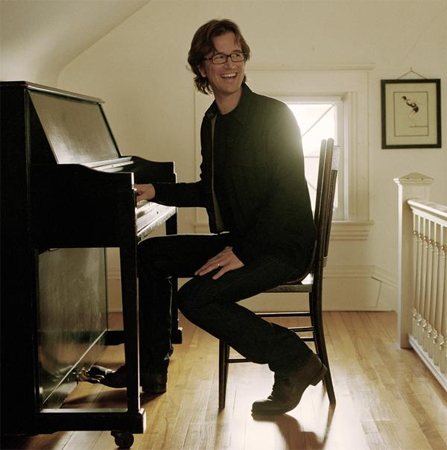
Dan Wilson’s band Semisonic may have gone on hiatus, but the man behind “Closing Time” has never stopped writing. Instead, he’s become the king of the co-write, working with artists as diverse as Dixie Chicks, Weezer, Keith Urban, Josh Groban, and The Bravery. Wilson’s latest album, Live At The Pantages, surveys his career so far.
Why did you decide to put out a live record?
I knew that I was heading into writing and recording a new jam of some kind. I was so enjoying the free life, the stretch of touring and playing those songs live and getting the band kind of happening. I don’t know if I thought about it consciously, but I didn’t want to wrap up that phase without documenting it somehow.
It seemed like it was going to be loose and fun and the band, we’ve played a lot together. The previous show in Minneapolis, year before, it was a little bit proper and precise, and like an execution of an idea, and this show we ended up recording, I knew that it was going to be loose and more of a live experience. So it seemed like a nice way to put a cap around that period of time.
Semisonic’s big hit “Closing Time” is not on the record. Was that a conscious decision?
I’ve never agreed with artists who avoid their big hit song at their concerts, that annoys me, actually. I almost always play “Closing Time.” By that gig, I had actually done “Closing Time” so many times at so many gigs that I had been telling this long, involved story. And just by chance, I decided to give it a rest that night. I’ll probably play it at another gig soon.
I was checking out Wikipedia today, and I wanted to see if this stuff was true.
It’s all false!
It says “Closing Time’s” lyrics were partly about the birth of your child.
It wasn’t exactly conscious, but it became pretty obvious as I was writing the song. I suddenly realized it was a big part. I was initially trying to write a song to end the Semisonic shows with. We had always ended with a song called “If I Run,” and I really liked it a lot. John and Jake, the other two members of the band, were always impatient with ending the show with the same song. So I set out to write a new closer for the set, and I just thought, “Oh, closing time.” Because all the bars that I would frequent in Minneapolis, they would yell out “closing time.” There was one bar where a guy always would scream really loud, “You don’t have to go home, but you can’t stay here,” and I guess that always stuck in my mind.
So I started writing this song and it’s just, “Okay, you’ve got to go out into the light, make your way home, or wherever you’re going to be.” Part way into the writing of the song, I realized it was also about being born. My wife and I were expecting our first kid very soon after I wrote that song. I had birth on the brain, I was struck by what a funny pun it was to be bounced from the womb.
It’s kind of a cool circle of life: it’s a song about hooking up, and then you’re thinking about your child being born.
(laughs) Totally. Exactly. Yes.
And what about the part where you sing “every new beginning”? Wikipedia says you appropriated that from a philosopher named Seneca the Younger.
I think that’s a fanciful falsehood. I made that up. I really like Wikipedia, but once you have the experience of being Wiki’d yourself, you realize that probably half of the really fascinating shit on there is totally lies.
A big part of what you do now is co-write with others, and the diversity of artists you’ve worked with is really impressive. How did you first get into it?
When I first learned how to write songs, it was with my brother, Matt. Our parents had listened to a lot of music in our household and one of us, probably me, got a guitar when I was 12 and he was 10, or something like that. We learned how to play it, and we both realized that you could write your own songs, and we went kind of nuts trying to write songs. Matt figured it out before I did, so I learned from watching him. But also, we’d finish each other’s songs when we were missing a part, a section would be bad, or it’d just have nowhere to go. We would always take it upon ourselves to finish the other brother’s song.
So I grew up with the idea of co-writing as part of my life. Then, when you’re in bands and you’re jamming and sound-checking and you turn a jam into a song, that’s another kind of co-writing. It’s more unwieldy, but it’s a total band-like way of writing a song together. Also when I was a kid, I had always seen Lennon/McCartney on my parents’ Beatles albums. In my mind, I just assumed that that’s how people did it.
I think it was about 1999, I started putting the word out to a publishing company that I wanted to try to write with other artists who I might not otherwise be able to meet. I had not had an easy time in Minneapolis meeting other songwriters who wanted to write with me. I’m not sure why, I think it may be because a person has to be confident in their songwriting to write a song with somebody else. Minneapolis, being a pretty small community, and people being insecure to some degree, there was not that much enthusiasm…I put it out there, but nothing came of it, but my publishing company gave me a blind songwriting date with Bic Runga. She’s a New Zealand singer-songwriter who’s really incredible. We wrote a song that ended up on the soundtrack for American Pie, which for our first try, felt like a pretty big success.
And my second co-write outside my band, same thing, my publishing company put me together with Carole King, and we wrote that song “One True Love,” which is on Semisonic’s All About Chemistry album. I could joke that it’s been downhill from there, because she’s kind of like my Lennon/McCartney, Gershwin brothers. She’s beyond legendary. That was just a great way to launch me, because it gave me the illusion that it was always supposed to be awesome.
Did Carole King give you any particular advice, or did you just start doing it?
She was really great to write with. She showed me by example how to approach it. One aspect was, she could tell I was really nervous just to meet her and talk to her. I was just nervous and excited. I mentioned a couple of old songs of hers, one of which the Byrds did, “I Wasn’t Born to Follow.” I said I really love that song. And she immediately just sang me the song. It was so comfortable and strange, but great that Carole King was just singing me one of her obscure songs that I loved. Then when it came to writing, she never said, “I don’t like it,” “I’m not feeling that.” She didn’t say no to anything. Every time I came up with an idea, she would just try to improve it or add something better to it or say, “Okay, how about this?” and she’d play the thing that would come next. Always adding, and always following the excitement.
She was really funny, it was a fun, good experience. It was not a serious, grim thing that a lot of my band writing experiences had been…grim determination of trying to write a great song. Carole just made into this funny, fun hang, and that resulted in a great song. It was a cool example for me to have in my mind, that being comfortable and being happy and having a good time are really important aspects to it. I know that she could tell that I was nervous, and I know she just put on her best gracious attitude to make me comfortable, and that was a real big learning experience. Every time she sang something, it was awesome. Literally, every time she opened her mouth, and she’d say, “What about this?” and sing a melody, she would just make me want to run around the room. I didn’t do that, because it would have been unseemly.
So your publishing company got the ball rolling. Do people come to you now, or does your publishing company still set things up?
It’s kind of a combo. There’s three things that happen. I have a wish list. I’ve kind of put the word out if there’s someone I really want to meet or write a song with, or if there’s a friend of mine I’ve never written, with but I really want to write with, I approach them. Then sometimes, people come to me, and suggest that we write something together. Then there’s a fair amount of the business side always trying to cook up a good idea.
When you co-write, are you generally more about the music or the lyrics, or are you involved in the whole thing?
It really depends on what’s needed. This has been a kind of a funny, fun week because the Weezer album is coming out in a week, [This interview took place in September 2010], and they just streamed on their MySpace page “Ruling Me,” which is a song I co-wrote with Rivers Cuomo. I had not yet heard the band version, I had only heard the demo that Rivers and I made. On that one, we wrote some lyrics for the verse, and he generated most of those, and I helped. And then I wrote the lyrics to the chorus, except for the last line, which is the title, which is his, and amazing. We kind of wrote the verse together, and then I said to him that I thought it sounded too innocent, and he said, “We’ll revise the innocence out later.” And then a week later he e-mailed me new lyrics and it was exactly that; the same story, the same song, but everything innocent and sweet was removed and replaced by something really funny and zippy and great, and sort of spicy. That was real collaborative, on the lyrics, and we wrote the music together.
And another song of mine, that I think is getting streamed today, is “Hidden Away,” by me and Josh Groban. That’s one where we really started from the very…I think I just played the first two notes on the piano, the first bar, and said, “Let’s write something around this pattern that’s really simple.” We built it up together every word, all the melodies. At times, I don’t write any lyrics. If the person’s really inspired with lyrics, and they have a real personal point of view, then maybe I might just suggest a good turn of phrase or a good rhyme and just stand out of the way.
How much of your lyric writing is just stuff that comes to your head, and how much is stuff that you’ve worked out over time? Is that different from the songs that you write for yourself, versus when you’re working with someone else?
When I’m working with someone else, usually the good lyrics happen right then and there, in the moment. I don’t have a collection of cool phrases. I have some friends who have books of titles, for example, like hundreds of possible titles. Sam Endicott and I wrote a song for his band, The Bravery, recently, and it’s on that Twilight Eclipse soundtrack out, and he has notebooks and notebooks of phrases and loose lyric ideas. When we’ve written together, he’s always going through his notebooks and looking for stuff. It’s like he’s searching through this already preexisting pile of ideas. Mike Daughtry is another one like that. He’s got it all written, and he uses all the lyrics for whatever album he’s working on, it seems. He has a huge pile of phrases and lyric ideas and then he uses them up and gets to a point where he says, “Well, there’s nothing left in the notebook, I’ve crossed them all out, I’ve used them all, I must be done.” Which is a really interesting way to work, I think. I don’t do that, I have stray ideas floating around on a pile of cards that I rotate through. There’s probably 100 of them, a little, short, a lyrical phrase. But it’s usually that phrase is the only thing in a new song that is older. The rest all happens the day I write it.
Do you ever have co-writing sessions where you’re not feeling it from yourself, or do you generally have good luck?
I don’t know if I ever have that feeling of not feeling it. That phrase, “I”m not feeling it,” whenever I hear that phrase, I get really annoyed. Because I don’t relate to it at all, I don’t understand it, it just doesn’t ring a bell with me. Mostly, if the person is basically interesting or nice, I’m going to be feeling it. Although, I have heard it from other people. I think that’s probably a good way to go; If you’re a person that feels it one day and then doesn’t feel it the next day, then you’ve got to only write on the days that you feel it.
I’m just really lucky, this is a ridiculously fun and interesting job, and I can’t fathom “not feeling it.” Maybe that’ll happen one day and I’ll really get it. I do know when in the session it’s time to go, like go get some espresso or just take a walk. Maybe that’s just my way of saying I’m not feeling it. I’ll just say, “Let’s distract ourselves for a minute, let’s go to the lake, or let’s take twenty minutes and walk down to the Starbucks and get an expensive espresso and walk back, we’ll have inspiration when we get back.”
One of the things that’s impressive about you is your ability to work in different genres. Was the music you worked on with Josh Groban classical sounding?
Yeah, it was. It’s funny, because I had this experience as a fan, I went to an Elvis Costello concert in 1987, I think. I had been familiar with a lot of his tunes. He played the whole show with a horn section and The Attractions, and they didn’t honor the original arrangements at all. It was as if they were a band that had learned a whole bunch of songs by lots of other artists, and just played them in their own style for that night. But it was actually all Elvis Costello songs, except for a couple.
It was just amazing to me how little they seemed to care about the original arrangements And that was really powerful, because if I write a song, just on the piano or just on a guitar, without any arrangement idea in mind, I have a lot of confidence if it’s a great song, it’s going to be useful and it’s going to work within whoever’s style that wants to use it. I know that’s probably not always true, but I operate on the principle that if it sounds great when you’re just playing it on the piano or guitar and singing it, then making it into a stylistic statement is just not a problem. It’s just going to be a matter of time, turning the crank and getting an arrangement out of the song.
Were you into country music before you started collaborating with the Dixie Chicks and Keith Urban?
Yeah, but kind of sporadically, and probably country that’s not really country. Like the country I like is almost historical country, like Hank Williams and Tammy Lynette and Johnny Cash. When I got together with the Dixie Chicks, I’d been down to Nashville several times, writing with people and getting put together with Nashville writers.
It’s actually an incredible education for a songwriter to go down to Nashville and give it an honest shot and trying to write some songs with country songwriters, because they have this ethic of you start late in the morning, and you discuss what thing you might be thinking about, trade a few ideas. And the idea that’s deemed to be the most promising, then you launch into finishing it, and by 4 o’clock, you’re done. It’s the Nashville ethic, and they just don’t look back. It’s so rare that more writing would happen on a different day. The first couple times I did that, I was a bit taken aback by it, because I’d always had the luxury of a band, where you would have all of the soundchecks for the rest of the year to finish a song if you wanted to. There’s just a very loose sense of time in a band. Everything’s in a hurry, but no particular one thing is in a hurry.
In Nashville, it’s like, “I don’t know when I’m going to see you next, so we’d better finish this song.” And the next time we get together, we’re going to be working on another song, we’re not going to be wasting our time on this one. They just keep it rolling and rolling. People write 200 songs a year there. It’s kind of tragic in one way to me, because you’re never going to get that many songs out into the world. On the other hand, it’s a great ethic of making music and continuously finishing stuff. Nobody goes, “I’m not feelin’ it,” and they don’t care if you’re not feeling it, we gotta finish the song by 4. There’s no time for any of the ego-driven stuff that slows people down.
I read an interview where you said that as a songwriter, things didn’t really click until you turned 30.
I know what was missing. What I figured out that year was how to write things about my life without really… before that, I had been trying to make things up that were interesting, that might happen to somebody. Or I had written things that were about myself that weren’t that close to my heart and were just kind of part of my experience, safer-type subject matter. I don’t think it had anything to do with turning 30, but I suddenly figured out how to write about my own life and my own heart and my own experiences in a way that was really frank and emotional. But at the same time, I realized that I could take my own life and mold it artistically into a song. It didn’t need to be exactly autobiographical, but it didn’t need to be fictional. All my songs had been fictional, and thus they had been kind of fake-sounding, and I guess I clicked on how to just be more real in the song.
My ideas for lyrics are sometimes pretty simple and not very clever, and the way that I’ve been able to make that interesting is just to make sure that it represents something real in my life. Usually by the time a person’s out of their 20s, they’ve had their shot at music or they’re done and very established by that point. I don’t know that many people who’ve been able to start, in earnest, the work of their life that late in the game. I’m really lucky that way.
More Articles
-

Pink Floyd concert at Wembley Stadium, 1988 (Photo by Nils Jorgensen/Shutterstock)