Photos by Laura Brown
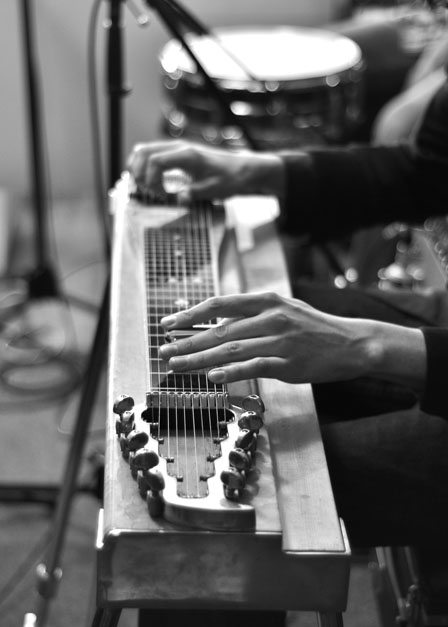
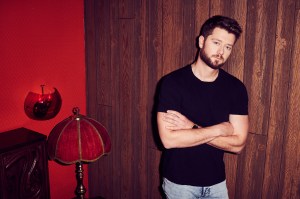
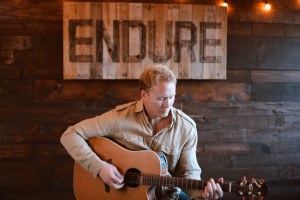
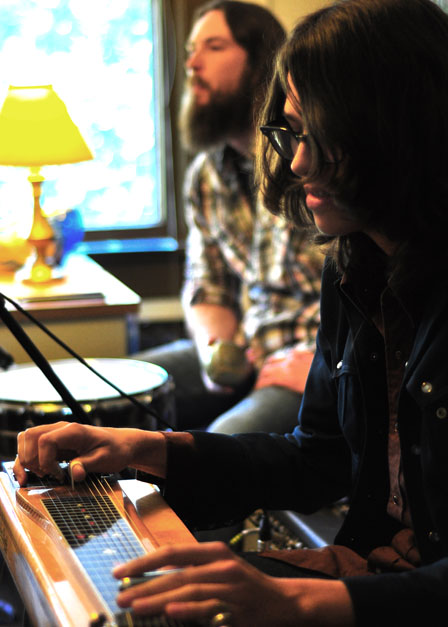
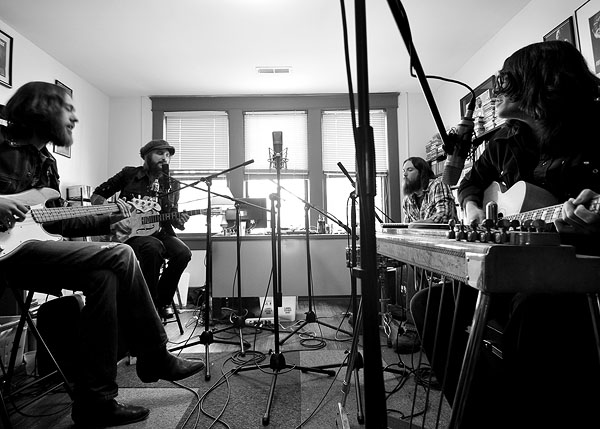
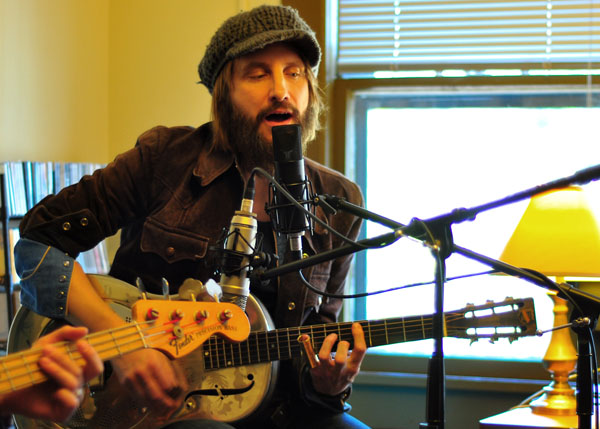
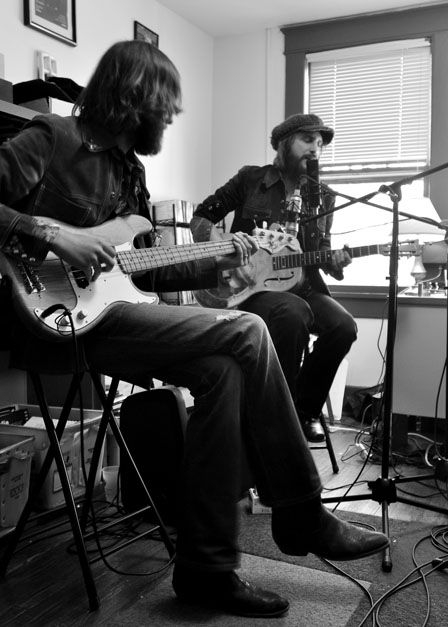
The Deadstring Brothers have somehow freakishly mastered the golden era sound of Exile-circa Stones. Though they playfully admit to their influences–guitarist Spencer Cullum, when asked about songwriting, jokes, “It’s stealing, really”–the fact that the band is made up of Americans and Brits, all weened on the same American blues, country and British Invasion rock’n’roll, gives their sound an alchemical authenticity. Bandleader and singer/guitarist Kurtis Marschke established the band in Detroit and only recently moved himself and the rest of the crew–the current lineup of Spencer on pedal steel and slide guitar, Jeff Cullum on bass, and new addition and Alabama-native Jason on drums as well as a rotating cast of keyboard players–to Nashville, Tennessee. The band is planning for their first west coast tour in the summer and will also play the Bloodshot Records party at this year’s South By Southwest festival in Austin, Texas. We talked to the guys about what it means to move to Nashville. Check out the live in-studio versions of songs off their recent Bloodshot Records release Sao Paolo and more.
[wpaudio url=”https://editorial.americansongwriter.com/wp-content/uploads/sites/7/2010/03/Smile.mp3″ text=”Deadstring Brothers – Smile” dl=”0″]
[wpaudio url=”https://editorial.americansongwriter.com/wp-content/uploads/sites/7/2010/03/The-River-Song.mp3″ text=”Deadstring Brothers – The River Song” dl=”0″]
[wpaudio url=”https://editorial.americansongwriter.com/wp-content/uploads/sites/7/2010/03/Deadstring_Bros_2.mp3″ text=”Deadstring Brothers – Talking Born Blues” dl=”0″]
[wpaudio url=”https://editorial.americansongwriter.com/wp-content/uploads/sites/7/2010/03/Deadstring_Bros_4.mp3″ text=”Deadstring Brothers – Sacred Heart” dl=”0″]
This session was engineered by Kyle Byrd.
So tell us how all you guys—from Detroit, England and Alabama—all got together? What are the bands origins?
In a nutshell, we met Spencer first in April of 2006. He had come out to a show, and we were talking. It was in London, and we were finishing [the tour] with a few dates left, and Spen was coming around to some of the shows. We were going back three weeks later to do opening dates for George Thorogood, so we were doing an eleven-show theater thing in Ireland and England, so Spen joined the band then. Then he flew back with us and toured with us the whole rest of the year. The band was the Starving Winter Report lineup. It was Phil [Skarich] on bass and Masha [Marijeh] singing and Trav [Harrett] on drums and Ross [Westerbur] was playing piano and organ at the time. The band has definitely turned into a family band, kind of, because a lot of people come in and out for tours and help out. But definitely, the core lineup is here.
In terms of songwriting, having members from both sides of the pond seems like it would legitimize, in a weird way, the connection to the ‘70s sound you guys draw on.
That’s exactly it. They [Brits Spencer and Jeff] kind of made the whole thing make more sense because we were drawing from American Outlaw, kind of ‘70s Willie and Waylon, the whole bit. Then a lot of that British country rock and blues rock. So the contribution just makes complete sense. It’s like a dream, you know? As soon as Spen joined the band, he started writing with me, it was just sort of, “Boom. That really happened!”
I remember the first time we [started writing together] was after that ’06 tour and we were winding it down and starting the next record. It was just me and him in the basement, and no one else wanted to. He was trapped in America, and he had two weeks off. He was stuck there, and we had to start the record. No one else was there. After eight months on the road, everyone else was gone. We just started putting it together–boom, boom, boom–and started recording.
Bloodshot Records seems like a great label for Deadstring Brothers: kind of a Midwest stronghold for alt-country. How did you get hooked up with them?
In late 2005, we were recording the Starving Winter Report record at our place in Detroit, and there were some conversations with [Bloodshot co-founders and owners] Rob [Miller] and Nan [Warsaw]. We were free to do stuff since we had licensed our first recording to a little thing in Detroit. When that thing went away, we were kind of ready to make a move and get out and really start to tour. We needed a label, and they had seen that we had history in Europe. They were interested in the recordings and what we were doing because we were doing it all out of our own studio. I think they liked the “do-it-yourself” thing that we were about and that we were going to go out and work it.
And Sao Paolo was recorded in Detroit?
It was recorded in our studio in Detroit. If you looked at the basement we had our studio in, you would just go, “Oh, they make records down there?” It’s just a little basement room. My business partner Dan is running the studio, and we’re toying with the idea of bringing the whole rig down [to Nashville]. That would be the dream. I want to bring the whole operation down here. We’re trying to work it out.
What’s the tour schedule look like for South by Southwest and the rest of the year?
We’re doing the No Depression showcase at the Continental Club on Saturday, the Bloodshot Day Party, then KDHX in St. Louis has a day party. I think there’s one other that’s going to come in in the next couple of days.
[For the rest of the tour], we’re kind of building the dates right now, and they’re putting together this thing out west, so starting at the beginning of June, we’re going to be out there. That’s all kind of coming together right now. We usually go over to the UK or Spain at least once a year. We’re kind of figuring out whether this fall we’ll stay here and work or if we’re going to go back over.
So tell us about moving to Nashville?
I’m excited about it. Growing up in Detroit and hearing about Nashville–and until we’d come down here and started playing–I had no idea it was as amazing as it really is as a music city. Jeff moved here, and it just seems to make so much sense for us to base the band here, touring out of here, and everything.
Geographically, where it’s located in America makes more sense than Detroit to tour from because the ten-hour radius around Nashville is much better than the one around Detroit. And just the community–we know there are a lot of musicians here. Like Spen was saying, the best players are here, so if you come here, you’re immersing yourself in it. You’re making the commitment to just saying, “Yeah. I’m going to feel a little sick going home some nights, but it’s okay.”
I told the guys when we were in Europe last fall, “I think [moving to Nashville] is the only option we have if we’re going to keep this going because of the distance between us all. And if you guys are interested–and Jeff was already here–I’m going to do it. I’d love it if we could just do it.” Again, it was one of those things where you were thinking, “Man, it’s just not going to work. It’s not going to happen. Something will mess up.” We’ve always had visa issues and these other things.
The weather’s nicer, and the style of music goes a little better in the South than up north.