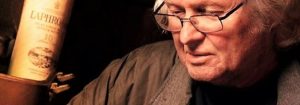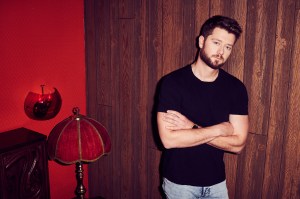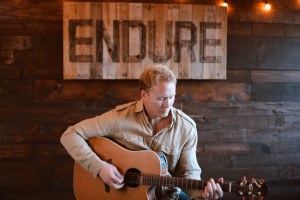
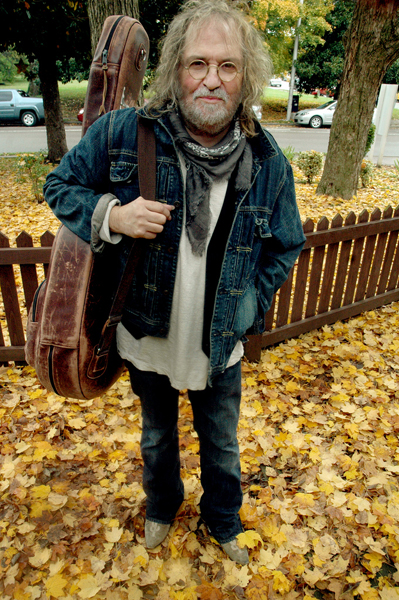
Ray Wylie Hubbard, the bard behind Jerry Jeff Walker’s classic ’73 cut “Up Against The Wall, Redneck Mother,” was visiting Nashville, up from his home outside of Austin, Texas, when he stopped in to discuss his new album A. Enlightenment B. Endarkenment (Hint: There is No C). The album features the title cut (inspired by his favorite Poe poem) as well as the co-write with Hayes Carll, “Drunken Poet’s Dream,” also the first cut on Hayes’ 2007 album Trouble In Mind. Hubbard discussed life in Texas as an elder statesman of songwriting, what it’s like taking guys like Hayes under his wing and new tools like e-mail (!) and Masterwriter that keep his songwriting fresh. Take a listen to three live tracks that Hubbard recorded in our office and, below the interview, check out the video of Hubbard playing the album’s title track.
Audio and video for the Ray Wylie Hubbard session was recorded and edited by Kyle Byrd.
American Songwriter: What was the process like for finishing the lyrics to “Drunken Poet’s Dream” with Hayes via e-mail? Did you already have a lot of the framework and melody?
Hubbard: Yeah, yeah. We had the melody and he kind of changed it up a little bit too, which I kind of preferred, rather than being in the same room with Hayes, to tell you the truth.
(Hubbard’s wife Judy interjects: “We tell people we found him on our doorstep in a little basket, that’s how we met him.”)
How’d you get the “Louis L’Amour” line? Who came up with that?
Man, I tell you what I really don’t know. I think we were just really scrounging around and Hayes turned me on to that thing called Masterwriter.
Yeah, we love Masterwriter.
Yeah and I thought well that’s gonna take away the inspiration but then he turned me on to that. So we went over there and started writing and all of a sudden there it was. The great thing about it is the rhyming dictionary and everything was right there and so, to tell you the truth, I really don’t know who came up with that line. We were throwing out lines. We had the first verse and the chorus and then kinda after that it took on a separate identity of whoever was writing at that point. Whatever I wanted to say, that’s what I was gonna say.
It’s a great line. You don’t hear lines like that enough in country music these days.
Yeah, well then I wrote it. If it’s a great line then that’s probably what I wrote. (laughter)
Definitely. So you’ve been writing with a bunch of younger guys like Hayes?
Yeah, Hayes and Slaid [Cleaves] and, oh gosh, a bunch of others. Stoney LaRue and Bill Emerson, Cody [Canada] and all those guys, kinda that Texas.
How did those types of co-writes, with the next generation of Texas songwriters, start?
Well, it’s really kind of cool ‘cause I can just intimidate them for whatever reason that is.
Are they scared?
I don’t know that they’re scared. The thing I like about these guys like Slaid and Hayes is that they really put [the work] into being songwriters. That’s really important to them to have a lot of respect for the guys who write their own songs. And so it’s a level playing field when they come in. You don’t have to worry about any embarrassment like, if somebody sings a line and somebody goes, “Oh, well that sucks we don’t wanna do that.” It’s like the song will tell you when it’s the right line so it doesn’t matter who wrote it. So I don’t know, that’s been really fun for me. They’re songs that maybe I wouldn’t have written otherwise.
Is it specifically a connection to Texas songwriting or does it just happen to be that Hayes lives nearby?
Well, I don’t wanna leave my house. So geographically they come to [my] area. (laughs)
[Judy Hubbard adds, “They come to Mt. Carmen to write with the ‘Wylie Llama.’ Or that’s what they say.”]
I really have such respect for these young guys because there’s this kind of plateau, especially with the Texas thing. Guy Clark, Billie Joe Shaver, Townes Van Zandt — those are kind of the big three that everybody’s aware of and the [younger songwriters] know they may never surpass them, but they try to have that quality of writing. They have to aspire to [write like that] and that’s the great thing about that area and running around with those young guys is that they’re aware of the tradition and the history of the songwriters of that caliber. It’s good to know when they come in there, that we’ve got to try to write something good.
Are you writing with guys like Billy Joe Shaver too?
No, I haven’t written with Billy Joe. Billy Joe’s one of those guys, I don’t know if he collaborates at all. I see Billy Joe and do some gigs with him but we never have written together. We just hang out together, unfortunately. But to have someone who’s still writing valid songs [like Billy Joe] and that’s the thing that I think with me too. The older you get I guess, for me, I’ve learned how to be able to write what hopefully are valid [songs] and still record.
Totally, I think a song like “Drunken Poet’s Dream” could’ve been written in 1970. It’s like that classic instantly.
I tell you this real brief story. I played the Hardly Strictly Bluegrass Festival a few years ago and I was out in San Francisco. So after I did my set this young guy came up and he said, “Mr. Hubbard, can I talk to you for a minute?” And I said, “Sure.” And he said, “Well, can I tell you how inspiring you are?” And I said, “Yeah, go ahead.” And he said, “I play mandolin and bluegrass and I just really enjoy watching and listening to your lyrics and what you’re doing, I just really respect your commitment that you have to what you’re doing. Please don’t take this wrong but you’re an older guy, you’re still writing these songs and taking that guitar and that case and flying and traveling and performing them and making records. I just really admire your commitment. I hope to have that commitment someday.” And I said, “ Well, just never learn to do anything else.” (laughter)
So that’s the secret?
Yeah, and you too can have this commitment. Kind of like when your parents said go to college so you can have something to fall back on. Don’t do that. Just do this. (laughter)
Is that the kind of advice you give to Hayes and Slaid?
I don’t know if I’ve really given them a lot of advice. Like I’ll show them some tricks and Hayes, I think he was pretty much a strummer, and I showed him some fingerpicking and some stuff like that that really kind of opened up some doors. For me, when I learned how to fingerpick, these doors started opening up so I said, “You just need to learn some different patterns and stuff” and he took it and started writing these great songs that he maybe wouldn’t have written hadn’t he learned that particular pattern. I enjoy doing that. That’s fun.
What do you think you’ve learned maybe from them?
The thing is I think seeing their inspiration and their desire, they believe in what they’re doing. Like I said I really respect that they’re taking the time to give the song the time and effort and care that it deserves. I think both those guys are really taking the time to really get that craft, to learn the craft of it. Inspiration plus craft and that’s very important that they’re taking the time to really learn how to do it and how to do it right.
That’s cool.
Yeah I like those guys.
Well, did you co-write on any of the other songs on the album? I don’t have the liner notes yet.
“Drunken Poets.” And I wrote a song called “Day of the Dead” with the guitar player Billy Cassis, the guitar player in Soulhat. He came up with just this horrific punk riff, so he came up with that and I put the lyrics to it. But most of the stuff on the new record except for “Drunken Poets” and that are all just me.
After you co-wrote “Drunken Poet’s Dream” using Masterwriter with Hayes did that change your process at all for this album? Or did you really write it the same way you have in the past?
Songwriting is inspiration plus craft. Right, that’s the deal. So the inspiration being called the great “A-ha,” where you go “A-ha! That’d be a great idea for a song!” And then taking that inspiration and putting it to the craft of like, “Well, this is a 12 bar blues, it needs to be this chord with no 3rd, or it needs this to make that.” And so I’d always kinda learned too that the craft will trigger the inspiration like learning something new, especially for me, like learning bottleneck slide or a different open tuning, or just some sort of groove, a blues groove, so that that craft — if you don’t have that inspiration — you can play and then that will trigger the inspiration. So that was really good. It was the first record where I actually sat down and wrote songs with a purpose. A friend of mine, a guy named Tiller Rusell, a young director, he and I wrote a screenplay and so I was scoring it and there were certain scenes in the movie that we needed songs for, so it’s like the first time that I sat down and said, “OK, I need to write a…Pentecostal hymn for a funeral,” and so I sat down and did that.
Did you have to research what a Pentecostal hymn would sound like?
Well a little bit, but then there was scene in there where they come up to this tent and these people and they’re smoking opium so I didn’t research that, I read about it. (laughter) So that was really a comfortable place to be, knowing that because I have a history with songwriting, that I could write a song that would fit a particular title or theme or idea. That was really good for me to get in there and do that.
Was that your first foray into film writing?
Yeah.
And you just started writing the screenplay?
What happened was this: I had the record out Snake Farm and I met Tiller through a great writer, Chuck Bowden, who’s just written all this Blood Orchid and everything, and so he introduced Tiller and I. So Tiller came and filmed the “Snake Farm” video and we started talking and he had just graduated. And we were just both fans of Peckinpah and dark, weird independent movies and so we just kinda kicked around ideas and we spent about a year writing. He would come to Texas and we’d go down and we’d spend five days writing, from nine in the morning to midnight. I mean we did that and then I went out to L.A. and we did that. We were writing all the time, even when they were filming it. Then once they got the budget it was a lot less than we had written, ‘cause we had written, we just wrote it with carte blanche. But once they got the film budget and everything, [if the script said] “burning the hacienda,” then we’d say in the movie, “There’s just a big house that burns.” Finding out things too like each horse had to have a wrangler plus insurance plus a stunt double plus costume so each horse was like $1,200 a day. So what do we did instead of having four bad guys on horseback, we had two really bad guys on horseback. (laughter) He’s gotta be really scary because we couldn’t afford to have four. But learning all that was really good for me too. And I think, like I say I’m an old guy, but it’s really important for me to keep learning new things. I think that’s really important, especially writing new songs, coming back to learning slide and open tunings and mandolin and just those open doors for these little songs to come through.
There’s the scene [mentioned above] in the movie where these people show up and one of the kid’s been hurt and they come up to this kind of tent and it’s Peter Dinklage and these Siamese twins who are going to perform and they go in there and they’re smoking opium. So I read the Chet Baker story and got a lot of ideas from that, ‘cause man that was just such a tragic thing. So I got my research through that rather than having to go out and do it. It was kind of just one of those things where we said, “How are we going to do that?” And then the line came to me “makes the deep things appear” and that’s why you’d want to [smoke opium]. So it was kind of funny. You know, the weird thing about it is I’ve written songs and had other people record them from Slaid and Hayes and Pat Green and Jerry Jeff and Bobby Bare, which is really cool. But what’s really cool is when you’re watching a movie and all of a sudden you see Kris Kristofferson say a line that you wrote in your living room, that’s really cool. That’s pretty amazing, that’s wild right there. Then the first time when you see it, you hear the music come on and do that… it’s pretty…it’s a unique feeling.
Very cool.
Yeah, it is. I’ll keep you posted on [the film].
Do any of the songs off the album appear on the soundtrack as well?
Well, this is a song on the credits and it’s also the title of the album and it’s just, we just needed something when they’re burying a guy and the credits are rolling. We needed a song to kind of come out of it so I’ve been reading some Edgar Allen Poe and one of my favorite poems of all time was “The Raven.” It’s one of those weird things that actually came to me in a dream. I’d been reading “The Raven” and I just love that poem and so I was just laying in bed and all of a sudden I just started thinking, “Well, what would happen if this bird landed at the foot of my bed? What would it say? It’d say A. Enlightenment. B. Endarkement. Hint: There is no C.” And I went, “Wow, how weird is that?” And all of a sudden I remember a line my grandmother said when I was a kid whenever something would go wrong she’d always just say, “Heaven pours down rain and lightning both.” Rain falls on the just and the unjust… always remembered that line somehow. Plus as you probably notice I’m at that age now where I’m writing songs that not only do they not change chords, they don’t even rhyme. (laughter) And just think of all that time I wasted trying to rhyme songs. Now you don’t have to.
Your songs have just distilled into the primal elements with that real bluesy melody.
I’m really happy with the record, I really am. On that song right there I had Kevin Russell and The Gourds come in and play mandolin and sing on it and Gurf Morlix played guitar on “Drunken Poets” and Billy Cassis of Soulhat played on a couple of songs. I had Derek O’ Brien, the great blues guitar player there in Austin, play and Seth James played on a track. David Abeyta from Reckless Kelly came and played guitar on it and George Reiff produced it with me, the guy who is a bass player who did the last Jakob Dylan tour. He goes out with Chris [Robinson] on New Earth Mud. So he’s got a studio there so we cut it with him and my son Lucas who just turned 16 played guitar on a couple of tracks.
He played guitar on Snake Farm too. He played a solo on “Old Guitar” right?
He’s my full time guitar player during the summer and when school starts I go to a trio. So it was really good. Rick Richards, of course, played drums. He played on my last four or five records, so he’s the guy there and then Jordan on bass. And I think that’s about everybody. Buck Allen played some keyboards and a group called The Trishas out of Dallas sang on a couple of tracks.
I’ve seen them before. I think maybe at the AMAs or somewhere. Which studio?
We did it at George Reiff’s studio at his house. See he has ProTools but he has all these old mics and all these old tube amps so we really did it that way. We did it at his place and some at Buck’s and some at Gurf’s place. Yeah, it was fun. George is a great, great produce and engineer.
So that was the last song from the film…
And it’s the first song on my new record. I feel good about the record and hopefully the movie will be out next year. They’re trying to figure it out. I think the record comes on January 12th and then we’ll see what happens.
Sounds like it should be a good year. Lot of stuff going on.
Well, like I say I’m an old guy and I’m out on the road and I come home and my wife Judy duct tapes me and sends me out again.
ON HIS GUITAR:
This is the [Gibson] True Vintage. I just got it. It’s what they call the True Vintage and I just love it. I love it to death. I played one and I had to have it. I had one of those Southern Jumbo Woody Guthrie but this one I just love it. Have you seen the Legend? That’s the one I want next.
We have it in the office right now.
Really?
We have the 1942 Legend.
I’m probably going to try to have them make me one with that neck and have the mahogany, because I think the Legend has the Madagascar rosewood, I think. I’m not sure but they’re good. I couldn’t quite afford that one.
[wpaudio url=”https://editorial.americansongwriter.com/wp-content/uploads/sites/7/2010/01/Ray_Wylie_Hubbard_1.mp3″ text=”Ray Wylie Hubbard – Drunken Poet’s Dream” dl=”0″]
[wpaudio url=”https://editorial.americansongwriter.com/wp-content/uploads/sites/7/2010/01/Ray_Wylie_Hubbard_2.mp3″ text=”Ray Wylie Hubbard – A. Enlightenment B. Endarkenment (Hint: There is No C)” dl=”0″]
[wpaudio url=”https://editorial.americansongwriter.com/wp-content/uploads/sites/7/2010/01/Ray_Wylie_Hubbard_3.mp3″ text=”Ray Wylie Hubbard – Opium” dl=”0″]