(Photo: Shervin Lainez)
One day, some forward-thinking university will probably hire Amanda Palmer to teach a class about how indie musicians kept their heads above water during the early 21st century. She could share the numbers from her record-breaking Kickstarter campaign — the one that raised 1.19 million dollars to help fund her second solo record, Theatre Is Evil — and rehash her battle with Roadrunner Records, the one in which she convinced the label to drop her by writing a song called “Please Drop Me.” Until then, she’ll continue juggling the jobs she already has — Dresden Doll frontwoman, solo singer/songwriter, social media queen — and talking to magazines like American Songwriter. We tracked her down last month to get the story behind her new album.
How’s your day going?
Fantastic. I’m in a beautiful house in the middle of nowhere in upstate New York, next to Bard College, where I’m about to embark on a two week tour rehearsal with my band and a bunch of tech crew.
What’s the tour going to be like?
It’s gonna be pretty spectacular, but we’re also trying to maintain an element of surprise. We really want people to come to the tour, though, so we’re basically saying, “You should come; it’ll be really good! Just trust us!”
You’re having local horn players perform at every show, right? How do you rehearse something that’s going to change each night?
We’re rehearsing a giant skeletal structure, on which we’re gonna hang a bunch of local material. But that’s also why we’re taking two weeks to rehearse. We’re practicing everything from camera moves to the way we’re gonna fit a horns and strings rehearsal into every two-hour soundcheck.
Does that kind of spontaneity make you anxious?
I’ve got an impeccable crew, so I trust them with my life. I’ve gotten to the point where touring is just touring. It’s never anything to be nervous about. Everything fucks up, and everything breaks, and nothing works, and there’s no power, and the video person gets hit by a train, and my guitarist runs off with an exotic dancer… Everything can, and will, fall apart. But even if the whole tour falls apart, as long as I have my piano and a ukulele, I’ll be fine. I have that safety net. I’m an entertainer and can make do with anything. But I’ve been touring with a piano and a ukulele for three years, and I’m getting a little sick of it. I’m ready to do a big, expansive, theatrical explosion for awhile.
The album has a big, expansive, theatrical sound as well. Did you write these songs alone? What’s it like to write an expansive album by yourself?
Every single one of the songs was written alone, on a single instrument. Arranging them was different issue. All of the songs were written on piano, except for “The Killing Type,” which I wrote during a walk in Amsterdam. Late one night, I couldn’t get a cab and just decided to walk back to my hotel. I heard the song in my head, and I knew it was going to be really simple and stripped down. I got back and plucked the chords out on my ukulele. That’s the beauty of the ukulele, especially since I can’t play it very well: there’s no danger of overcomplicating anything. “The Killing Type” is just a simple, simple song, with four chords and no flourishes. Nothing extra; just the facts.
Apart from “The Killing Type,” did you write these songs with the full band in mind? Did you know what kind of album this was going to be?
No, it worked the other way around. I kind of take direction from my songs; they don’t take direction from me. I write what comes into my head, and I stand back, and at a certain point I have a large pile of songs that have been written since the last time I released an album. In this case, the pile was pretty high by the end of 2009. I looked at the pile and said, “Ok, what’s this going to be. What kind of record is this? What do the songs ask for?” And they were desperately pleading for a full rock band. The songs needed guitar, they needed synth, they needed a strong rhythm section. It was in the DNA of these songs to be rock songs. I could’ve looked the other way and put out a really powerful, stripped-down piano album, and probably saved myself a couple hundred grand in touring expenses, but that’s not what the songs were dictating. They needed a full band.
In the majority of cases, I had a really clear picture of what I wanted the sonic end-result to be. With songs like “Smile” and “Want It Back” and “The Killing Type” and “Lost,” I had a finished painting in my head. I just needed to direct the band and the producer to make sure the painting could be as close a replica as possible to what I was already seeing. But there were other songs like “Bottomfeeder” and “Grown Man Cry” where I knew I had a good song, but I didn’t have a strong vision for how it should be produced. With those songs, I had a blast. I brought them to the band and we hashed it out. In those moments, the band absolutely shone like diamonds. They were such brilliant musicians. I felt like I was riding on the shoulders of giants.
You’ve played with a lot of musicians over the years. What can these guys do that other musicians can’t?
Part of it is we’re all on the same psychological page. These guys are theater dorks. They aren’t just showing up and playing their parts. They understand that being onstage with me is part of a huge art circus, and you can’t just stand there and play. You have to enjoy it. These are guys who love being onstage and love when I throw them a nutball idea. They don’t shrug and say, “That sounds really weird, but if you want to do it, then fine.” They’re game. I needed a bunch of freaks onstage. Anybody can just play the parts — these songs are simple — but not everybody can be performers, especially performers in the correct spirit. I’m always trying to serve a higher purpose, and using music as a way of connecting people together, and everyone in the band has to be on that same page or it just doesn’t work. With them, it works.
Which song are you most proud of?
“The Bed Song.” I think it’s the strongest song I’ve ever written. When I finished writing it, I kinda stood back and looked at it and said, “Holy fuck, how did I do that?” As a songwriter, you’re lucky if you get one of those every couple of years. I got the idea for the song because of something someone told me in passing, about being in a relationship where their spouse just wanted to get a bigger and bigger bed, so they wouldn’t have to touch while sleeping. That’s the saddest thing I’ve ever heard, but it’s such a perfect image for a song: the idea of being in a giant bed and not touching, of the bed becoming this organic thing that grows wider and wider until it’s surreal. So I was holding that idea in my head, then I decided one night to sit down and nail it. I hate being disciplined, but I know that my songs are better if they’re written in one sitting. I need to put my ass in a chair and not get up until the song is finished. Usually, I’ve always felt it’s my responsibility to turn off the phone, shut the door, and close down the computer so I can write. I need to rid the room of distractions. This time, I decided to do an experiment, and I didn’t shut anything down. Instead, I Twittered to my followers that I was about to sit down and write a song, and I updated my feed during the entire songwriting process. I didn’t say what I was writing. I didn’t ask for lyrics or songwriting tips. I just documented the process. I just started Twittering all these things, asking for support in the moment, and my twitter followers showed up in the hundreds, cheering loudly. I was there, scribbling furiously, tweeting pictures of myself sitting by the idea, surrounding by my piles of paper. Two hours later, I finished my song and announced to Twitter that I had just created the best song of my career. And I thought, “Maybe I’ve been wrong all this time about not wanting to work with distractions. Maybe some distractions can be valuable.”
It was a massive psychic shift for me. You have a way that you work, and tools that you use, and if you just approach songwriting from a “whatever works” perspective, you can do anything. I think as songwriters, we’re led to believe that there are these rules we have to follow. These environments, these tools of the trade that you just have to accept… when in fact, everyone has a different process. The onus is on you, as the artist, to figure out what works. Don’t let someone else dictate how you’re gonna write a song. Also, you’re fucked if you think it’s not gonna change. What works on Monday isn’t necessarily what’s going to work on Sunday. The best songwriters are the ones who come to realize they need to serve their own process, and get rid of the fake myths they have about what the artistic process is supposed to be. Because there isn’t one. Ultimately, you answer to your yourself, your own process, your own muse. No one can do that work for you.
Most Viewed
-
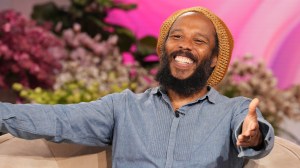
BURBANK, CALIFORNIA – MARCH 25, 2026: Grammy-winning musician Ziggy Marley appears on "The Jennifer Hudson Show" airing April 29, 2026 in Burbank, California. (Photo by Chris Haston/WBTV via Getty Images). Check your local listings for times.