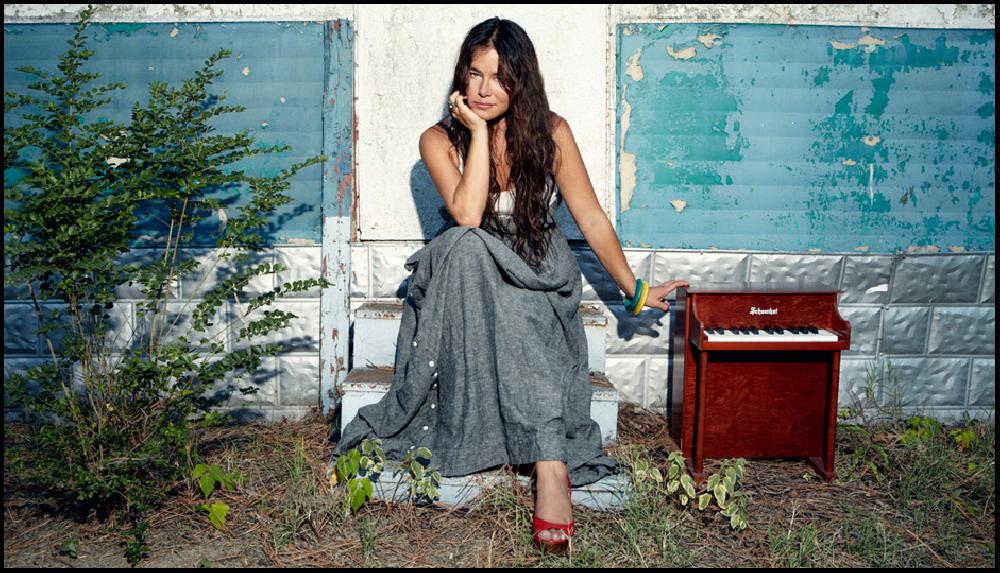
On October 11, sultry singer-songwriter Rachael Yamagata will release her latest album, Chesapeake, on her own Frankenfish Records. The new disc was funded by her loyal fans through a PledgeMusic campaign.
We’re proud to bring you the premiere one of our favorite tracks from Chesapeake, the lyrically inventive “The Way It Seems To Go.” Take a listen, and read our interview with Yamagata on her new album below.
Tell us a a bit about writing “The Way It Seems To Go.”
I wanted something with a little bit of a sense of humor about it. I remember talking to my previous A&R guy at Warner Bros. He just kept saying, “you’re such a light-hearted person, you’re funny on stage, you have this other side of you that you don’t really show, or haven’t shown yet in your records about your personality. He encouraged me to explore that a little bit in song. So that song was me trying to plug into my basic personality and be very realistic about my goofy nature, and it’s very autobiographical. Lyrically, it’s true to form to how my life just seems to develop. It made it sort of a fun, musical setting for it because it’s got that nature to the lyric.
Did it come out quickly, or did it take a long time?
Super quickly, actually. And I didn’t even know if it would make the record. It’s harder to assess lyrics that are so basic about your own life, so I didn’t even know if it would resonate with anything else. And, we played it live twice while I was doing a residency up in Woodstock, and people just loved it. So, we ended up recording it. But, it was very fast. When I wrote it, the lyrics were just like, well, let me describe everything about my life. And it was just very easy to tap into.
How would you describe “The Way It Seems To Go” musically?
Like a porch jam [laughs].When we were working it in the studio before I recorded it, we were out on a front porch and had upright bass and cello and a little Casio keyboard and a Dobro guitar, and it had a spontaneous, everyone’s-at-a-party-and-picks-up-an-instrument feel of it. It had a real, old school, jam vibe to it.
Do you have a standard approach to songwriting?
Not really. I have a standard scenario. It’s usually in the middle of the night. I don’t know why, but I seem to write at like 4 in the morning. Music and lyrics usually come together at the same time. There are the occasional songs where I’ll just hear a line in conversation or have an idea, and I’ll scribble it down on a piece of paper so I don’t forget the basic idea and revisit it later. But, I tend to write late at night, by myself, that kind of thing.
Do you feel it gets harder, the more songs you write, to come up with the next one? Or does it actually get easier?
I worry about that. I write all the time, in terms of when I get a block of time to really sit down and just let it all out, when I’m not on the road. So, I’ll come into a record with over 100 songs to mess around with. Sometimes I worry, “What if I don’t have any more interesting ideas or a way to approach a situation that hasn’t been done before?” That’s when I put the guitar down, and walk away from the piano, and try and live life with it, and go on an adventure, because I think that’s what inspires the content for songs.
You never know. Some things come so quickly, and you’re like, “Where did that come from? I had no plans to do a song like that, but thank God”. Like I said, I just have to keep my life, stay authentic and in the moment, and keep it exciting [laughs] so there’s something good to write about.
For this album, you raised the funds from fans through PledgeMusic. Does that change your thought process when you’re making the record? Does it make you want to tailor it to your fans in any way?
No, no, not at all. The thing that my fans in particular are so great about is that they trust my take on things. I think people resonate with me being vulnerable and honest and frank on stage and in my writing. For me to try and garter any song in a direction to please anybody else would not be the right place for me, and it wouldn’t resonate with them either. I know plugging into my perspective on it, my interpretation of it, my experience of it seems to connect with something universal that’s in everybody. At least, with my fans.
So, I don’t think they’d ever want me to cater to what they want, because that’s like a painter standing over your shoulder. Nobody wants to help you paint if they love your work, they just can’t wait to see what’s next.
I imagine that, if someone puts the money down, they’ll probably feel a certain pride in the record.
I think so. I mean, that’s the great thing about Pledge is that you can have people be a part of the whole experience as its forming, you can show them what’s happening as you’re going along. It’s all things that I would be interested in knowing about an artist I was a fan of, and I’m always curious, “What do they do in the studio? Do they write in their pajamas? Are they a morning person? Are they wasted when they’re singing?” There are so many different behind-the-scenes things that would be intriguing to know about the process. So, Pledge just lets you be a part of it, and it’s structured so it’s giving you a million and one extra things, as well as the record. Which you hope people would be interested in anyway. So, it’s a backstage pass. And it’s gone surprisingly well, and it’s given me a lot of energy and enthusiasm to get out and play live and all of those things.
Any good stories behind any of the other songs on the record?
“Even If I Don’t” is one where I definitely plugged into two of my friends and their relationship. Well, a relationship I was in, and then a relationship two of my friends were in.We kind of had this parallel experience in our relationships. I think even one of them said to me, “They cry in the mornings”, or “I miss her in the mornings”, or something like that.
And I really loved that idea of waking up, and that’s your time to reflect on something. When you’re alone, and you’re starting to date, and you realize you’re not with somebody. So, that was fun. There’s a song called “I Don’t Want To Be Your Mother,” which was almost a joke song, at first. I was writing with Mike Viola, and had gotten off a fight phone call with somebody, and literally just said, “can we write a song called “I Don’t Want To Be Your Mother?” I was just joking, and he’s like “yes, of course”. So, we wrote this song that plugs straight into The Carpenters in terms of the production and chord progression.
Mike’s one of my favorite co-writers. I tend to shy away from that because I get pretty attached to my lyrics and point of view, but for whatever reason, he and I mix really well when we do songs together.