
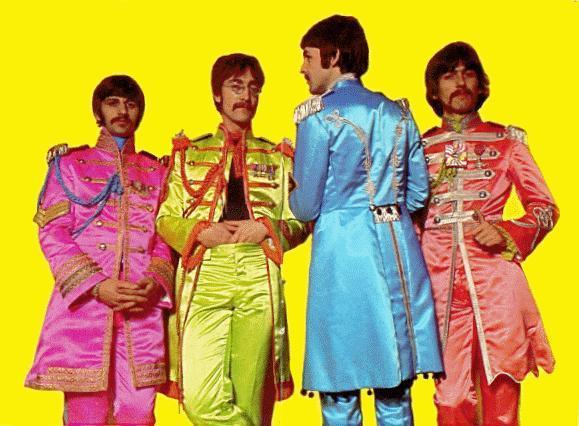
It was twenty years ago today that Sgt. Pepper taught the band to play, but it has only been a year since the debut of the SongwritingABCs channel on YouTube. Nevertheless, a modest celebration is in order, because we recently completed the step-by-step play-throughs of examples from Lesson 1 on rhythm and released four videos on the dialog games (nos. 34 – 37). The dialog drills are the heart of the course, so everything up to this point has been mere prelude.
This is not to discount the first 33 videos, which give everyone a firm foundation in reading rhythm and other important musical skills. But the dialog games will begin to alter your musical consciousness. I thought I’d take this blog to describe how. Yes, there will be some overlap with the content of videos 34 through 37, but you will also find some new information and a preview of coming attractions.
The Primary Goal
As mentioned in video 27, the paramount goal of the dialog games is to repeatedly “get in the zone,” that mysterious, but highly desirable state of mental clarity and effortless creativity. Video 36, the first of the dialog drill videos, is a continuous performance of one-measure rhythmic examples at 62 beats per minute – no talking at all, just rhythm. It lasts about 15 minutes, which is time enough to achieve the primary goal.
Having said that, the material you have to work with at this point is severely limited, and that is intentional. I cannot stress this enough: It is better to do all you can with limited musical material at first. Many of you know your way around guitar or piano or another instrument, and if so, chances are good that you will not like these limitations. You will want to add harmony and melody, because, after all, you can. Well, don’t worry – that will happen soon enough.
What you are doing right now is something new: upping your Musical Imagination Quotient (Musical I.Q.). Musical imagination is a quirky beast. It combines the precision of mathematics with the limitless possibilities of the musical soundscape, which have never been exhausted in over 700 years of artistic endeavor. Examples of an astounding Musical I.Q. include Beethoven, who composed his greatest works while deaf, and Mozart, who could compose symphonies while engaging in a dinner conversation, then run to his table and write down every single note at breakneck speed, without a mistake. Obviously, they could hear harmony, melody, and rhythm in the theater of their minds before putting their fingers on a keyboard. These are the most remarkable and intimidating examples of a high Musical I.Q. in history, but the same kind of genius can be found among the pop and classical composers and singer/songwriters of today.
Achieving a high Musical I.Q. on a much more modest scale is well within the reach of every reader of this column. How much more modest? Two measures’ worth – that’s all. The ability to “futurize” two measures of harmony, melody, and rhythm is all you need to compose a credible song or solo. But please note: Musical I.Q. is independent of your instrumental prowess. It is entirely a matter of imagination. You can acquire it through a combination of talent and years of taking lessons, playing gigs, and writing music, or you can take a shorter, more direct route through the dialog games, which flex only the relevant mental muscles.
Playing the Games
Each one-measure example is followed by three measures of silence (except for the metronome clicks) in which you can play any of the four dialog games:
- The Parrot Game
- Q&A
- “As If”
- Word Play
The three measures of relative silence are called “the gray zone” because the video goes gray. The gray zone means it’s your turn to play.
The “dialog games” will be familiar if you have ever taken a language class. First, there’s the “Parrot Game,” which is pure imitation. In a French class, for example, the teacher might say, “Listen and repeat: ‘Bonjour, monsieur,’” and you would reply, “Bonjour, monsieur.” Such drills are designed to perfect your pronunciation and bolster your vocabulary. At this stage of the dialog games, you are using one-measure rhythmic examples to enhance your ability to model time and sound in your mind. You are also acquiring a vocabulary of one-measure rhythms that you can deploy without a thought in songwriting.
In the next game, “Q&A,” you reply with a variation. In French class, you might reply to “Bonjour, monsieur” with “Bonjour, mademoiselle.” In the dialog game, you respond with a one-measure rhythm that is a variation or contrast based on the example. The trick is to futurize the rhythm (plan it) before you play it. You should be thinking of whole measures, not chasing the metronome, responding beat by beat.
Since the example is repeated, you can test your memory by repeating your response. Or not – it’s up to you.
The third game is called “As If.” It is the same as “Q&A,” but you act “as if” you were communicating some emotion. Getting into the mood for a round of “As If” isn’t hard. You can think of a hit song, for example, that projects an interesting emotion, and try to communicate the same thing with your improvised rhythm. Another technique is to reach back into your memory for an emotionally-charged moment, meditate on it a moment, and then act “as if” you were feeling something similar right now.
A light emotion is just as good as a heavy one and probably a lot more accessible for make-believe games. I hate to repeat a cliché so often heard in songwriting classes, but ideas really are everywhere. For example, you might notice your cat sleeping in a pool of sunlight streaming through the window in the afternoon. If you were a singer/songwriter named “Donovan,” you might take this moment of peace and calm a step further and use the image as an evocative symbol (see “Summer Day Reflection Song” on YouTube).
The virtue of the “As If” game is that it sidesteps the self-consciousness task of sitting down and compelling yourself to come up with song ideas. Instead, it is playful, resulting in a dreamy state where ideas flow freely.
There is even more free association in the fourth game, “Word Play,” where you simply fit syllables or words to the example rhythm. They can be complete nonsense, but you will undoubtedly find a few gems in the mix, so keep a notebook handy to jot down ideas.
All we’re doing with all four games is breaking the ice with the act of songwriting. If you’re new to the game, an assignment such as “write an eight-measure verse” can be completely overwhelming. Worse, it associates a feeling of strain with the act of songwriting. Even the word “assignment” engages the wrong side of the brain. The purpose of the games is to encourage unlimited creativity with limited (but ever-evolving) materials. This encourages playfulness and discourages intellectualization.
Benefits from Playing the Games
Elementary they may be, but the games produce noticeable benefits right away:
- If you are used to surfing the rhythmic waves of a song without much awareness of what is ahead or behind, you will begin to hear their rhythmic structure in bold relief, like you have never heard it before. (In order to reap the full benefit, you will need to do some of the focused listening exercises described in Excerpt 1.)
- After playing the rhythmic dialog games for a few weeks, you will notice an improved ability to generate rhythmic forms of time from within. This will be an indicator of your growing rhythmic vocabulary and a sharpening precision in your rhythmic expression.
- Doing the drills, particularly fighting against the limitations, sets up a fermentation process. Soon, ideas will begin bubbling up from nowhere. That is, you will start to hear new rhythmic ideas, and eventually new melodies and harmonies, whenever your mind drifts into idle. For example, lately I’ve been “hearing” bebop solos and “Heart and Soul” (I – vi – IV – V) songs over the “tick-tock” of the turn signal in my car. They are not tied to any music in the car; they’re just part of the fermentation process triggered by dialog drills. Blurry music coming through the bathroom door when you’re taking a shower can also be a great source of ideas. Eventually similar things should start happening to you.
How to Get the Most Out of the Dialog Drills
Here’s a plan to get you started:
- Listen to each rhythmic example, pause the video, and write down the rhythm. The answers are given in the next video (no. 37, in this case).
- Replay the video and play the Parrot Game. Just “listen and repeat.”
- Replay the video and play Q&A. Do this once a day for three days.
- Replay the video and play “As If.” Do this once a day for three days.
- Replay the video and play the Word Game. Do this randomly over the course of a week.
Upcoming Videos
The first dialog-drill video was performed at the leisurely tempo of 62. Slow tempi such as this allow you plenty of think-time. There will be two more 15-minute videos with the same type of rhythm, but at medium and fast tempi. These will press you to get into the zone more quickly.
Another group of three videos will explore pickup beats at various tempi.
The final group of three videos will use “rolling wave” rhythms, which have been described elsewhere. They are like pickup rhythms, but with rests, typically a full measure of rests, on either side of the “wave.” Rolling waves are popular in hit songs, probably because they play so well in a moving automobile.
All-in-all this amounts to over six hours of dialog drills on rhythm. We will stick with 4/4 meter throughout. I’d like to create dialog drills for cut time (2/2) and other meters, such as 3/4 and 6/8, but this would impede progress into “Elements of Harmony” (Excerpt 2), which is coming up next.
Outro
Enjoy. Feedback welcome: just email composeyourself@live.com. I’ll respond as quickly as I can. Your email may become the subject of a column or a blog. Incidentally, the November column will appear on the American Songwriter website, rather than in the magazine. I will begin 2015 with a new series on phrase construction. This is where the “game” really begins to get interesting.
More Album Reviews
-

Photo via cover of ‘Butter Miracle, The Complete Sweets!’ by Counting Crows -

Photo by Will Von Bolton -

Will Heath/NBC via Getty Images