
2015 failed to yield a single platinum country album. Wanna know why?
The year I moved my family to Nashville (1995) kicked off with “Pickup Man” by Joe Diffie enjoying its final week (of four) at number one. This smartly crafted shuffle was the second consecutive chart topper from Diffie’s second consecutive platinum album, Third Rock From The Sun.
With a warm, elastic voice and almost limitless range, Diffie was a country singer’s country singer. Unfortunately, however, his portly build topped by a mullet-framed face resembling a moon pie with a mustache made “Average Joe” an unlikely candidate for superstardom. Regardless, these were good times for the ultra-talented singer and his label, Epic Records. Extremely good times.
The boom started in the latter half of the ’70s, when album sales for The Eagles, Peter Frampton, The Bee Gees, and Fleetwood Mac rocketed past 10, even beyond 20 million units. Then, of course, there was Michael Jackson! By the mid-‘80s, major labels were taking platinum for granted — it was the minimum expectation.
Country, however, was tardy to the party. Its core audience was not growing or getting any younger, while remaining relatively isolated in smaller towns and rural areas. These “backwards” folks also tended to be a might-bit poky in adopting new technology. While the compact disc boosted an even greater spike in sales, they saw little reason to scuttle their vinyl LPs and audio cassettes. So, while Guns N’ Roses and Mötley Crüe tallied multi-millions, Alabama and Reba McEntire settled for more modest numbers. While popsters and rockers enjoyed multiple-week chart toppers, country performers traded chart positions like children playing musical chairs. 1985 saw 51 separate number-one country singles. (Ronnie Milsap’s “Lost In The Fifties Tonight” ever-so-greedily hogged the top spot for two consecutive weeks.)
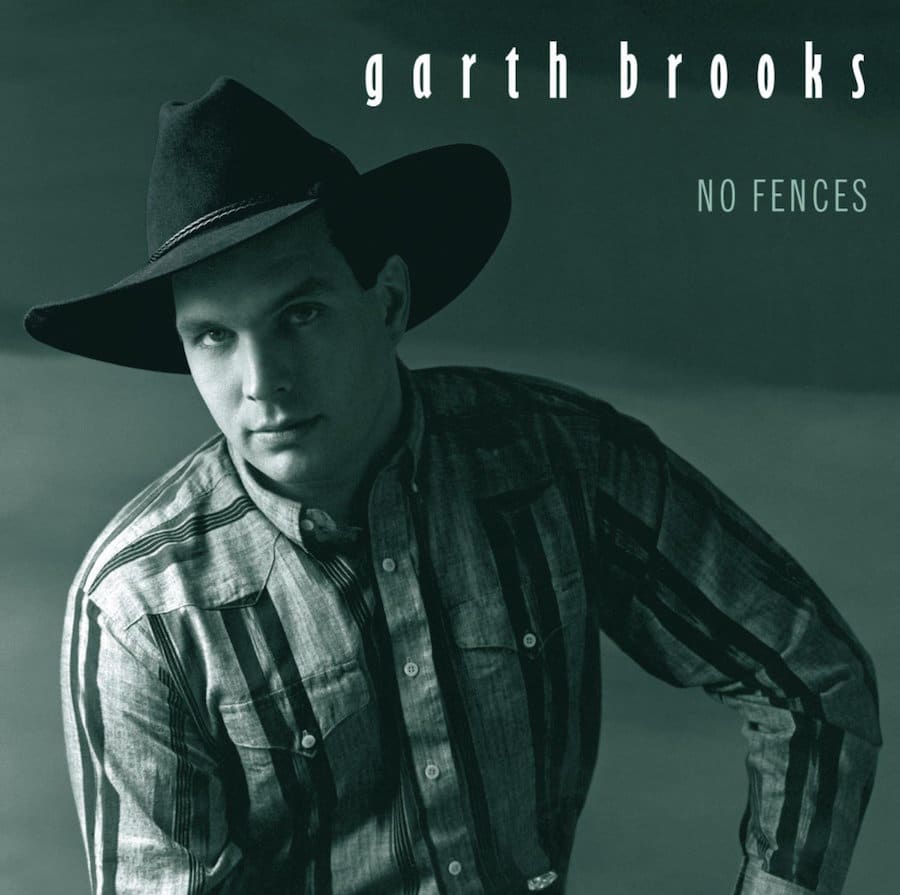
Then a fellah named Garth Brooks blew every pre-conceived notion anyone ever had about country music to smithereens. The audacious marketing grad from Oklahoma accomplished this feat strategically — by following the model of his multi-platinum predecessors. First, Garth geared his material to the widest possible audience, rocking the youthful party crowd with “Friends In Low Places,” then plucking the heartstrings of his more mature, contemplative fans with “The Dance.” To seal the deal, he rocked arena stages with crazed, Springsteen-level exuberance.
Thanks to the Brooks phenom, the ’90s commenced with millions of urbanites and suburbanites of all ages joining the ranks of country fanship. Almost over night, country albums, too, were routinely scoring platinum. In 1992, for the first time ever, a country collection — Billy Ray Cyrus’ Some Gave All — ranked as the year’s top seller across all genres, at 4.8 million units. Established stars like George Strait and Randy Travis gleefully rode Garth’s coattails. Even “Average Joe” Diffie hit the platinum jackpot — twice in a row!
This decade of plenty saw Tim McGraw adding some Dwight Yoakum sex appeal to that surefire Garth formula. By borrowing Britney Spears’ bare mid-riff and Def Leppard’s snare drum, Shania Twain scored Garth-level sales. And the decade’s airplay titleholder Toby Keith tossed a hunk-a good-natured Hank Jr. irreverence into the mix.
In the meantime, country radio stations were getting gobbled up by greedy corporate conglomerates whose market research advised: “Slash playlists for higher profits.” Result: lengthier number ones. Just 30 singles reached the top spot in 1995, McGraw’s “I Like It, I Love It” leading the pack with its five-week reign. Still, as The Dixie Chicks closed out the ’90s in three-part, ten-times-platinum harmony, country looked bulletproof.
As the millennium turned, a plague swept through the industry — digital file sharing. Album sales plummeted. Unlike competing genres, country didn’t take to its deathbed. In an ironic stroke of reverse karma, the country crowd’s innate resistance to technology worked to the genre’s advantage. In fact, a unique core fan base — women, 25-to-45, Walmart shoppers, still in the CD-buying habit — gave Nashville’s labels a golden opportunity to snatch up an even larger slice of the marketplace pie. But were industry gurus wise enough to dance with the gals that brung ‘em? Boy, howdy, no! They caught a lascivious wink from a younger babe and sent those faithful ol’ broads packin’.
Montgomery Gentry’s southern-rock-inflected country masculinized radio. Then, the outta-the-blue success of Big and Rich’s country/hip-hop hybrid sent Music Row on a misguided quest to woo an ever-more-youthful audience. In 2005, just 20 singles hit the top of the country charts — with a scant 12 artists camping out at the pinnacle for 45 of 52 weeks. Then, in 2014, a year when the singles chart was dominated for 30 weeks by “let’s get drunk and party” songs, it took a bona-fide superstar (Jason Aldean, with “Old Boots, New Dirt”) to score country’s sole platinum certification — a hurdle portly “Average Joe” Diffie had cleared with ease 19 years earlier.
By 2015, country had “turned it down to eleven.” Eleven number ones — for the entire year! Airplay champ Sam Hunt held the peak position for 18 weeks with two R&B-inflected tracks that could just as easily have been performed by Jason DeRulo. And the year failed to yield a single platinum country album.
So, while millions of abandoned ex- and potentially new country fans fork over retail price for Adele’s 25, the rowdy crowd courted so vigorously by Music Row squander an equivalent amount on tonight’s 12-pack and dance around the tailgate to Luke Bryan — on Pandora.