
Even if you don’t consider yourself a Steve Miller Band fan, you can probably at least hum along to his hit single from 1973, “The Joker.” I’m a joker, I’m a smoker, I’m a midnight toker has become one of the most sing-along-able hooks in classic rock history. But back then, it was a throwaway song on the last album of Miller’s seven-year contract with Capitol.
Indeed, Miller wasn’t convinced the song would be a hit. In fact, he wasn’t even sure he would have a career by 1974. Luckily, he couldn’t have been more wrong.
Videos by American Songwriter
Steve Miller Thought His Career Was Over
While we often associate Steve Miller Band with their golden years in the 1970s, Miller and his group of backing instrumentalists had been cutting their teeth together since 1966. They achieved respect amidst their musical peers (well, besides Miles Davis, anyway), even landing a spot as Chuck Berry’s backing band for a Fillmore Auditorium performance.
But commercially speaking, the Steve Miller Band struggled to gain any notable ground. The rock band signed a seven-year contract with Capitol Records, under which they released six albums: Children of the Future, Sailor, Brave New World, Your Saving Grace, Number 5, and Recall the Beginning…A Journey from Eden. Occasionally, a single track from one of the records would start to take off before fizzling out again.
Simply put, it was a rough six years for Steve Miller and his bandmates. By the time they started working on their seventh and final album for Capitol, Miller was disillusioned and convinced he should give up altogether. “I thought I was going to have all these resources,” he admitted to AXS TV’s Dan Rather. “What I really ended up in was this pool of 200 artists who were all fighting for the same resources. There was [only] so much to go around, and we were way down on that list.”
The Frontman Fought With The Label Over The Future Hit
As Steve Miller explained in his AXS TV interview, he had found himself at odds with Capitol Records during most of his seven-year label contract. He noticed that whenever he would go on tour, only a small fraction of the cities he and his band visited would be selling Steve Miller Band records at their local vinyl shops. “We were always at war with Capitol Records,” Miller recalled. “Every band goes through this.”
But it wouldn’t take long for Miller to prove to himself and his label that he wasn’t just any band. As he was listening back to his seventh and final record, which included “The Joker,” with the label executives, someone pointed out the laid-back track as a potential hit single. “I said, ‘Listen, pal, I don’t care about hit singles anymore,’” Miller recalled.
Miller said he told the label, “I’m going out. Here’s the list of 60 cities I’m going to go to in the next 75 days. I want you to have albums in the stores where I’m playing. Got it? I left in kind of a huff.” The musician said he thought it was his last album he would ever record, so he didn’t mind burning a bridge or two. “I thought my career was over. I thought this was pretty much it.”
He realized just how wrong he was when he was driving to a show at the Fox Theater in Oakland, California, and heard “The Joker” playing on four radio stations at once. The iconic hit would go on to top the charts in the U.S., U.K., Ireland, New Zealand, and several other countries. It was also certified platinum 5x in the States—not bad for a joker, smoker, and midnight toker whose musical career was almost over.
Photo by Michael Putland/Getty Images
More Behind The Song
-
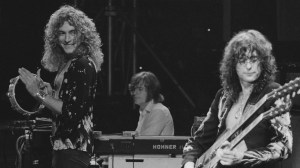
Left to right: Robert Plant, John Paul Jones and Jimmy Page, of British heavy rock group Led Zeppelin, performing at Earl's Court, London, May 1975. The band were initially booked to play three nights at the venue, from 23rd to 25th May, but due to public demand, two more concerts were later added, for 17th and 18th May. Total ticket sales were 85,000. (Photo by Michael Putland/Getty Images) -
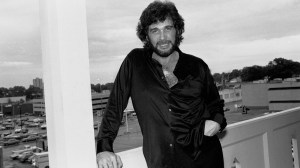
Portrait of country singer Eddie Rabbitt in Memphis, Tennessee, May 31, 1981. (Photo by Paul Natkin/Getty Images) -
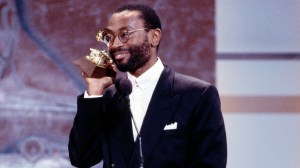
LOS ANGELES – FEBRUARY 22: 31st Annual Grammy Awards. Broadcast February 22, 1989. Shrine Auditorium, Los Angeles, California. Pictured accepting award is Bobby McFerrin. His song "Don't Worry, Be Happy" won Record of the Year, Song of the Year, and Best Pop Vocal Performance, Male. Also Best Jazz Vocal Performance, Male. (Photo by CBS via Getty Images) -
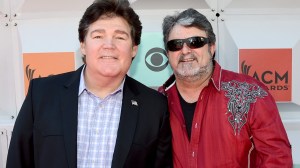
LAS VEGAS, NEVADA – APRIL 03: Singers Mike McGuire (L) and Marty Raybon of Shenandoah attend the 51st Academy of Country Music Awards at MGM Grand Garden Arena on April 3, 2016 in Las Vegas, Nevada. (Photo by Rick Diamond/ACM2016/Getty Images for dcp) -
Photo by Tim Mosenfelder/Getty Images -
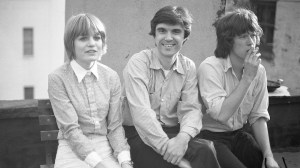
The three founding members of Talking Heads on a Manhattan rooftop, US, 1976. (Jerry Harrison would join the group at the beginning of 1977.) (L-R) Bassist Tina Weymouth, singer-guitarist David Byrne and drummer Chris Frantz. (Photo by Linda D. Robbins/Getty Images) -

Patty Smyth of Scandal at the Poplar Creek Music Theater in Hoffman Estates, Illinois, June 3, 1983. (Photo by Paul Natkin/Getty Images) -
Photo by Michael Ochs Archives/Getty Images