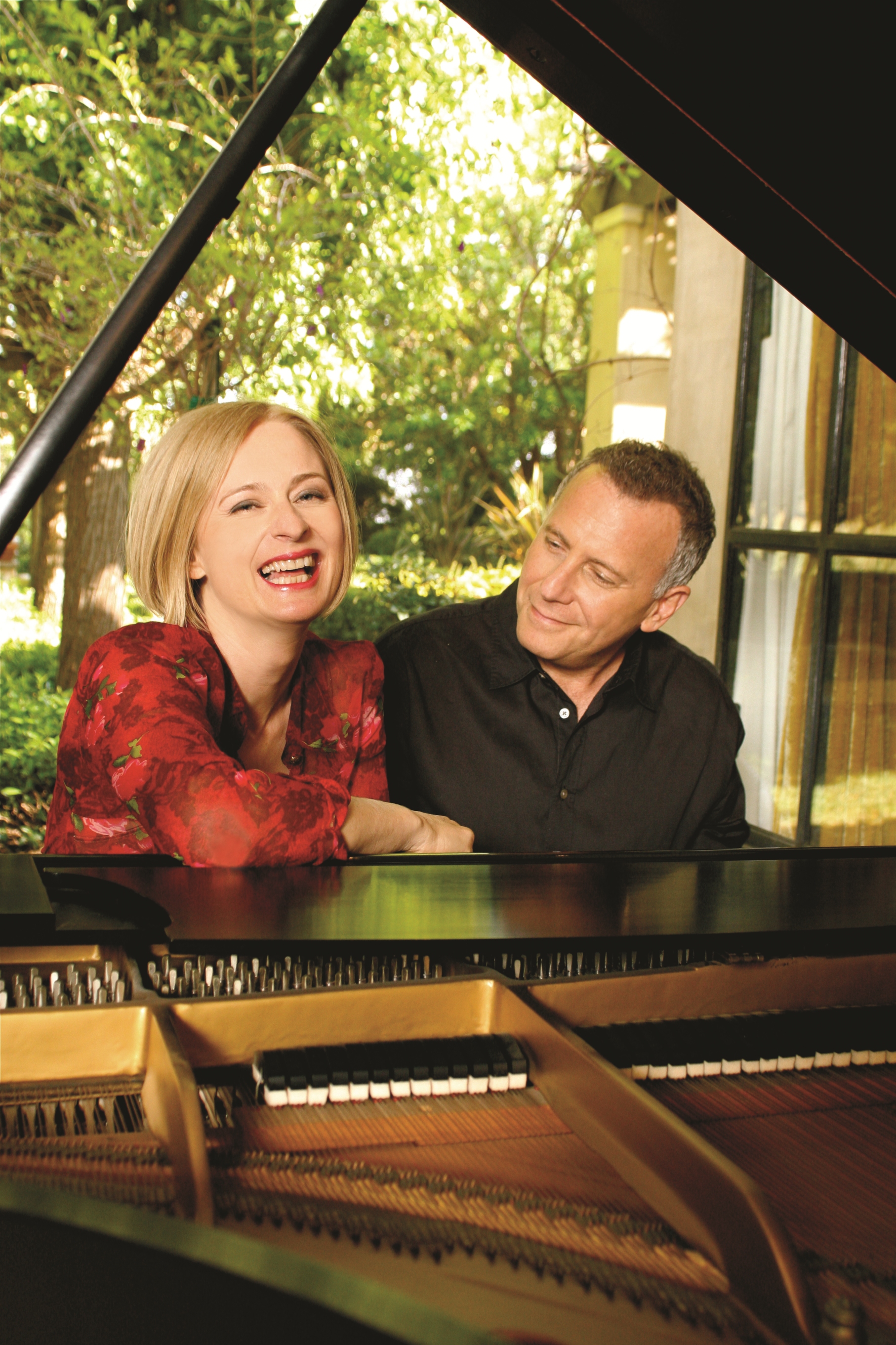
What do you get when you cross one famous comedian with one highly respected British singer-songwriter? In the case of Paul Reiser (Mad About You,The Paul Reiser Show) and Julia Fordham, you get a surprisingly cohesive and enjoyable album. Unusual Suspects pairs Fordham’s vocals and lyrics with Reiser’s piano compositions. We chatted with the two old friends about how they pulled it off. Also, my name gets involved.
Publicist: You’re on the line with Evan Schlansky.
Paul Reiser: Evan Schlansky? Always been a fan of Evan Schlansky.
Well, I appreciate that. Likewise.
Paul: Remember I was saying that Julia? Years ago?
Julia Fordham: Yes. He loves all your stuff. He’s just been watching your videos on YouTube.
Paul: Yes! Once you left Led Zeppelin I thought you were always much stronger…
Julia: You don’t have to put up with him, Evan.
Paul: A friend of ours brought their 14 month old baby over, and my ten year old wanted to play some music and decided Led Zeppelin was the way to go. So we just blasted a 14 month old girl with “Whole Lotta Love” this morning. It was quite special.
Julia: Aww.
Paul: What can we peddle to you?
Well, I’ve got a bunch of questions for you. One of them is, what kind of live performances are you going to be doing in support of the album?
Julia: We’ve got two gigs booked at the moment. December the 7th and December the 8th. We’ll be playing the Catalina Jazz Club in Hollywood, and we are using the fabulous cats who played on our album. You know, Paul’s extrememly busy with his other life which is his TV show, and just at the second he finishes he’s gonna have one day off to clean his teeth, and then we’re rehearsing.
Paul: And run sixteen songs…
Julia: In fact that’s why I’m only giving you 10 songs, and then I’ll do some of my old favorites. Songs that people know me for.
Paul: I’ll play the tambourine on those songs.
Julia: That’d be excellent. So basically, to be honest, it’s like if time permits it, or if we had a monstrously large fabulous hit on our hands, we would joyfully and gleefully go trotting off around the globe.
Paul: That would be a secret joy. Should there be enough interest in our art, which we’re hoping, that we go to some very select cities and play in some lovely intimate places.
Julia: And if not, I’ll just go by myself.
Paul: …and call me when you get there.
You also played together recently for a show in Laguna Beach. Paul, was that your first time playing live?
Paul: Well, first of all I had a band in 7th grade. So I’m an old “road cat”, if I may. But I actually had gone out with Julia on a couple dates of hers also at the Catalina, and played one or two songs. But yeah, with the whole band…
Julia: This is an exciting thing for both of us because we’ve both been pretty much committed to making the album how we wanted it to be. Now we’re gonna have a chance to kind of flesh the songs out in the live arena, where it’s not quite so disciplined and we can inject a little bit more of their personality into the music’s life.
Paul: It’s also exciting because these songs were never initially conceived as an album. This began so innocently as a play-date, we jokingly call it. We bumped into each other and I said, “I have this lovely little melody that might wanna be a song. I don’t know. It might wanna be a side dish at a dinner table. I don’t know what it is.” And Julia took it and came back and it became this lovely song. And she gave it lyrics, and we said well, listen, let’s make another one just for no reason. And it was only when it was all done that we said, “You know, I think there’s an album here. These are ten lovely songs.” So now to hear that with no premeditation, it actually holds together as a piece. You know, we weren’t aiming for a theme or anything, but now hearing it in it’s full form and playing it, it’s very exciting to see that it works and holds up as a piece.
I read in your Huffington Post piece that you first heard Julia Fordham’s music on the radio. Do you remember what song it was?
Paul: I think it was “Girlfriend”. Or “Falling Forward.” And I’m pretty sure it was 101 I was on. Not the radio station. The freeway. There were many moments in my life that were memorably dotted with Julia Fordham music. I remember sometime in the early 90’s taking a trip to Scandinavia and being far from civilization, and I’d been listening to her music. It seemed very appropriate. This was way up north. I had a…well I guess it wasn’t an iPod then, it was CDs. I had a lot of classical music and Julia Fordham CDs. And it works! It works very high north on the globe. So, yeah, I had a very strong emotional attachment to her music, and was a huge fan never having met. So this is all very fortuitous and fun for me.
You were a composition major in college. Had you been getting back into songwriting and composing around the time that you sent her your first song?
Paul: Yeah! I had on my to-do list: “Get back to music.” I had “pick up milk, drop the kids off, and write more music”. And about two years ago I said, “It’s time.” And I went into my little makeshift studio: a piano and wires and buttons that I didn’t know how to work, and I just started playing and recording with no aim, rhyme, or reason. Certainly no goal other than just to do it. And it was just circumstance that we bumped into each other. Sorta courageously, I sucked it all up and invited her. I said, “Forgive me for being so presumptuous, but would you maybe wanna get together and see if this is a song? And she was very open. The rest in independent record history.
Now the stuff that you were writing, was it similar to the stuff you ended up sending to Julia? Did it resemble pop music?
Paul: No it wasn’t as all. Not being a singer, I never think of it as a song. I was really just writing melodies and playing with my new fabulous technology, Logic, and all these samples. I was like a kid in a candy shop. Ooh, pretend violins! Ooh, trumpets! So I was writing something I thought was gonna be a string piece.
In my head it was a big lush romantic piece, but when it was thinned out it was just some pretty melodies and some chord changes that I loved. I wasn’t aiming as a song at all. I had no plan. I was trying to free myself from that because it’s very limiting when you think, what’s it gonna be? Well, I don’t know. And once you throw those conditions away it’s very liberating. Is it a novel? Is it a script? Is it a short story? Who knows? Just write page two and page three, and you’ll see what happens.
So I was sort of in that head, and I thought well maybe this will be a short little piece for some virtual movie. But when I saw Julia, I thought maybe it’s a song? It was very melodic and it wasn’t a crazy stretch to imagine Julia taking it and making it her own. So it was very much a change of direction that it became a Julia Fordham album.
Julia, was this a novel experience for you, having someone else compose the music and you writing the lyrics?
Julia: Yes, entirely. With this, it’s all in reverse order because I write songs. They come in, and then I put the arrangements and the chords. But with Paul, I’m taking this beautiful music. And when I met him I could tell he had an innate talent, that he was gifted, extraordinarily so, in all these different arenas. And I just loved what he was doing. I could tell he had the chops that I could work with. But for me to actually take something away and do something over it was a completely different experience. I almost had to just let Paul’s work wash over me and seep into my pores, and then sometimes I’d just go away from it. And then see what came in over it when I wasn’t even listening to it, sometimes, because that’s sort of the only way I know how to write songs.
But I didn’t find it a struggle. I found it a really delightful twist on what I’ve been doing for so many years, because I’m bored with myself, quite frankly! So, I was so grateful when Paul came along. It just seemed so interesting, everything about the experience. I took to him as a person and a player. And we had similar sensibilities. So, I felt quite comfortable just jumping in. And I felt like the first song that we did, “Walking Shoes,” and the second one, which is the first one on the album “You Keep Me on My Feet,” I thought they were really strong! Having done it so long myself, I know how to edit out a lot of stuff as I’m going, and at times Paul gave me music that I couldn’t work out how to do something with it.
Paul: She’d say, “This is not speaking to me.”
Julia: I would say to him, “It’s not speaking to me.”
Paul: And I said, “Well talk louder! Perhaps it will speak back!”
Julia: For the most part I’ve thoroughly, in fact completely, enjoyed the whole process. Even the bits where we’ve had disagreements on how to go forward.
Paul: What was, I thought, so novel and interesting is that even when there were differences of opinion, which there are going to be, there was never any pressure. It wasn’t, “We have to come up with an answer because this album is due next week! Or this show has to air!” There was nobody waiting for this. There was nobody involved but the two of us. So it really stripped it down to its most pure creative level of two people who got along and had a huge overlap of tastes and sensibility saying, “What if this, and what if that?”
It was a much bigger, braver step for Julia, having never collaborated. I’m used to a lot of collaborators– most of the time, too many. With television you sit with six people in a room writing and coming up with ideas, and then the studio giving their input. It can be very suffocating and stifling. Working with one person was delightful. Julia, having not gone through that, would come in with a set of lyrics and I’d say, “Well, what if we changed this line here?” And she says, “Well, why would you change that? What’s wrong with it as it is?” “Could it possibly be bit more orange and less blue?” So, she had to get used to the fact that there was another human being even talking to her.
Julia: That was hard, I have to say, because I’m used to being in my own head, and I’m very married to how something sings and Paul is very committed to how it reads on the page. I like to take it and bend it and run with it, and a lot of times I’m doing things because I know my voice will sing something well. And so all of those things I’m now being forced to discuss with my partner.
Paul: For the most part it would be seamless. I would send her what I heard in my head, and it would often be orchestrated. There would be strings, and some horns, and some woodwinds or something. And then I had learned to then send her right after that the torn down bare bones version of it. So, “Here’s what I have in mind, and here’s something you can work with.” And she would take that and live with it, and back would come, invariably, a fully formed set of lyrics.
There wasn’t that much back and forth really on the lyrics. What was interesting to me is that she would always make it her own. It would rarely be the exact melody I had written, but it was never that far. She would find it and bend it. She would use the structure of it, but make it entirely her own. And a lot of time there were very structural things: this part here you’re calling the chorus is actually the bridge, and then we take this piece over here and make that the verse. And I was like, “Oh, that’s great too!” And that was exciting to me because I had never really written songs. I had written little diddies by myself, but I had never taken it seriously and worked with somebody. I found her very courageous.
In the Huffington Post piece, you described the music as rather melancholy and sad. Julia, do you agree with that? And why do you think that is?
Julia: I don’t entirely, because I feel that the theme of most of my stuff, I like to think, might be melancholic, but it is infused with hope. It’s coming from this pallet of grays and blues, but there’s always a big blob of yellow and orange in there lifting you out of wherever you are. And it’s that experience of being happy and sad together. I think they call it, “poignant”. Cause I think if you just say, “Melancholic and sad” it just sounds like a big ol’ downer.
Paul: It’s not that at all. To me, I’ve always been moved by sad stuff, and we had fun playing with that because I think the last thing people would expect from this comedy boy is a loud or funny, whatever record. You wouldn’t necessarily presume that it’s gonna be pensive, and as she said shades of grays and blues. I always use that as a disclaimer up front. It’s not light. It’s not jovial at all! But it’s very much the stuff I love listening to.
That’s why I responded so powerfully to Julia’s music. It’s just as she described it in that pallet. It’s emotional. I don’t think upbeat music could ever grab you and touch you as much as stuff that-sad is not the right word-stuff that is affective. I like being moved. I’ll always lean toward something that will grab you. Something emotional, tender, and honest, and courageous. And the area Julia went to on her own, entirely off of this thing, often was on the darker side.
The very first one we did, “Walking Shoes” was this woman that was in this relationship trying to get out, and she doesn’t quite have what it takes to leave. She drives and drives and always ends up circling back. Two years earlier I had done this movie I wrote with Peter Faulk about that! It was about a woman who had spent her whole life wishing for the courage to leave her husband. I went, “That’s crazy that you got that. Did you ever see this movie?” She goes, “No I didn’t.” But after seeing it she says, “That was the feeling.” So, we were connected independently to these same sensibilities, which was kinda freaky.
They say a lot of comedians want to be musicians and vice versa. Have you found that to be true?
Paul: No, I don’t wanna be anything more than anything else. That’s the thing about this. I didn’t do it as a career. I’m not using anything to be a spring board. This had no goal for me. There was no career objective. It was truly a house project that was fortunate enough to be with somebody that I really admired. And the goal was, “Let’s just put this out. And if it would warm anybody’s heart, here it is. If not, move along.” So on my part, there’s no goal. I’d love to do more, but it’s not a career shift at all so much as finally articulating and doing stuff that I have sorta been doing in the background for years.
I was just wondering if Seinfeld plays the bass, or anything like that.
Paul: I doubt it. But ironically, Yo-Yo Ma is playing at Chuckles in Ohio this weekend. So yeah, you’re right. Classical musicians want to be comedians.
Well, that’s about it. Thanks for taking the time to talk with us.
Julia: Thank you!
Paul: Make us look clever, would ya?
Most Viewed
-

LOS ANGELES, CA – NOVEMBER 20: Blake Shelton performs during "Jimmy Kimmel Live!" on November 20, 2024 in Los Angeles, California. (Photo by PG/Bauer-Griffin/GC Images)