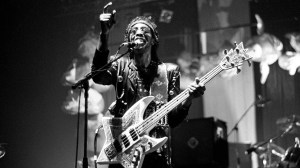
Whether you consider it the apex of the late ’80s alternative music scene of the forefather of the grunge revolution that would sweep the music world in the ’90s, or both, it’s safe to say that few albums have been as impactful as Sonic Youth’s 1988 disc Daydream Nation without ever threatening the mainstream. The closest the album came to commercial success was its opening track and lead single “Teenage Riot.”


Part of the reason for the song’s acceptance at the time on modern rock radio was its capitulation to traditional rock song structure. Once you get past the non-sequitur intro music featuring Kim Gordon’s cryptic chants, “Teenage Riot” settles into a frenzied guitar workout for Thurston Moore and Lee Ranaldo while Gordon on bass and Steve Shelley on drums keep the rhythmic hammer down. Even at the rapid tempo, Moore imbues the song with enough melody to keep things catchy.
In the liner notes to the deluxe edition of Daydream Nation, Moore was quoted as saying the lyrics were inspired by another alt-rock standout. “It was actually about appointing J Mascis as our de facto alternative dream president,” he said, referring to the frontman of Dinosaur Jr. After all, 1988 was an election year, so the intensity and earnestness behind Moore’s wish was understandable.
But “Teenage Riot” ends up transcending those quirky origins and becomes a kind of anthem even though Moore’s deadpan vocals and wry lyrics never dare to aspire to anthemic status. The song ends up being a snapshot of the disaffected, alienated kids who could get behind a leader who would “come running in on platform shoes/With Marshall stacks/To at least give us a clue.”
In many ways, the kids are the ones enacting the change in the song. “Looking for a ride to your secret location,” Moore sings about the leader. “Where the kids are setting up a free-speed nation for you.” Anything is better, after all, than the ambivalence that has enveloped the narrator’s world: “Cause it’s getting kind of quiet in my city head/It takes a teenage riot to get me out of bed right now.”
One of the ingenious things about “Teenage Riot” is how Gordon’s incantatory rambling at the beginning suddenly makes sense once you hear the bulk of the song. In the context of Moore’s subtle rallying cries, her opening lines seem the collective voice of the teenage populace, especially when she sings, “We will fall.” That pessimism is immediately countered by the glimmers of hope that come shining through once the guitars rev up their engines.
And it is undoubtedly hope, albeit hope tempered with sarcasm, that emerges as the seven-minute song rolls to a close. “You’re never gonna stop all the teenage leather and cooze,” Moore promises. “We’re off the streets now/And back on the road/On the riot trail.”
As we listen to politicians lining up one by one to tell us how they’re going to lead, the message of “Teenage Riot” resonates even louder. Sonic Youth, in their uniquely indirect way, seemed to be saying that the youth of America will ultimately choose their own leaders even if they can’t be bothered to elect them.
More Features
-
Photo by Michael Ochs Archives/Getty Images -

American country music singer Earl Thomas Conley (1941 – 2019) performs at the Poplar Creek Music Theater in Hoffman Estates, Illinois, May 26, 1985 in Hoffman Estates, Illinois (Photo by Paul Natkin/Getty Images) -
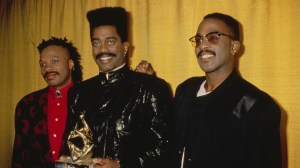
American funk band Cameo (American singer Charlie Singleton, American singer and musician Larry Blackmon, and American singer and musician Tomi Jenkins) in the press room of the 1987 Soul Train Music Awards, held at the Santa Monica Civic Auditorium in Santa Monica, California, 23rd March 1987. Cameo won the awards for 'Album of the Year (Group, Duo, or Band)' for 'Word Up!' and 'Best Single (Group, Duo, or Band)' for 'Word Up'. (Photo by Vinnie Zuffante/Getty Images) -
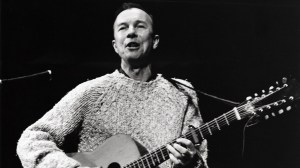
UNITED KINGDOM – JANUARY 01: Photo of Pete SEEGER; Pete Seeger performing on stage at a Paul Robeson benefit concert (Photo by Brian Shuel/Redferns) -
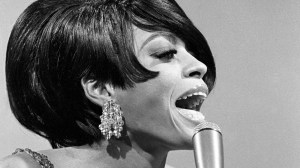
UNSPECIFIED – CIRCA 1970: Photo of Diana Ross Photo by Michael Ochs Archives/Getty Images -

The British singer Kate Bush poses for a photo shoot. Great Britain, 1980 (Photo by Angelo DeligioMondadori via Getty Images)