
Folk music, by definition, contradicts the modern music industry’s inherently capitalist structure. In its purest form, folk music is supposed to be shared amongst players with no real ownership. But once record labels started turning musicians into money-making machines, ownership became necessary to make sure people who ought to get paid do get paid.
And it’s in this confuddling pretzel that a rift began between New York City folk darling, Paul Simon, and British folkie, Martin Carthy. The latter musician was responsible for sharing the traditional ballad, “Scarborough Fair”, with Simon and fellow New York folk icon Bob Dylan. Carthy didn’t write the song itself—that melody and lyric can be traced back to the late 1600s.
Videos by American Songwriter
Still, there was something about Simon releasing his version of “Scarborough Fair” with Art Garfunkel that rubbed Carthy the wrong way. Perhaps it was Simon and Garfunkel’s rising star. Or maybe the industry inevitably shifted Carthy’s perspective on folk music and rightful ownership. In any case, the rift lasted for decades until the pair buried the hatchet on stage in 2000.
Paul Simon Learned “Scarborough Fair” From Martin Carthy
To be clear, Martin Carthy’s arrangement of “Scarborough Fair” was a re-arrangement of Ewan MacColl and Peggy Seeger’s version in The Singing Island, which was a re-arrangement of mid-50s recordings, which re-arranged late 1930s field recordings, and on and on it went. Paul Simon’s arrangement of “Scarborough Fair” was another arrangement on a long list of revisions. In Simon’s, he combined the traditional ballad with a revised version of his 1963 anti-war song, “The Side Of A Hill”, this time called “Canticle”.
This version, “Scarborough Fair/Canticle”, appeared on the soundtrack of The Graduate, the hit 1968 movie with Dustin Hoffman, which elevated the centuries-old tune into a household song. Simon’s version was copyrighted only by Simon and Garfunkel, which ruffled Carthy’s feathers. As he would later confess to Uncut, he allowed those around him to rile him up further, convincing him that Simon had stolen from him and ripped him off.
“What a fool I was,” he said via Guitar.com. “It’s a f***ing folk song. Everybody owns it, and that includes Paul Simon. It’s mine. But it’s also yours.”
The Musicians Buried the Hatchet in Front of a Crowd
Though the two didn’t often run in the same circles, there was always a bit of tension between Paul Simon and Martin Carthy. That is, until one day, Simon called Carthy while he was on tour in the late 1990s. Simon asked Carthy if he had been upset with him, and Carthy admitted he was. “But I got fed up with being mad at you,” he recalled telling the singer-songwriter.
He continued, “Because it wasn’t true. He didn’t rip me off. The arrangement he had was a tribute. It wasn’t the same as what I played, and what a lovely compliment to pay.” Around that same time, Simon invited Carthy to sing the song as a duet at the Hammersmith Apollo in 2000. “It was bloomin’ lovely,” Carthy recalled. “I’d been unable to sing the song properly because there was too much baggage. But I sang it with Paul, and it was truly great. I laid the ghost to rest with the help of Paul.”
Photo by Paul Natkin/Getty Images
More Behind The Song
-
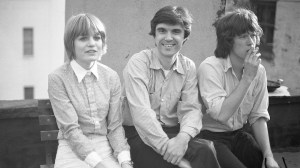
The three founding members of Talking Heads on a Manhattan rooftop, US, 1976. (Jerry Harrison would join the group at the beginning of 1977.) (L-R) Bassist Tina Weymouth, singer-guitarist David Byrne and drummer Chris Frantz. (Photo by Linda D. Robbins/Getty Images) -
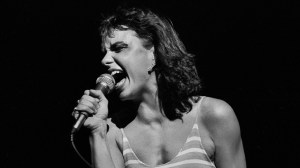
Patty Smyth of Scandal at the Poplar Creek Music Theater in Hoffman Estates, Illinois, June 3, 1983. (Photo by Paul Natkin/Getty Images) -
Photo by Michael Ochs Archives/Getty Images -
Photo by Larry Hulst/Michael Ochs Archives/Getty Images -

NASHVILLE, TENNESSEE – MARCH 20: Dolly Parton attends Dolly Parton's Threads: My Songs In Symphony World Premiere at Schermerhorn Symphony Center on March 20, 2025 in Nashville, Tennessee. (Photo by Jason Kempin/Getty Images) -

Studio portrait of Go-Gos lead singer Belinda Carlisle, Chicago, Illinois, June 25, 1986. (Photo by Paul Natkin/Getty Images) -
Billy Idol performing at the Poplar Creek Music Theater in Hoffman Estates, Illinois, June 1, 1984. (Photo by Paul Natkin/Getty Images) -
Photo by © Hulton-Deutsch Collection/CORBIS/Corbis via Getty Images