
For a young Paul McCartney fresh off the heels of The Beatles’ breakup, the world was practically bursting at the seams with equal parts opportunity and pressure. The entire planet was waiting on bated breath for what Macca would come up with as 25% of the former Fab Four. The first day he sat down with his backing band at Columbia Studios in New York City, he showed them a song that assured them that whatever was in store for McCartney post-Beatles, it was going to be a success.
Of course, it helped that The Beatles had already showcased McCartney’s acute talent for the past several years. In fact, McCartney’s bandmates couldn’t help but make a Fab Four comparison after hearing the frontman’s first song to record: “Another Day”. The song paints a rather melancholy picture of a woman who does the same routine every day: working at her boring job, drinking coffee, and waiting for a man who arrives only to leave her alone once more.
Videos by American Songwriter
To drummer Denny Seiwell, “Another Day” seemed to be “‘Eleanor Rigby’ in New York City,” referencing McCartney’s Revolver composition from 1966 (via Peter Carlin’s Paul McCartney: A Life). One notable difference between this song and The Beatles’ number, however, was that McCartney had no qualms exercising complete creative control.
What Recording “Another Day” Was Like, According to the Band
Being in a band is already tough. But being in a band that also shares writing responsibilities can sometimes feel more tenuous than a rocky marriage. When ego and art combine, it doesn’t take much for feelings to get hurt—something the band was obviously wrestling with during the infamous Get Back sessions. However, McCartney no longer had to operate within the confines of his partnership with John Lennon. He was the band leader now, no question about it, and he played the part.
“We were told exactly what to play,” guitarist Dave Spinozza told biographer Peter Carlin. “He knew what he wanted. He took some suggestions—two out of ten—but changed into a Paul McCartney thing.” McCartney’s strict expectations seemed to perturb Denny Seiwell less, with the drummer telling Carlin with a shrug, “He had great ideas.”
Spinozza later recalled with some irritation that Linda McCartney would come into the sessions halfway through and offer her thoughts. “It didn’t make sense to me,” Spinozza said. However, Carlin draws an interesting parallel between Paul and Linda and John Lennon and Yoko Ono. John and Paul were accustomed to having an intimately close creative partner. In the early Beatles days, John and Paul’s friendship filled that role. Eventually, the musicians’ romantic partners took over.
Paul McCartney Had One Weird Quirk in the Studio
Regardless of what the band thought about it, Paul McCartney chose to lead his early Ram sessions, the first of which was for the song “Another Day”, with him at the helm and Linda McCartney nearby. Paul would vocalize the parts he wanted to hear his backing band play and then live track with the musicians on keyboard and guitar. Interestingly, guitarist Dave Spinozza remembered McCartney always overdubbing the bass by himself. “He never played the bass with other people around,” Spinozza told Peter Carlin, “which was weird.”
Weird, maybe, but it worked. Paul McCartney released “Another Day” in late February 1971, marking his debut single as a solo artist. The record’s B-side was “Oh Woman, Oh Why”. “Another Day” peaked at No. 5 on the Billboard Hot 100, No. 2 on the U.K. Singles chart, and topped the charts in Ireland, Spain, and Australia.
Photo by Jones/Daily Express/Getty Images
More Behind The Song
-
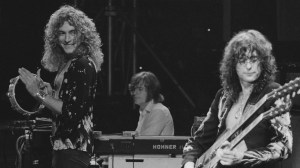
Left to right: Robert Plant, John Paul Jones and Jimmy Page, of British heavy rock group Led Zeppelin, performing at Earl's Court, London, May 1975. The band were initially booked to play three nights at the venue, from 23rd to 25th May, but due to public demand, two more concerts were later added, for 17th and 18th May. Total ticket sales were 85,000. (Photo by Michael Putland/Getty Images) -
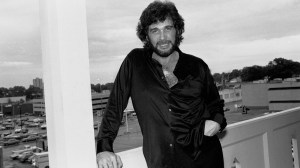
Portrait of country singer Eddie Rabbitt in Memphis, Tennessee, May 31, 1981. (Photo by Paul Natkin/Getty Images) -
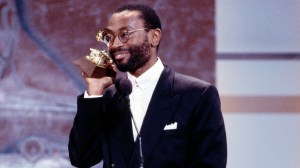
LOS ANGELES – FEBRUARY 22: 31st Annual Grammy Awards. Broadcast February 22, 1989. Shrine Auditorium, Los Angeles, California. Pictured accepting award is Bobby McFerrin. His song "Don't Worry, Be Happy" won Record of the Year, Song of the Year, and Best Pop Vocal Performance, Male. Also Best Jazz Vocal Performance, Male. (Photo by CBS via Getty Images) -
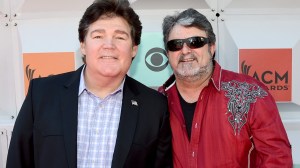
LAS VEGAS, NEVADA – APRIL 03: Singers Mike McGuire (L) and Marty Raybon of Shenandoah attend the 51st Academy of Country Music Awards at MGM Grand Garden Arena on April 3, 2016 in Las Vegas, Nevada. (Photo by Rick Diamond/ACM2016/Getty Images for dcp) -
Photo by Tim Mosenfelder/Getty Images -
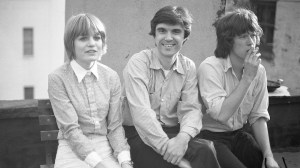
The three founding members of Talking Heads on a Manhattan rooftop, US, 1976. (Jerry Harrison would join the group at the beginning of 1977.) (L-R) Bassist Tina Weymouth, singer-guitarist David Byrne and drummer Chris Frantz. (Photo by Linda D. Robbins/Getty Images) -
Patty Smyth of Scandal at the Poplar Creek Music Theater in Hoffman Estates, Illinois, June 3, 1983. (Photo by Paul Natkin/Getty Images) -
Photo by Michael Ochs Archives/Getty Images