Behind almost every monumental, mind-blowing, history-making concert, there is at least one musician thinking, ‘Man, I wish I could’ve done that better.’ The grandiosity of these venues and events makes it easy to forget that performers, no matter how famous or talented, are humans susceptible to a brain fart, bad mood, or other impediment to a good show. The Grateful Dead were no exception. And indeed, this seemed especially true at some of the biggest concerts they ever played, like Woodstock and Monterey Pop Festival.
During a 1987 appearance on Late Night with David Letterman, Jerry Garcia and Bob Weir half-joked, half-admitted that not all of their performances are that great. In fact, they argued, they were more likely to play poorly if the show was a big one. When the musicians mentioned Woodstock, Letterman pressed them on it. The host asked if they were willing to admit they didn’t play well at the historic musical event in Woodstock, New York. “Yeah, we were terrible at Woodstock,” Garcia insisted with a big laugh.
Videos by American Songwriter
Woodstock and Grateful Dead go together like rain and mud, of which the festival had plenty. And to Garcia and Weir’s credit, that’s where most of their trouble was. Not their playing, necessarily, but their playing conditions.
It’s a Miracle Grateful Dead Made It Out of Woodstock
One can’t think of the Woodstock Music and Art Fair of August 1969 without also thinking of late-summer deluges. The August rainstorms saturated the festival grounds and turned Max Yasgur’s farm into one giant, drug-filled mud pit. The living conditions were their own hurdle to overcome. And musicians had the extra burden of figuring out how to perform safely. After all, rainstorms and electrical musical equipment don’t quite mix. According to Bob Weir’s account of Woodstock from a 2019 Rolling Stone interview, the San Francisco jam band was lucky they made it out of upstate New York alive.
“It was raining toads when we played,” Weir recalled. “The rain was part of our nightmare. The other part was our sound man, who decided that the ground situation on the stage was all wrong. It took him about two hours to change it, which held up the show. He finally got it set the way he wanted it. But every time I touched my instrument, I got a shock. The stage was wet, and the electricity was coming through me. Touching my guitar and the microphone was nearly fatal. There was a great big blue spark about the size of a baseball. I got lifted off my feet and sent back eight or ten feet to my amplifier.”
For whatever it’s worth, The Grateful Dead weren’t the only ones who felt less-than great about their set that fateful weekend. Creedence Clearwater Revival, who were slated to perform after The Dead, felt the same way. The electrical delays of The Dead’s set inevitably delayed CCR’s. Afterward, the band felt so poorly about their performance that they didn’t allow the documentary crew to include it in the Woodstock film.
Photo by Jim Peppler/Newsday RM via Getty Images
More Features
-
lake Shelton, presenter Video Director of the Year (Photo by Frank Mullen/WireImage) -
Photo by Robert Kern/Getty Images -
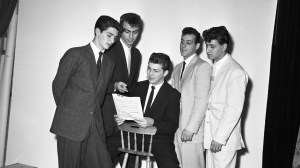
NEW YORK – SEPTEMBER 1958: Pianist Bob Gaudio, drummer Tom Austin, tenor sax Larry Qualiano, singer Dianne Costello and guitarist Billy Dalton of the rock and roll band "The Royal Teens" pose for a portrait in September or October of 1958 at the Brooklyn Paramount in New York, New York. (Photo by PoPsie Randolph/Michael Ochs Archives/Getty Images) -
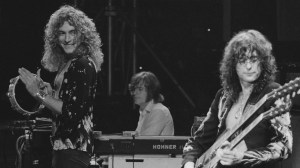
Left to right: Robert Plant, John Paul Jones and Jimmy Page, of British heavy rock group Led Zeppelin, performing at Earl's Court, London, May 1975. The band were initially booked to play three nights at the venue, from 23rd to 25th May, but due to public demand, two more concerts were later added, for 17th and 18th May. Total ticket sales were 85,000. (Photo by Michael Putland/Getty Images) -
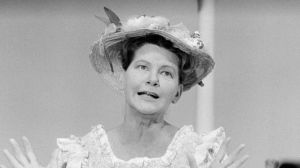
American country comedienne Minnie Pearl (1912 – 1996) performing, circa 1970. (Photo by Silver Screen Collection/Getty Images) -
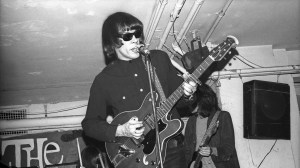
NEW YORK – JUNE 11: Rock and roll band Steppenwolf (L-R Jerry Edmonton, John Kay and Michael Monarch) perform at Steve Paul's The Scene nightclub on June 11, 1968 in New York, New York. (Photo by Don Paulsen/Michael Ochs Archives/Getty Images) -
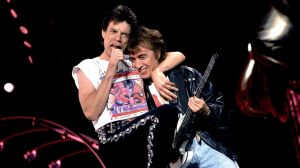
British musicians Mick Jagger (left) and Bill Wyman of the Rolling Stones performs on stage during the band's 'Steel Wheels' tour, late 1989. (Photo by Paul Natkin/Getty Images)