
A good musician might listen to the professional advice of their record label or publisher, but a great musician is more likely to listen to their audience instead. Such was the case for Hank Williams in the late 1940s, when he pushed back against his producer Fred Rose’s wishes and recorded “Lovesick Blues”. Rose didn’t think the old Tin Pan Alley song was worth the country singer’s recording.
But Williams knew he had a potential hit on his hands. According to the Shreveport Times, when Williams played “Lovesick Blues” on Louisiana Hayride, “capacity crowds…nearly [tore] the house down for encores” (via the Library of Congress). That was enough to convince Williams that he ought to release a version of the track, regardless of what Rose had to say.
Videos by American Songwriter
And indeed, Rose certainly had plenty to say. When Williams finally got into the studio, Rose called “Lovesick Blues” a “disaster.” Williams replied, “I’ll tell you one damn thing. You might not like the song. But when I walk off stage and throw my hat back on the stage and the hat encores, that’s pretty hot.”
Why Was There so Much Pushback Against “Lovesick Blues”?
Decades later, it’s hard to imagine a world in which “Lovesick Blues” isn’t a Hank Williams tune. The song is synonymous with his musical legacy and sound. But in the late 1940s, Williams’ sound was defined by major-chord cowboy songs. “Lovesick Blues” had a minor section, which was unheard of for Williams at the time. That, paired with the arrangement of verses, choruses, and bridges, is what made Fred Rose so hesitant to let Williams cut a version of the song.
Ultimately, though, he was wrong. Williams was right. “Lovesick Blues” soared to the top of the charts, becoming the first of eleven No. 1 hits the singer would enjoy during his tragically short lifetime. The song, which stayed at the No. 1 spot for sixteen weeks straight, bolstered Williams throughout his career, and it remains one of his best-known and most beloved tracks even to this day.
Louisiana Hayride’s Horace Logan later remembered, “[Hank] was the first real star we had. The last show he encored ‘Lovesick Blues’ seven times—he could have encored it ten times. I never let anybody encore more than seven times, to keep Hank’s record.”
For whatever it’s worth, not even all of the hubbub around “Lovesick Blues” was enough to change Rose’s mind. When he heard the final studio version of the track, he reportedly told Williams, “My God, Hank, I still say that’s the worst song I’ve ever heard.” We’d guess he had few complaints when the checks for that “disastrous” song cleared.
Photo by Michael Ochs Archives/Getty Images
More Behind The Song
-
Left to right: Robert Plant, John Paul Jones and Jimmy Page, of British heavy rock group Led Zeppelin, performing at Earl's Court, London, May 1975. The band were initially booked to play three nights at the venue, from 23rd to 25th May, but due to public demand, two more concerts were later added, for 17th and 18th May. Total ticket sales were 85,000. (Photo by Michael Putland/Getty Images) -
Portrait of country singer Eddie Rabbitt in Memphis, Tennessee, May 31, 1981. (Photo by Paul Natkin/Getty Images) -
LOS ANGELES – FEBRUARY 22: 31st Annual Grammy Awards. Broadcast February 22, 1989. Shrine Auditorium, Los Angeles, California. Pictured accepting award is Bobby McFerrin. His song "Don't Worry, Be Happy" won Record of the Year, Song of the Year, and Best Pop Vocal Performance, Male. Also Best Jazz Vocal Performance, Male. (Photo by CBS via Getty Images) -
LAS VEGAS, NEVADA – APRIL 03: Singers Mike McGuire (L) and Marty Raybon of Shenandoah attend the 51st Academy of Country Music Awards at MGM Grand Garden Arena on April 3, 2016 in Las Vegas, Nevada. (Photo by Rick Diamond/ACM2016/Getty Images for dcp) -
Photo by Tim Mosenfelder/Getty Images -
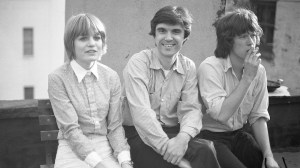
The three founding members of Talking Heads on a Manhattan rooftop, US, 1976. (Jerry Harrison would join the group at the beginning of 1977.) (L-R) Bassist Tina Weymouth, singer-guitarist David Byrne and drummer Chris Frantz. (Photo by Linda D. Robbins/Getty Images) -
Patty Smyth of Scandal at the Poplar Creek Music Theater in Hoffman Estates, Illinois, June 3, 1983. (Photo by Paul Natkin/Getty Images) -
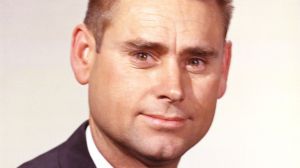
Photo by Michael Ochs Archives/Getty Images