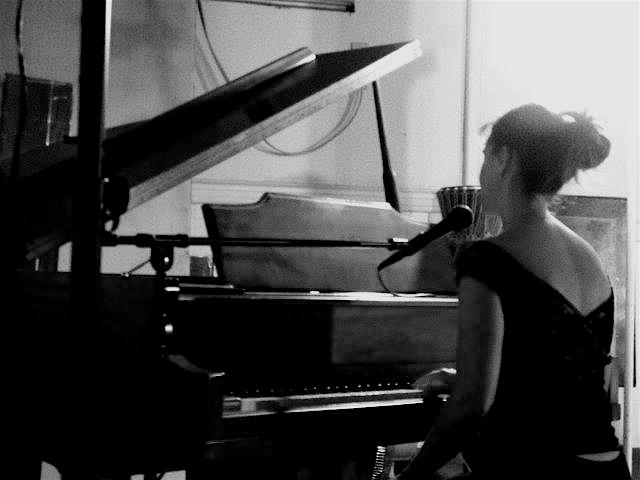
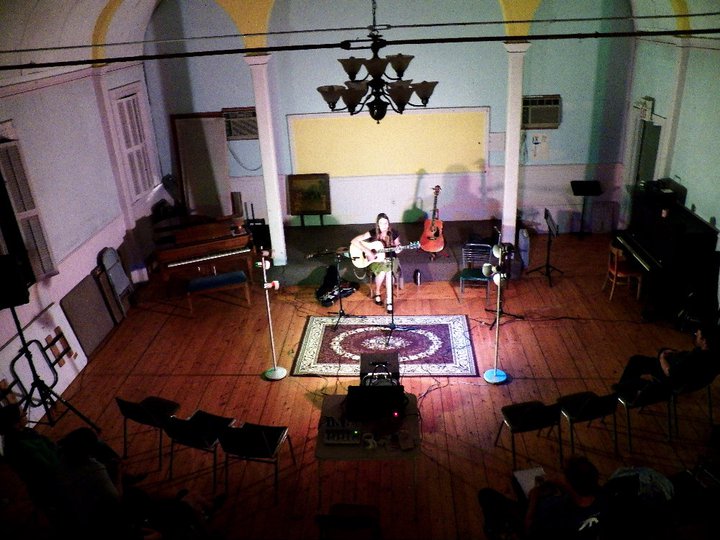
(Tania Alexander performs during an open mic at The Mediator Stage.)
Tania Alexandra, seated at a baby grand piano, turns around and breaks into an awkward grin. The piano at The Mediator Stage in Providence, Rhode Island, faces away from the audience in this old church, stage right. Colored lights play the dust on it. Alexander sings, her back to the crowd, a dark ballad. A confident voice, and a good piano player, she hardly needs the reels of well-timed thunder that begin as she closes in on the last verse of her song. But they don’t hurt. She’s unfamiliar here, and the regulars weren’t sure what to expect when her name was called near the end of the open mic. She drives into crescendos, the thunder like tympani, double bass, rain hitting clapboard snares just the other side of the walls. She lucked out, and as the thunder cedes to a heavy ovation, it becomes clear that her weird fortune has benefited all in attendance. Anecdotes like this one are not uncommon at The Mediator Stage: a dialog on the history and merits of St. James Infirmary Blues emerged during a performer’s open mic set; a recent in-the-round show evolved into a match of one-upmanship between a talented newcomer and the regular who had the misfortune to perform after him in the rotation.
New to New England, Alexander came by The Mediator to hear her friend Christopher Moon, who was the featured performer that night and playing, as he often does, with his girlfriend Kim Lamothe. Moon and Lamothe are among the better-known handful of Rhode Island’s younger, folksy singer-songwriters. In addition to Alexander and the Mediator regulars performing on this night are Allysen Callery, an institution on Rhode Island’s singer-songwriter circuit; a pair of poets who stopped by to cross-promote a poetry slam in town; an outlandishly dressed hippie with a galloping rhythm and a huge voice; Dan Oulette, a performance artist who sings tongue-in-cheek postmodern verses over a laptop computer’s synthesized backing tracks. The night closes, as has become a tradition, with a group sing-along of Bob Dylan’s “Knockin’ on Heaven’s Door” led by regular Bob Fitzgerald and his twelve-string acoustic. Alexander returns to the piano for the finale, other attendees picking up their guitars, harmonicas, mandolins, lending their voices to the easiest, most familiar song not sung at birthday parties. It is likely one of the most diverse performances of “Knockin’ on Heaven’s Door” the audience is likely to witness but, except for the thunder, it’s just another Thursday night on Rounds Avenue.
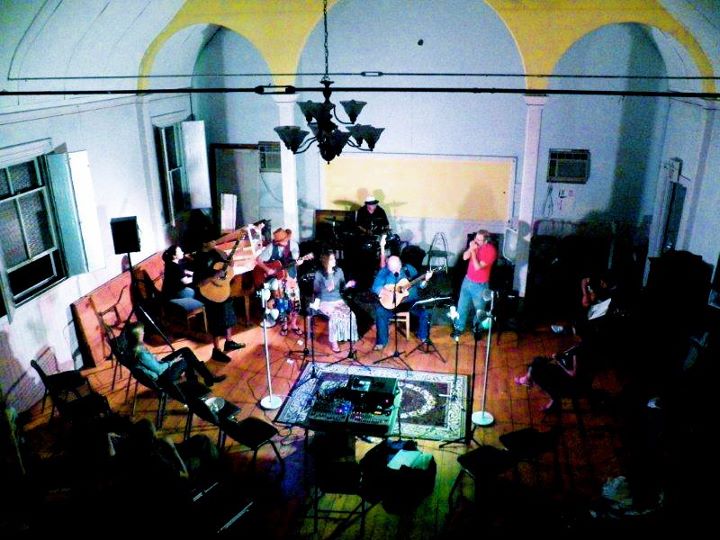
(Performing “Knockin’ On Heaven’s Door.”)
Since singer-songwriter Donald Tassone took over The Mediator’s music events and began implementing popular new elements like the sing-along (called the ‘Door-jam), a monthly in-the-round show, and recording sets, attendance at The Mediator has shown modest growth. A devoted field of regulars signs up or is there listening almost every week. The New England music scene is taking notice, as well. It’s not uncommon to find well-known local acts featuring or on the open mic list: Boston’s Ian Fitzgerald is a semi-regular–attending with The Mediator’s unofficial opener and closer, his father, Bob; songwriter scene luminaries like Marilynn Manfra, Charlie Cover, Jacob Haller, Jan Luby, John Fuzek, Steve Allain, and the Grass Gypsies are not strangers to The Mediator. Among the performers have been established Rhode Island acts like Sit Down Baby, Kim Trusty, Reverend Bastien, members of The Sugar Honey Iced Tea. Attendance at The Mediator is not reserved for the less-than-rowdy, either: local rock acts, or at least some of their moving parts, have been known to stop by The Mediator, including Fall and Bounce, and members of Detroit Rebellion and The Benedictions.
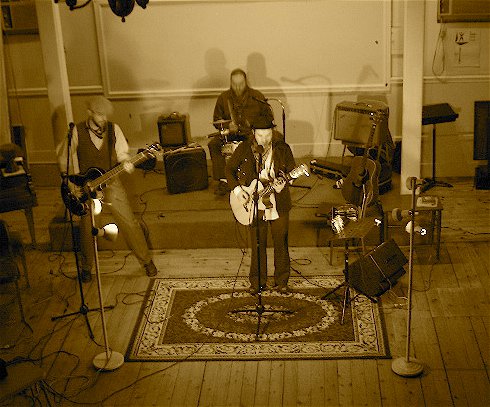
(Reverend Bastien and His Congregation of the Traveling Empire)
The Mediator Stage is permitted to host musical events, for free, by The Mediator Fellowship, a Unitarian Universalist fellowship housed by a dusty old church in a residential neighborhood on the line between Providence and Cranston. (Religion, despite the venue and the protestations of the thunder, stays out of the proceedings. Here, atheists sing with the devout.) In 2007, Brad Maloney, a Rhode Island fiddle player and local music writer, approached The Mediator Fellowship about hosting an open mic series there. Maloney recruited a rotation of hosts: Frank Martyn, Art Toegemann, and Tassone, all Rhode Island music scene regulars, each taking one week per month to host the Thursday night open mic. Using the connections each host had cultivated, The Mediator drew from an impressive field of New England talent for the series’ featured performers: The Low Anthem, The Accident that Led Me to the World, Superchief Trio, Ian Fitzgerald, Marc Cutler all played feature sets during open mic nights.
“In the beginning,” says Tassone, the event was “limping along with little or no promotion, recognition, or attendance.” Hosts began to lose interest, and fall away. Ben Miller, from The Low Anthem, remembers the band’s open mic feature during this time. “There were eleven people there and when we pulled up we drove past it twice–we didn’t think it was a venue.”
“I had the idea of using my night, which was poorly attended anyway, to try something different,” says Tassone. “I was a member of the Rhode Island Songwriters Association back then and always enjoyed the Songwriters in the Round series.” Songwriters in the Round is RISA’s signature event, recruiting trios of local members to join the event’s host in a monthly set of alternating songs, one of which is a brand new composition written on a preselected theme and performed for the first time during the event. “I came up with my own songwriters’ showcase,” says Tassone, “it would be angular, square–like the room–not ‘in the round.’ I would book four songwriters, each taking turns singing on four different categories: signature song, current best song, theme of the night and song of love or hate.” He called it Four Corners.
Four Corners, benefiting from Tassone’s promotional diligence, ran stably, if quietly at first. Performers are more forgiving about attendance at such events: even with an empty room they have, at least, each other to play for. The open mic, recalls Tassone, foundered. “I remember once booking harp guitarist Chief Noda…and the only people present were me, Art and Chief…It was around this time–about two years ago–that I decided to step up promotion and really push what I felt made the venue unique.”
According to many who have performed at The Mediator, what makes it unique is its sound. And its silence. “That room is entirely perfect for acoustic performances,” says Mark Mandeville of The Accident that Led Me to the World, “it’s just that the audience must be receptive to quietly and respectfully listening.” And this is what makes The Mediator unique among Providence music venues. “It would be a true ‘listening room.’” says Tassone, “with no competition from latte machines or chatter from bar-room stools. There would be an intermission, so everyone could talk then, and ‘fellowship.’” Former host Frank Martyn concurs, citing the “‘no talking’ rule, during performance, that is enforced…It’s different from bars, of course, even coffeehouses.” “It is a church, after all,” says Tassone. With the audience listening, the room’s natural sound is laid bare. When The Accident that Led Me to the World performed a feature set, they never turned on their microphones. No one ever knew. “The natural reverb,” says Malyssa BellaRosa of Fall and Bounce, “lends to a giant live sound. You can’t help but want to sing.” “It’s very vibey, but bare,” says Miller, “with a slap delay off the back wall that can’t be ignored.”
Some found the sound of the room a little too hot, especially when sent through a public address system. “The acoustics were a challenge,” says Martyn. “We tried baffles, rugs, P.A. settings. Our tweaks had some success, but it’s a big effort.” When local singer-songwriter Scott Lewis became a regular, his ear and skills at the soundboard, in addition to upgrades to the public address system, settled the room down. Now, The Mediator hosts rich, clear performances, accommodating a broad range of musical styles, even the aforementioned techno and poetry. Performances are regularly recorded. Last year, Lewis and Tassone circulated home-pressed discs of The Mediator’s marathon 2010 Four Corners season-opening show: sixteen songwriters performing four songs each. Inspired by the quality of Mediator recordings circulating around the web, a regular attendee is planning to record a live album during a feature later this year.
Although Tassone made a promotional push, posting advertisements with local media outlets and using social media websites aggressively, a wide portion of The Mediator’s success comes from a more traditional network. The advertisements and event pages get the name, night, time, and featured performers out there, but many learn about The Mediator face-to-face. Bob Fitzgerald became a regular after attending Ian’s feature performances. BellaRosa learned of it directly from Tassone. Many, like Alexander, came to see a friend perform and found themselves anxious to return. Some, already aware of it, hear from fellow musicians that it’s worth signing up for the audience, the sound, the camaraderie. Many place the appeal on this latter element. Performers new to the venue are welcomed almost immediately, play with little pressure, and usually return. It’s not unusual for regulars to join each other’s performances. Regulars get to know each other well enough to be in on mild ribbing that takes on, for example, Martyn’s loquacity, Ian Fitzgerald’s reticence, the out-sized sounds and personalities: at The Mediator, humility is as much a regular as intimacy.
But perhaps the appeal lies elsewhere. Says Miller: “There’s something creepy about The Mediator…It has a mysterious limbo, as if God has His doubts about the place…It’s splotchy and unassuming.” Remaining with Miller’s simile, we can perhaps assume that some higher power approved of at least Tania Alexander’s performance. “One that I won’t forget,” she says. “I had goose bumps the entire time. It was like me and Mother Nature were playing a duet, and then I turned around to everyone standing and applauding and I realized that we all had that magical musical experience together.”
(Tracie Potochnik prepares during a sound-check at The Mediator Stage.)