
Few country songs have been as transformative for two legendary artists’ careers as “Crazy”. Penned by Willie Nelson and made definitive by Patsy Cline, this 1960s staple saved both of their careers when they needed it most. Learn more about the making of this song and the struggles it went through to get recorded below.
Videos by American Songwriter
The Story Behind Willie Nelson’s “Crazy”
Contrary to the success it found after being recorded by Cline, “Crazy” got off to a rocky start. Nelson was struggling to get cuts in Nashville. At the last possible second, he wrote this song and got it recorded, effectively saving his career. Though that wasn’t a straight-line path.
For how legendary and simply beautiful this song is, Nelson couldn’t get traction on it. He tried to sell it to others (namely country mainstay Larry Butler), but no one wanted to touch it with a ten-foot pole. In hindsight, anyone who passed on this song must’ve been out of their mind. But I reckon it was harder to tell this song’s hit potential in its day.
This torch song saw Nelson sing through unrequited love. “I’m crazy, crazy for feeling so lonely / I’m crazy, crazy for feeling so blue,” the iconic opening line reads. Few songs have captured that emotion better than this simplistic, hard-hitting ballad.
The Song That Saved Patsy Cline
As much as this song saved Nelson’s career at the last moment, it was also a savior for Cline. Shortly before she recorded this track, she went through the windshield of a car, suffering major injuries.
Once she started to record again, she was looking for material that had the opposite sentiment to “Crazy”. Cline disliked the vulnerability in this song. Additionally, she hated Nelson’s backbeat singing and off-kilter musicality.
Cline’s husband, Charlie Dick, and producer Owen Bradley convinced Cline that it would be worth leaving her hesitations behind. Reportedly begrudgingly, Cline recorded this song, earning one of her biggest hits ever.
Cline’s tender voice made for the perfect coupling for this emotional track. This song only went to No. 2, but its enduring fame makes that fact of little consequence. Nelson eventually ended up recording his own version of this song that was equally stunning, if a little unconventional. Revisit Nelson’s rendition above.
(Photo by Tracey Silva/WWD/Penske Media via Getty Images)
More Features
-
American singer, songwriter and musician Tom Petty (1950-2017) attends a press conference for his debut solo album 'Full Moon Fever', 1989. (Photo by Vinnie Zuffante/Getty Images) -
(Original Caption) A singer called Joni. Joni Mitchell, Canadian singer-songwriter, United Kingdom, 1968. The guitar-pickin' gal is Joni Mitchell, a long blonde haired Canadian folk singer. Pictured last night outside the Revolution club, Joni is here (until 1st October) for radio, television and concert appearances. Apart from concert appearances, 25 year old Joni will be heard on "Top Gear" on Radio One and "The Monday Show" on BBC 1. (Photo by © Hulton-Deutsch Collection/CORBIS/Corbis via Getty Images) -
English rock band the Beatles arrive at London Airport from the USA, with their manager Brian Epstein (1934 – 1967, in coach doorway), 2nd September 1965. From left to right, John Lennon (1940 – 1980), George Harrison (1943 – 2001), Paul McCartney and Ringo Starr. (Photo by George Stroud/Express/Hulton Archive/Getty Images) -
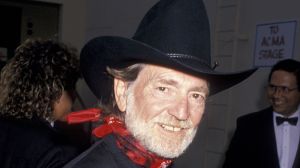
Musician Willie Nelson attends 24th Annual Academy of Country Music Awards on April 10, 1989 at Disney Studios in Burbank, California. (Photo by Ron Galella, Ltd./Ron Galella Collection via Getty Images) -
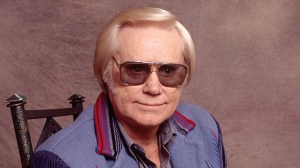
George Jones, who released several country songs about whiskey -
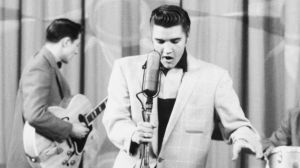
Elvis Presley and Scotty Moore (left) performing on The Milton Berle Show at NBC's Hollywood studio, Los Angeles, California, 5th June 1956. Presley performed 'I Want You, I Need You, I Love You' and 'Hound Dog'. Press reaction to his performance was largely negative with his gyrating movements during 'Hound Dog' proving particularly controversial. (Photo by Bettmann Archive/Getty Images) -
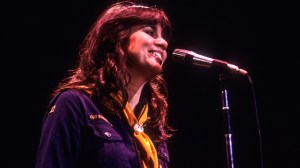
BERKELEY, CA – SEPTEMBER 1977: Linda Ronstadt performs at the Greek Theater on September 17, 1977 in Berkeley, California. (Photo by Ed Perlstein/Redferns/Getty Images) -
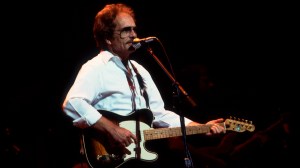
Singer and musician Merle Haggard performs at the Poplar Creek Music Theater, Hoffman Estates, Illinois, August 16, 1983. (Photo by Paul Natkin/Getty Images)