
When Jeannie C. Riley first heard “Harper Valley P.T.A.”, the song that would turn her into a one-hit wonder in 1968, she was working as a secretary for Nashville songwriter Jerry Chesnut. The demo, which sounded like a two-bit imitation of Bobbie Gentry, wasn’t enough to impress Riley. Moreover, Riley was annoyed at Plantation Records owner Shelby Singleton for insisting she change her name to Rhonda Renae and exclusively wear miniskirts, in reference to the mother who “socked it to the Harper Valley P.T.A.” Riley didn’t want to oblige either request.
Nonetheless, Riley’s friends pushed her to sign a three-year contract to record with Plantation Records, due in no small part to the fact that those friends wrote the song that the label slated for the B-side. Decades later, Riley would say, “I was mad at my friends for puttin’ me on the spot, I was mad at myself for not being able to say no, and I was mad at some other things. All that anger came out in the song. I just opened my mouth and let it rip. I sassed everybody I was mad at. That’s why it came out like that.”
Videos by American Songwriter
And indeed, that sass played exceptionally well. The one-hit wonder from 1968 topped both the Billboard Hot 100 and Hot Country Singles charts, making her the first woman to top two different charts.
This 1968 One-Hit Wonder Was Inspired by a True Story
Tom T. Hall based “Harper Valley P.T.A.” on a true story he witnessed as a child. Speaking to the Country Music Hall of Fame and Museum in 2005, Hall described the “really free spirit” from his hometown, Olive Hill, Kentucky. The local PTA contacted the woman about her lifestyle through her daughter. “She took umbrage at that and went down and made a speech to them,” Hall said. “Here’s this ordinary woman taking on the aristocracy of Olive Hill, Kentucky, population 1,300. It was unheard of.”
Jeannie C. Riley would channel this frustration into her own rendition. Somewhat ironically, though, she came to detest the image her record label wanted her to uphold—the same image the defiant mother is defending in the 1968 one-hit wonder. Riley later recalled Shelby Singleton telling her, “It doesn’t matter where you are. This is your image. This is who you are. If you’re in an airplane or in a supermarket, if you’re in church, you need to be in a miniskirt, ‘cause that’s who you are.” She replied, “Well, why? I was the little girl who brought the note home. I was made to be the mother and expected to be.”
Despite the success surrounding her debut single, Riley didn’t take well to the pop music environment. She became a born-again Christian in the mid-1970s, pivoting to gospel music. Even if she was eager to separate herself from her late 1960s image, Jeannie C. Riley’s pop-country sound and sexualized, feminine style paved the way for similar artists like Shania Twain decades later.
Photo by Doug Griffin/Toronto Star via Getty Images
More Behind The Song
-
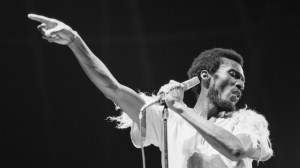
Jamaican singer Jimmy Cliff performs on stage at Porte de Pantin, in Paris. (Photo by John van Hasselt/Sygma via Getty Images) -
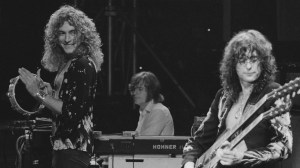
Left to right: Robert Plant, John Paul Jones and Jimmy Page, of British heavy rock group Led Zeppelin, performing at Earl's Court, London, May 1975. The band were initially booked to play three nights at the venue, from 23rd to 25th May, but due to public demand, two more concerts were later added, for 17th and 18th May. Total ticket sales were 85,000. (Photo by Michael Putland/Getty Images) -
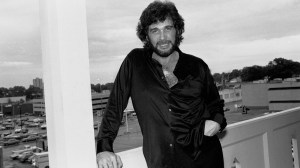
Portrait of country singer Eddie Rabbitt in Memphis, Tennessee, May 31, 1981. (Photo by Paul Natkin/Getty Images) -
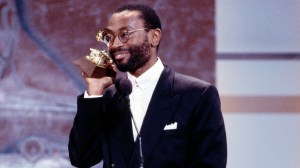
LOS ANGELES – FEBRUARY 22: 31st Annual Grammy Awards. Broadcast February 22, 1989. Shrine Auditorium, Los Angeles, California. Pictured accepting award is Bobby McFerrin. His song "Don't Worry, Be Happy" won Record of the Year, Song of the Year, and Best Pop Vocal Performance, Male. Also Best Jazz Vocal Performance, Male. (Photo by CBS via Getty Images) -
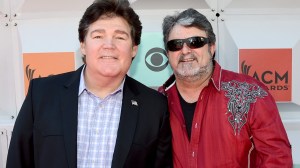
LAS VEGAS, NEVADA – APRIL 03: Singers Mike McGuire (L) and Marty Raybon of Shenandoah attend the 51st Academy of Country Music Awards at MGM Grand Garden Arena on April 3, 2016 in Las Vegas, Nevada. (Photo by Rick Diamond/ACM2016/Getty Images for dcp) -
Photo by Tim Mosenfelder/Getty Images -
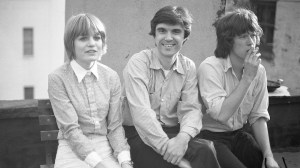
The three founding members of Talking Heads on a Manhattan rooftop, US, 1976. (Jerry Harrison would join the group at the beginning of 1977.) (L-R) Bassist Tina Weymouth, singer-guitarist David Byrne and drummer Chris Frantz. (Photo by Linda D. Robbins/Getty Images) -
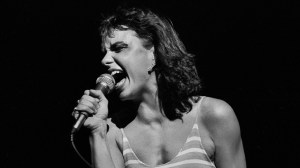
Patty Smyth of Scandal at the Poplar Creek Music Theater in Hoffman Estates, Illinois, June 3, 1983. (Photo by Paul Natkin/Getty Images)