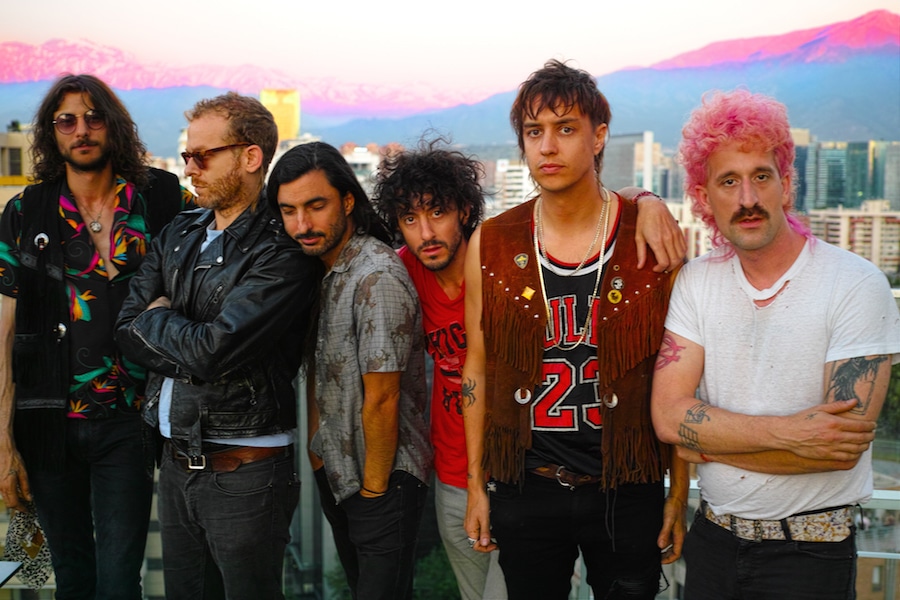
For better or for worse, Julian Casablancas will probably forever be associated with a specific time and place: New York City in the early 2000s. In 2001, his band The Strokes released their debut Is This It, an album celebrated for its feelgood, no-nonsense, hook-filled rock and roll, with impeccable reference points ranging from the likes of Iggy Pop and Lou Reed to Tom Petty and the Heartbreakers. They became one of the first big rock success stories of the still-young millennium — along with The White Stripes, who had also released their album White Blood Cells that year — which led to a hyperbolic response from critics that rock was perhaps entering a new Golden Age.
The Strokes were emblematic of an era of excess and a kind of now-quaint idea of sex, drugs and rock and roll. In fact, one of their song titles ended up being repurposed for Meet Me In The Bathroom, a salacious tome released last year that documented the hedonism and indulgence of the early ’00s rock scene. Casablancas, a few months shy of his 40th birthday, isn’t nostalgic for those days. In fact, he’s in a very different place now, psychologically, physically and geographically. In conversation, he’s low-key and thoughtful, a photo negative of the wailing rock star his music projects. And in recent years, he’s taken up residence in upstate New York, disillusioned by the rapidly gentrifying city once synonymous with his music.
“The whole beauty of New York to me — the different neighborhoods and 24 hours of Manhattan — it’s not like that anymore,” he says. “It wasn’t hard for me to leave. But I still live close, so it’s the best of all worlds.”
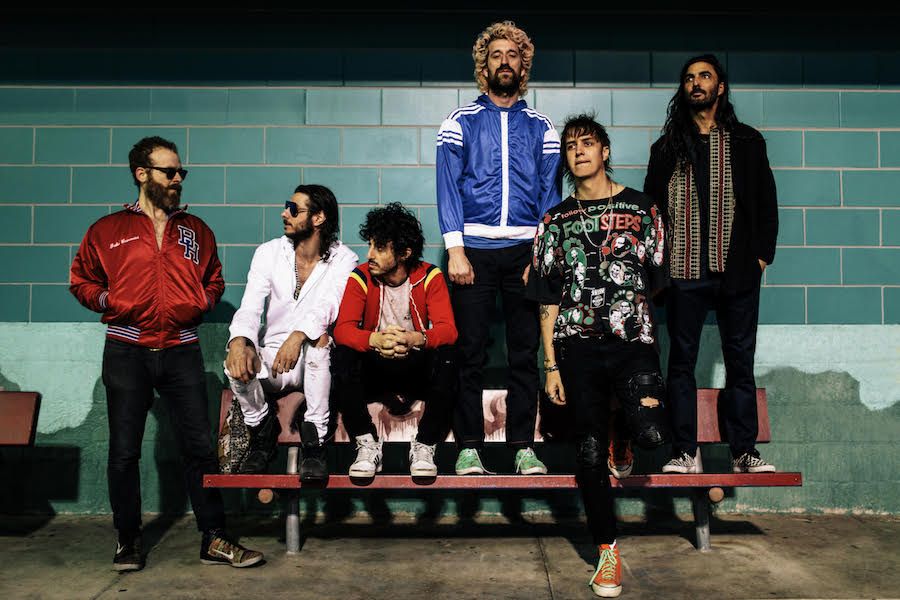
These days, Julian Casablancas is 100 percent invested in his latest creative project, The Voidz. Formed in 2013, following the release of The Strokes’ last album Comedown Machine, The Voidz have opened up a new world of creative possibilities for Casablancas and his bandmates. On their 2014 debut Tyranny, The Voidz took an everything-but-the-kitchen-sink approach to their songwriting, leaping from style to style from one song to the next, balancing lo-fi indie rock with psychedelia, and even Congolese-inspired polyrhythmic electronics. That openness and exploratory approach has carried over on Virtue, the band’s second album, released in March via Casablancas’ label, Cult.
“I think we found kind of this wild freedom in each other for the first record,” he says. “To have partners that were all so excited about these kinds of directions. I think in all our previous collaborations, we worked with people who wanted to do more standard stuff. So I think we were very encouraged about not doing that. We have total freedom.”
If anything, Virtue unfolds over an even wider expanse of sounds than its predecessor, finding the band venturing into previously unexplored terrain throughout their sophomore effort. “Leave It In My Dreams,” one of the first singles from the album, is a reasonably straightforward new wave pop track that showcases Casablancas’ knack for melody and hooks, while “QYURRYUS” incorporates elements of Middle Eastern pop music through a heavy layer of fuzz, Auto-Tuned bleating and pulsing disco beats. “Pointlessness” is a strange dirge steeped in big synthesizer sounds and curious, gothic flourishes. “All Words Are Made Up” scarcely even resembles a rock song at all, instead showcasing a heavy electronic presence as well as elements of Nigerian high-life and Afrobeat.
To a degree, Virtue is a response of sorts to Tyranny. The name, as he explains, is how Casablancas defines the opposite of tyranny. Yet on a musical level, it’s a deeper dive, if one with a more explicit aim to maintain some kind of cohesion amid the sonic diversity, which some of the band’s critics didn’t find as endearing the first time.
“Some people loved it and felt validated on some level, and some people just thought, ‘Oh, they’re being weird on purpose,’” he says. “That wasn’t the case, we were just doing stuff we thought was cool. I think this time we had that in mind, but not trying to overreact too much. We stayed true to what we wanted, but maybe cut to the chase a little more and stuck with what worked and didn’t go on wild LSD adventures in every song.”
*****
The eclectic, often unpredictable nature of The Voidz’s music is reflected in its personalities. Keyboardist Jeff Kite and drummer Alex Carapetis both played in Casablancas’ Sick Six band in support of his solo debut Phrazes For The Young in 2009. But the rest of the band — guitarists Amir Yaghmai and Jeramy Gritter and bassist Jacob Bercovici — came together just before the recording of Tyranny, building up a sense of camaraderie while figuring out the particulars of their own musical chemistry as they embarked on their earliest tour dates.
Four years later, that bond has only strengthened to the point where they all seem to speak the same language — even if trying to decipher it from the outside can be a tricky thing. In an afternoon chat with the group, things veer off topic quickly, from Yaghmai asking if they’ll be talking about the L.A. Lakers and sci-fi film Annihilation to Carapetis’ breakdown of the group’s influences to the tune of “The Fresh Prince Of Bel-Air” (“Amir likes classical, Jake likes jazz …”). One gets the sense they’re easily distracted, which speaks to the breadth of their creativity. For while they might speak each other’s language, they’re seeking to build outward on that creative vocabulary.
“There are some people who prefer to speak within the language, and some people who are drawn to expanding the language,” Bercovici says. “And I think we all have interests or curiosity about the outer reaches — being on the edge of stuff instead of retreading paths that are super enjoyable and danceable and making music that infants and grandmas can dance to and sing-along together. That stuff’s great, but it’s not why we get up in the morning. We want to see what’s weird and inspiring and unusual and unique.”
Given how many varied sounds and influences they pull from, and how eclectic the resultant set of songs, one wonders if anything is off limits to the sextet.
“Twelve-bar blues is pretty much the universal joke,” Carapetis says. “If you want to undo anything you’re doing: 12-bar blues.”
“It’s like the Chernobyl of music,” Bercovici adds. “Don’t build a new house on that.”
Loose boundaries aside, what the members of the band all agree on is the thrill that making new music brings. When the six of them are in the studio together, that’s when The Voidz are at their strongest, firing on all cylinders.
“Just putting out work is so important for anyone with any sort of art project,” Gritter says. “Any sort of creative thing is that way. If you could put us in a vacuum and we didn’t have to worry about money, we’d all just be working on records.”
The Voidz are realistic about being professional musicians, meaning that the part of being in a band they consider the most fun — the actual process of songwriting and recording — has to take a backseat to the long, hard slog of being on the road for several weeks at a time. Yaghmai refers to the touring life as “80 percent grind, 20 percent glory,” which Carapetis concurs is a pretty succinct way to put it. Still, as much as it might mean cycling through the same material over and over again to the point it’s lost its flavor, they also acknowledge that there’s still a lot of value in the less glamorous parts of being performers.
“I’ve walked by empty bars where someone is playing an acoustic guitar cover of a Bee Gees song or something, and I think genuinely he’s having more fun sometimes than when I’m playing a song I’ve played 2,000 times,” Carapetis says. “And he probably figured it out a week ago. That’s why I like playing new songs live. But the more you play a song the better you play it. Maybe you’re bored at times, but that’s the moment the crowd enjoys the most. But there are moments where the vibe and sound are great, and those are the moments you strive for.”
*****
Julian Casablancas has undergone a great deal of change in the 17 years since his early success with The Strokes. For one, he’s more outspoken in terms of his political beliefs. Is This It’s “New York City Cops,” with its refrain “they ain’t too bright,” was as topical as his previous lyrics ever got — though that track did cause a bit of controversy, being removed from the album’s U.S. tracklist (along with the risque Smell The Glove album artwork). But today, when asked about how his music is received, Casablancas says earnestly, without a hint of irony, that he hopes listeners take away the idea that “they can change the world for the better.”
It seems safe to say he’s an idealist, if not necessarily an optimist. Virtue finds Casablancas taking on a more cynical view of the powers that be, lamenting on “Pyramid Of Bones,” “Truth is complex, lies are simple/ Murder in the name of national security.” He repeats that “lies are simple, truth complex” mantra in “Permanent High School,” only later on to ponder, “When did my dreams tear at the seam?” And on “Horse To Water,” he takes bad corporate actors to task, singing, “And they said that mother nature couldn’t give us what we need … and that explains the factories and pollution in the stream.”
That’s not the only change Casablancas has undergone. He’s also living a lot more healthfully than he used to. He stopped drinking alcohol, which he referred to in a 2014 Rolling Stone interview as “asshole serum.” Yet the consequence of getting sober was growing more confident in his own abilities.
“I drank, maybe, to make up for lack of experience and things I wanted to learn,” he says. “It was almost like a false confidence thing. I think I gained that confidence over time and I don’t need to drink to feel that. I’m a little bit more in control. And that feels nice, I guess, because I’ve made it.”
Part of that confidence is being honest about what he wants out of his music. Casablancas hasn’t released new music with The Strokes in five years, though their next could possibly arrive sometime next year. Still, he’s come to acknowledge The Strokes as being just one shade on his palette. He speaks of his work with The Strokes affectionately, while realizing there’s so much more he aims to do. The Voidz, for Casablancas, is exactly the outlet he needed.
“You’re always grateful with what you have … and it’s not that you’re not satisfied. Like, we got to that point and it’s great, but it felt like the mountain I wanted to climb was a higher mountain, I suppose,” he says. “And it’s not that I was dissatisfied with what we were doing, it was just phase one. The ultimate goal was to support myself doing music, so it was kind of like these goals and dreams were realized. On the one hand I was very happy, and then on another I think I had a longer term ambition, and I don’t know if that really carried through to the other guys so much.
“In terms of the musical journey I see myself on, I feel like now it might intersect and go back and forth,” he adds. “My goal was to focus on vocals and words, and every person in the band would be the best drummer and best guitarist, not just technically but live and everything. I used to kind of write all that stuff in The Strokes, but I didn’t want to, long term. I think the way things evolved did not evolve the way I specifically envisioned it, which is fine. But I think this situation is what my dream was.”
More Features
-
April 1964: Legendary American rock'n'roll singer Roy Orbison (1936 – 1988) at Dolphin Square in London. (Photo by Moore/Fox Photos/Getty Images) -
HOLLYWOOD – DECEMBER 13, 1975: Disco singer Gloria Gaynor performs a song on December 13, 1975, in Hollywood, California. (Photo by Michael Ochs Archives/Getty Images) -
Singer Mahalia Jackson singing at reception in hotel. (Photo by Don Cravens/Getty Images) -
Circa 1965, American country singer and songwriter Loretta Lynn performs on stage at the Grand Ole Opry, Nashville, Tennessee, 1960s. (Photo by Getty Images/Getty Images) -
Photo by Michael Ochs Archives/Getty Images -
American country music singer Earl Thomas Conley (1941 – 2019) performs at the Poplar Creek Music Theater in Hoffman Estates, Illinois, May 26, 1985 in Hoffman Estates, Illinois (Photo by Paul Natkin/Getty Images)