
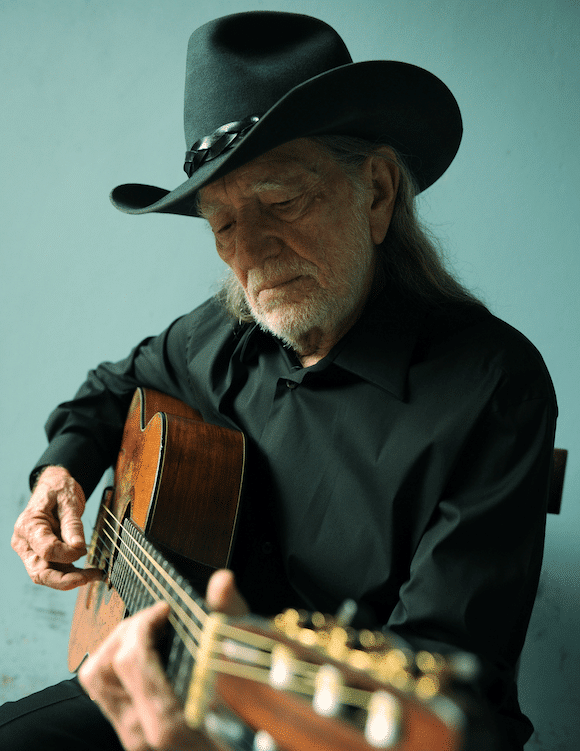
The word “legend” gets tossed around often, but if anyone fits the definition, it’s Willie Nelson. Though venerated as a co-founder of outlaw country, his recorded output spans nearly the entire spectrum of popular song and stands as one of the greatest bodies of work in modern music history. His cultural impact stretches even further; he’s an established film and television actor and best-selling author, not to mention philanthropist and crusader for humanitarian causes. As he approaches his 85th birthday, it’s fair to ask what makes the man a legend — and the legend a man. The verdict: It’s as much about character as career. Maybe more.
Just after 4:20 p.m. on April 20, 2012, Willie Nelson stood on a street corner in Austin, Texas, looking mildly bemused. Squinting in the sun, he peered at a newly unveiled statue — a larger-than-life bronze replica of himself.
As he studied that benevolent-looking visage, regarding its faithfully rendered part-Cherokee cheekbones, chest-length braids under his trademark bandanna, and even Trigger, his well-worn Martin acoustic, the irony of this honor was not lost on him. Most people will never know the peculiar experience of standing next to their own statue; usually, we raise monuments to icons posthumously. And yet, here he was, immortalized with the most reverential symbol we bestow upon our heroes, erected in homage to someone who became one of the world’s most successful artists and elder statesmen by thumbing his nose at Nashville’s music establishment, and the establishment in general.
Noting the time — a number particularly relevant to cannabis fans — he debuted a song from his then-upcoming album, Heroes, titled “Roll Me Up” (a.k.a. “Roll Me Up And Smoke Me When I Die”). The winking acknowledgement of his favorite indulgence at such an event somehow perfectly conveyed why he’s a bona-fide, no-last-name-needed legend. His role in establishing outlaw country bronzes his place in music history, but his low-key, good-natured attitude and unwillingness to take himself too seriously endear him even to people who don’t care about his music. His peace activism and support of family farms, animal rescue, marijuana legalization, LGBTQ rights and environmental causes cement the deal.
The statue partly commemorates Willie’s role in helping Austin become “the live music capital of the world.” It sits at Willie Nelson Boulevard and Lavaca Street in front of Austin City Limits Live at the Moody Theater, a venue he helped build — not only with dollars (his nephew, Freddy Fletcher, conceived the place), but as the artist whose pilot appearance helped sell Austin City Limits, a little public-television show that eventually established Austin’s musical credibility worldwide and is now nearly as iconic as he is.
But no matter where Willie goes, seemingly everybody loves this well-weathered 84-year-old, who’s regarded more as a kindhearted, joke-telling stoner granddad than a threat to any status quo — musical, political or otherwise (despite his 5th-degree black belt in the martial art Gongkwon Yusul). That’s fine by him; the status quo, he knows, will catch up eventually.
Like Ray Charles, one of his heroes, Willie revels in defying expectations. His career finally flourished once he started breaking the rules and doing what he damned well pleased, including writing concept albums; playing a guitar on life-support, with an oddly attached macramé strap; forsaking his suited-up, short-haired mainstream-country look for jeans and waist-length braids; promoting biodiesel; and openly endorsing weed long before any state legalized it.
*****
“Willie goes out on a limb all the time musically. And that’s a good place. There’s not many people out there,” says Buddy Cannon, who writes with Willie and has produced most of his albums since 2008. “Everything that early Nashville thought was wrong with Willie’s way of singing and playing was what I loved.”
Cannon is referring to Willie’s intricate, Django Reinhardt-influenced guitar-playing and warm, slightly nasal voice, informed by western swing and employed in a unique, jazz-inflected, behind-the-beat style most singers would never associate with country.
Asleep at the Wheel’s Ray Benson, who moved his band to Austin at Willie’s suggestion, says of his friend, “He’s not a schooled musician, but his music turns out to be very complicated — more complicated than one would imagine. He has an innate musical ability; he doesn’t read or write music or know about theory, but his ear and his heart and his hands … he’s just totally natural.”
Once Willie gained artistic control over his work in the early 1970s, he stretched genre confines, then broke them altogether, recording pop classics, collaborating with top jazz and blues artists and even dabbling with reggae, rap and opera stars. He’s sung with Luciano Pavarotti, Julio Iglesias, B.B. King, Wynton Marsalis, Diana Krall, Norah Jones, Snoop Dogg, Kid Rock and even Frank Sinatra, one of his major influences.
There’s really no one left on his wish list, if he ever had one.
“Oh, I’d love to sing or play with everybody,” he says, adding, “I‘ve been lucky to be able to record and sing with just about anybody I ever thought of. Even Barbra Streisand and I, we have a record together. It hasn’t come out, but we have one we cut that I thought was pretty good.”
For some reason, Streisand left their duet off her album. But justice prevailed. “We beat her for the Grammy,” Cannon says. “We thought that was kind of funny.”
That 2017 Best Traditional Pop Vocal Album Grammy, Willie’s eighth, was for Summertime: Willie Nelson Sings Gershwin, his latest dive into the Great American Songbook. His first was 1978’s Stardust — another Grammy winner (for “Georgia On My Mind”). It’s ensconced in the Grammy Hall of Fame along with his 1975 classic, Red Headed Stranger, and 1976’s Wanted: The Outlaws, with Waylon Jennings, Tompall Glaser and Jessi Colter, which became country’s first million-selling album. His singles “Always On My Mind” and “On The Road Again” are also Grammy Hall of Famers, joining Patsy Cline’s cover of “Crazy” and Faron Young’s “Hello Walls” (all unofficial entries in that songbook). He’s also received President’s Merit and Lifetime Achievement Grammys, and was among four inaugural Grammy Legend Award winners.
Summertime was conceived after another honor: the Library of Congress’ 2015 Gershwin Prize for Popular Song. He’s the first country artist to earn it.
“I was fortunate enough to be introduced to all kinds of music growing up, from “Stardust” to Hank Williams,” Willie explains while relaxing in his bus during his Fourth of July Picnic, an event he’s hosted almost annually since 1973. “I got a Gershwin award, so I figured it was only fair that I do a Gershwin album. I really ripped off Sinatra; I went to the Internet and found everything on there that Sinatra had done for Gershwin and I said, ‘I’d like to do it exactly that way.’
Laughing, he adds, “I sent all that to my producer and I said, ‘Good luck.’”
*****
Cannon, luckily, knows how to handle whatever Willie sends. They first worked together on a George Jones album track; after that, whenever Cannon’s requests filtered to Willie, he always agreed.
“Willie is always willing to come around if somebody asks,” Cannon says. “I don’t know if he ever has said no. He’s always been so generous with his gift.” After Cannon asked Willie to join Kenny Chesney on the pop nugget, “That Lucky Old Sun (Just Rolls Around Heaven All Day),” he sent Willie his mix.
“I was on vacation down in Florida,” Cannon narrates. “My cell phone rang, and it was a blocked number. I answered and he said, ‘Hey Buddy, it’s Willie.’ My hands were a little shaky. He said, ‘Hey man, I just got this rough mix. I love this. This is the best I’ve ever heard this song recorded.’ And he said, ‘Let’s find some songs and go in and make a record.’
“I called Kenny and told him what happened, and he said, ‘I want to help!’ So Kenny and I ended up co-producing that next Willie album [Moment Of Forever], and we had a blast. It was so much fun. From that point on, I had his phone number.”
Eventually, Willie called again, asking, “Why don’t you get some pickers together and come down to my studio for three or four days and see what happens?”
Cannon recalls, “I handpicked some guys that I knew would have as much respect and excitement about doing that as I did. And we went down to Willie’s studio.”
They cut 26 songs at Pedernales. The first batch became Heroes; the rest became Willie And The Boys: Willie’s Stash, Vol. 2, featuring Lukas and his younger brother, Micah — Willie’s sons with his fourth wife, Annie. That was his second 2017 release; his first, God’s Problem Child, came out on April 28, a day before his 84th birthday.
Addressing mortality with humor (“Still Not Dead”) and gravity (Gary Nicholson’s Merle Haggard ode “He Won’t Ever Be Gone”), it also includes Leon Russell’s final vocal session on the title track. The album hit Billboard’s Top Country Albums chart at No. 1 — a spot Willie has held 17 times, according to the magazine. He also holds the chart’s record for top 10s, with 50.
*****
Willie’s longtime publicist, Elaine Schock, says no one knows exactly how many studio albums he’s done. Some sources report 72 — plus 32 collaborations, 12 live albums, 37 compilations and well over 200 guest spots. And he’s always adding more. Before the holidays, he and Cannon worked on an album of new songs for possible spring release.
Benson, who produced Willie And The Wheel, their Grammy-nominated western-swing collaboration, just recorded Willie with ukulele wizard Jake Shimabukuro, and got Willie and George Strait together. Unbelievably, the two Texans had never collaborated.
“The point is to always try to point Willie in a cool direction,” Benson says.
Apparently, he’s good at it, though Willie admits, “I just play it by ear. If it sounds good and feels good, do it.”
*****
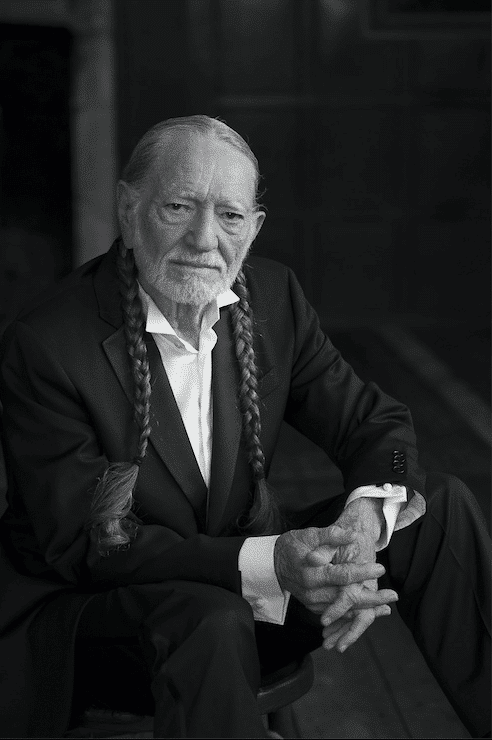
That may extend beyond performing, though his outlaw ways and hard-living days are behind him. Pot busts might not be, but even that threat is subsiding as legalization spreads.
“I didn’t really think it would happen in my lifetime,” he says of the changing laws, which have allowed him to establish his premium Willie’s Reserve brand. “I always thought that it would one day, but it’s happening faster than I thought.”
Unlike his Old Whiskey River bourbon, he actually uses Willie’s Reserve; he gave up alcohol and cigarettes some time ago.
“I’m glad he quit drinking, because he wasn’t the easiest person to get along with when he was drunk, to be honest, and he knows it,” Benson says. “Although there were also times when he was drunk when he did the most brilliant shit I ever saw.”
Willie can still outsmoke Snoop Dogg and slaughter at poker; he still golfs and rides horses, too — when he’s not busy rescuing them, or stumping for family farmers, even three decades after founding Farm Aid with Neil Young and John Mellencamp.
“We thought that if we did one, that all the smart people up there in Washington would say ‘Hey, these guys have an idea here. We should follow up on it.’ No. That’s not in their agenda,” he says. “A lot of the big corporations, they could care less what happens to the small family farmer, and that’s unfortunate. We’ve been fightin’ ‘em for 40 years, and we’ll fight ‘em another 40. They’re not gonna change, but we’re not, either.”
Willie is obviously tenacious; he’s also generous. One reason he famously got into such hot water with the IRS was because he couldn’t wrangle enough cash to pay a proposed settlement; he’d spent it supporting friends and relatives. But his loyalty is unshakable: Willie isn’t surrounded by bodyguards; he’s got friends and family, including his sister, pianist Bobbie, and the other lifer members of his Family band and crew. His daughters Paula and Amy are performers, too.
During the 25 weeks a year when he’s not on the road, Willie splits his time between Maui, Hawaii, and Luck Ranch, his spread in Spicewood, 45 minutes from Austin.
After the IRS seized his ranch in 1990, Benson asked how he was doing. “He went, ‘Oh, I’m fine,’” Benson reports. “He says, ‘Look, I got a goddamned Rolex and a Mercedes Benz; I can walk into any fuckin’ honky-tonk I want and walk out with cash in my pocket. I’m a little embarrassed for my family that they gotta listen to it.’ That’s Willie, and that’s, I think, one of the great lessons I learned from Willie: Don’t sweat it.”
When Benson was young and broke, Willie offered free recording time, and sometimes cash, or hired him to open shows.
“I wouldn’t be here as Ray Benson or Asleep at the Wheel without Willie Nelson. Period,” he swears. “Luckily for the world, Willie thinks about himself third. He thinks about the world first.” Both volunteer immediately for any post-disaster fundraiser; the amount they’ve tallied over the years is likely incalculable.
Says Lukas, “The folks who go down in history as being the most respected and well loved are the ones who have been able to find a way to take their gifts and give them. And Dad is one of those people.”
Benson offers another observation. “The man is comfortable in being himself in every situation,” he says. “That’s the other thing I learned from Willie: It’s a happy man who wakes up and does what he thinks is right and good and that he wants to do every day.”
Willie doesn’t dwell on past hardships; he has what matters, including Trigger, which he saved from both the IRS and a fire that engulfed his Nashville home. The one tragedy he’ll never get over is his son Billy’s suicide. But he doesn’t dwell on that, either.
“I really do, more or less, live one day at a time,” he says. “That way, I don’t have to worry about tomorrow, or yesterday, or a while ago, or after a while. I’m just right now. That’s the only thing I can do anything about.”
That Zen attitude may have helped to jumpstart his career after he left Nashville for Austin in the early ’70s — and found his shows drawing both rock- and folk-loving longhairs and country-craving “rednecks.” Together, they forged what writer, record-label executive and former Austinite Bill Bentley labeled “a marriage made in hippie-hillbilly heaven.”
The music Willie and pals Waylon Jennings, Kris Kristofferson, Jerry Jeff Walker, Billy Joe Shaver and others were playing for those audiences — an amalgamation of country’s traditions, folk’s expressiveness, rock’s convention-flouting attitude, some gospel and blues, and Texas’ dancehall- and honky-tonk liveliness (not to mention its fiercely independent, frontier ethos, which predisposed fans to accept renegade artists) — became known as outlaw country.
But Willie often gets credit for fusing hippies and honky-tonkers into one groovin’ gang of cosmic cowboys because the glue set at those Fourth of July Picnics.
*****
Perhaps paradoxically for someone whose career exploded once he started ignoring rules, Willie has one he doesn’t break: He won’t spout opinions while performing.
“I don’t do politics onstage because I just assume I have all kinds of people out there,” he explains. “Not only Democrats and Republicans, but Baptists and Methodists. I don’t want to do anything or sing anything that would be derogatory about any of those folks, ’cause I’m glad they’re there. And politics shouldn’t be in there. I think they came to see and hear music; I don’t think they’ve come to hear me tell ’em how to vote.”
Offstage, he’s not shy about expressing his views.
“Ask me what I think and I’ll tell you,” he says. He’s also fond of weaving his opinions into humorous songs. But even when he takes sly pokes at close-minded attitudes, such as his Valentine’s Day cover of “Cowboys Are Frequently Secretly Fond Of Each Other” — which tweaked homophobic critics of the groundbreaking 2006 film Brokeback Mountain — he’s never suffered major boycotts. (He did avert one by apologizing to police officers after playing a fundraiser for Leonard Peltier, the Native American activist then charged with killing two FBI agents).
“He’s always written about things that people can relate to in a very clever and very simple way,” says Lukas. “Like any great poet, he’s taken simplicity and injected it with complexity and truth … his art speaks to every single human being on the planet, if they’re in touch with their feelings.”
In 2007, the University of Texas’ Project on Conflict Resolution gave Willie its inaugural Bridging Divides Award, for showing the world that art can “advanc[e] peace and understanding among diverse audiences.”
Says Cannon, “If there were more people like him in the world, the world would be a lot more gentle.”
*****
Willie claims doesn’t co-write easily, but Cannon is an exception. They co-authored seven tracks on God’s Problem Child.
“We’re workin’ on one now called ‘Bad Breath Is Better Than No Breath At All,’” Willie cracks, adding, “I was gonna put ‘halitosis’ in there, but I couldn’t spell it.”
As Willie describes their process, it sounds easy.
“I start with an idea and he’ll add a verse or a melody and the next thing you know, we’ve got a song,” he says.
When they began collaborating, Willie just started texting, Cannon says. “I would just pick it up wherever he dropped off and add to it. We’ve written probably 30 songs that way and we’ve never sat in a room with a guitar anywhere. Everything we’ve written has been over text-messaging.”
They rough out a melody, then Cannon cuts a music track, they enter the studio and Willie sings.
“He always changes everything, melodically, when he gets it — it doesn’t matter if it’s Hank Williams or whatever,” Cannon says. “He puts his own twist to it. The melody is not written until Willie’s in there behind the microphone singing it.
“That’s the way it’s been working for us, and he loves it and I love it,” Cannon says. “It’s an unorthodox way of doin’ things, but neither one of us have ever been accused of being normal.”
*****
Speaking of requests, Willie doesn’t turn them down for autographs, either; after his shows, he used to sign anything he was handed, even just-removed socks, for as long as it took.
“I like people and I like hangin’ out with folks,” he says. “I’ll hang out until I run out of air. I’ll sign autographs until I can’t anymore because that’s what I think I’m supposed to do.”
That might also apply to his support of young artists, from Los Lonely Boys to Jamey Johnson and new Interscope signee Lily Meola, all of whom graced Farm Aid bills before anyone knew their names.
“He always understood the value of hard work and persistence,” says Lukas, who’s also inspired by traits his dad and sometime-boss, Neil Young, share: “Integrity in their work and their artistry, not bowing down to trends or what’s selling, and just staying true to who they are.”
Lukas could do without fans who get too emotionally invested, however. Appreciation for his dad’s work, he understands. “But considering him a god or something other than just a human being,” he warns, “is a mistake.”
No, he’s just a mortal, trying to work as long as he can. Though Willie’s voice doesn’t always sound as strong as it once did live, his studio work is as rich as ever, and his gnarled hands still coax gorgeous, silvery textures from his miraculous Trigger. And as long as people want to listen, he’s happy to keep going — regardless of how the business changes around him.
“Good music will always be here,” Willie says. “People are always gonna demand good music. And they’ll drive a long way to go see it and hear it and buy it. But the people decide what’s good.”
For over half a century, they’ve decided Willie is good. At this point, he says, there’s nothing he really needs to achieve.
“I feel like I’ve been treated fairly. More than fair,” Willie says, just before lighting up a Washington state strain of Willie’s Reserve. “I want to do a good show tonight, and that’s about it.”
Later, he ambles onstage and sings, “Whiskey River,” just as he’s done thousands of times before — and with luck, will do for thousands more.