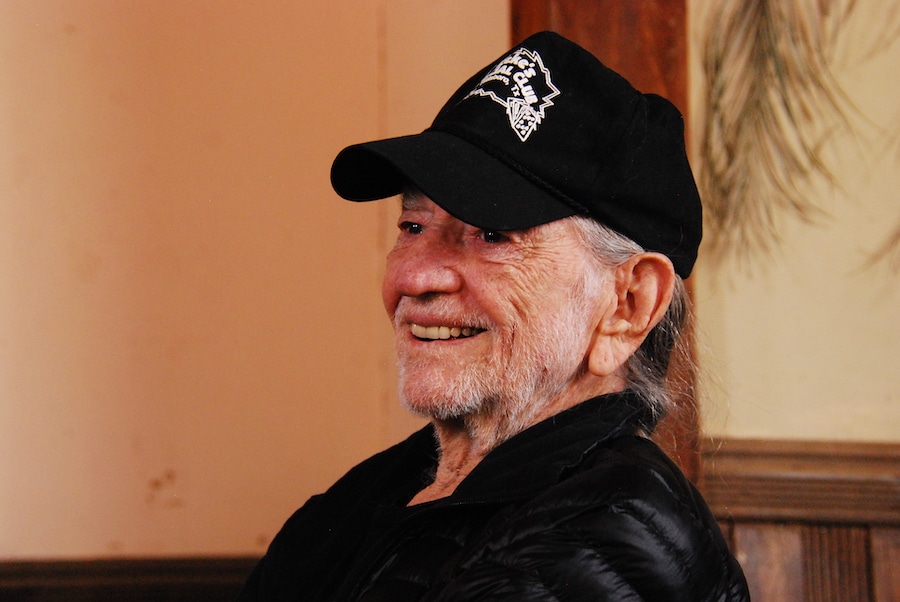
Willie Nelson folds his arms tightly across his chest as he sits on a wooden chair in the tiny chapel at Luck Ranch, his spread in Spicewood, Texas. His right leg drapes over his left, dangling a boot polished so often, its seams carry a permanent sheen. He’s dressed head to toe in black, his single long braid topped by a trucker’s cap advertising the apparently long-gone Zeke’s Social Club in Hillsboro, Texas.
Fifty contest-winning fans of SiriusXM radio’s Willie’s Roadhouse channel fill the pews facing him on this gray Saturday. They’re also trying to ward off the chill as Roadhouse air talent Paula Nelson, his daughter, interviews “Papa Bear” and producer Buddy Cannon in-between previewing tracks from Willie’s new album, Ride Me Back Home. By the time the album arrives on the summer solstice of Willie’s 86th year, that chill will be long gone.
Videos by American Songwriter
Willie likely will be, too — thousands of miles away at his Maui home, or on the road again, where he still spends a good portion of his time. But here at Luck, where he’s hosted the wildly popular Luck Reunion during South By Southwest for eight years now, and all around Austin, his presence is everywhere even when he is not. And whenever his name comes up, as in the flurry of tributes celebrating his latest birthday (which somehow straddles April 29 and 30), it’s not unusual to hear people declare he’ll live forever — physically, not metaphorically — as if they’re trying to convince the universe to make it so.
But Willie’s awareness of mortality, never far at his age, has been a prominent aspect of his recent work. Last year’s Last Man Standing addressed the losses of several good friends; on this album, he pays tribute to his late bassist, Dan “Bee” Spears, by covering “Nobody’s Listening,” which Spears co-wrote with Skip Denenberg, and does two songs by his late friend Guy Clark: “My Favorite Picture of You” and “Immigrant’s Eyes” — the latter selected, in part, he says, because “it’s appropriate for these times.”
In two of three songs Nelson co-wrote with Cannon, he confronts the Grim Reaper with a mix of humor and attempted acceptance. The jaunty “Come on Time” may not provoke the guffaws of “Roll Me Up” or “Still Not Dead” or Last Man Standing’s “Heaven is Closed” and “Bad Breath” — on this album, his rendering of Mac Davis’ “It’s Hard to Be Humble,” with sons Lukas and Micah, provides the biggest comic relief — but it’s hardly a pitiful wallow. Nor is “One More Song to Write,” actually a Last Man Standing leftover.
That one, says Cannon, “[Is] a song about a guy who’s realizin’ that time is movin’ by, and you can tell yourself that you’re not a party to it, but when it gets down to it, it’s goin’, whether you like it or not.”
As these songs fill the chapel, it’s hard not to notice the sometimes stoic, sometimes pensive look on Willie’s deeply grooved face — or the tear that forms, more than once, in the corner of his eye. Is that a reaction, or just a condition? One wonders what goes through his mind as he listens. Does he think about what he could have done differently? The friends he misses? The horses milling around outside who helped inspire the title track?
That song, the latest of many equine-referencing Willie tunes — Luck Ranch itself was built as the set for the film inspired by the horse-loving “Red Headed Stranger” — also seems to contain a subtext about riding off into the sunset. But it originated with a former stuntwoman who shares his passion for horses and rescue.
About a dozen years ago, Lucinda Hinton, who performed her first tricks at Luck for the 1992 TV movie Ned Blessing: The True Story of My Life, approached her friend, songwriter Sonny Throckmorton, with an idea and some lyrics. She wanted to honor the horse’s role in advancing civilization, and address how unfairly this country’s wild horse population is being treated in return.
Around that time, Willie’s family went to Capitol Hill to support the Animal Welfare Institute’s efforts to stop federal roundups of horses for slaughter and sale as meat overseas. There, they met the rescue group Habitat for Horses. Shortly afterward, the organization called, frantic to save several horses about to be sold. “I had all this land out here,” he recalls in the chapel. “I said, ‘Well, bring ‘em out here. The place needs some horses.’”
He took in 12; five were pregnant. Eventually, he rescued 50, in addition to the 10 or 15 he already owned. “They’re the happiest horses,” he adds. “They get fed twice a day; they’re spoiled rotten.”
Like his beloved Trigger, they represent his childhood cowboy dreams — and a legacy. As daughter Amy noted in a 2014 Habitat video, “Dad would like to be able to say that he was able to save American horses from that terrible fate.”
Throckmorton, who lives nearby, was inspired to finish the song after meeting those horses. Of course, Willie knew recording it might save more lives — not that he needed to add to his already-cemented legacy. But it never hurts. And it’s one less song he has to write before he does take that final ride.
The Siriux XM broadcast referenced in this article debuts on Willie’s Roadhouse on Friday, June 21.