
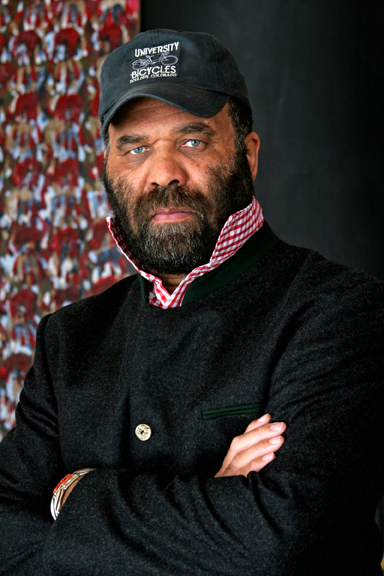
Bluesman Otis Taylor defies all categorization, some argue even the title of bluesman, but Taylor is most definitely a songman. His sparse, call and response numbers echo his experiences in the mountains of Colorado, driving across the United States and spending countless hours spent earning frequent flyer miles. Mr. Taylor was kind enough to spend some time with American Songwriter again before he left to play a series of shows in Europe with Gary Moore. His new album, Pentatonic Wars and Love Songs is out now.
How do you get down your thoughts? Do you take a computer with you, or do you take some kind of recorder with you.
No, I’m not that deep. You guys just think I am. [Laughs] I conception conceptually you know. You have to have a concept of a song then just figure out how to turn that concept in your head. So that when you put the record down you can’t get that concept out of your head. That one lyric you know.
When you’re writing these concepts, how do you connect the concept to the lyrics? Or is sometimes the lyric the concept?
The concept is the lyric. I was talking to my publicist and my agent and I said I’m at the big party, must be like 800 people there or 500 at least. I felt like let’s just walk up to everyone and being like “Hi, I wrote a single, I can’t do anything for you.” I should write that into a song. But she cracked up ‘cause everyone there is trying to network, but that’s a concept you know.
How do you keep all these concepts straight? Do you edit songs after they’ve been written?
I’ve got 10 albums, [and I don’t know] how many songs I have to remember in my head. I don’t have a photographic memory for words. My photographic memory is for things people say or objects not for technical comprehensiveness. It’s really conceptual. No bullshit. If you listen to the words for “I’m looking for some heat” the whole things just one verse. “I’ve been to Paris, well they call that France.” That makes it hip already, this is attitude, [laughs] you know what I mean? I’ve been to Germany and I’m looking for the railroad man. But it’s a true story you know. One time I was driving from New York to Montreal and the trees were like bent over, like really bent, and I go “What the hell is this?” I guess it was like a really bad rain storm. [Bent] almost like in half, or close to half. The trees were at like at 2 o’clock and at like 3 o’clock they snap. I’m like this is so weird. But I’m talking to somebody “oh yea that was the great ice storm and there were a bunch of babies born that year.” That’s what somebody told me. So I said you know the trees in Canada look kind of sad to me I think I’ll go down to Paris, Texas cause I’m looking for some heat. That’s all, you know, it isn’t anything, you know. Nothing deep there.
No, but you’re complimenting it with all your instrumentation that can make something sparse lyrically, feel much deeper.
But it got the point out. Everybody is looking for some heat, you know. I am like the anti-Dylan. I’m like the anti-Dylan and the anti-blues musician because I’m too depressing for the blues people.
But let me tell you one thing you can tell people. Everybody has a song, but some people have hundreds of them. But everybody has a song, because everybody has a life and a story. Because if you have a story, you have a song. You don’t have to have long hair or be eccentric to write a song. You can tell people I’m a strong believer in that. Sometimes there’s sort of this propaganda machine that… “Oh, if you have long hair…you’re different, you can write a song.” But you can just be an everyday secretary, or a nurse or an airplane pilot and write a song, you know? That’s the only social or political thing I want to say.
To read more about Otis Taylor, visit his American Songspace Profile here.
More Writer Of The Week
-

Photo by Jesse Spencer -

Photo credit: Sean Brackbill