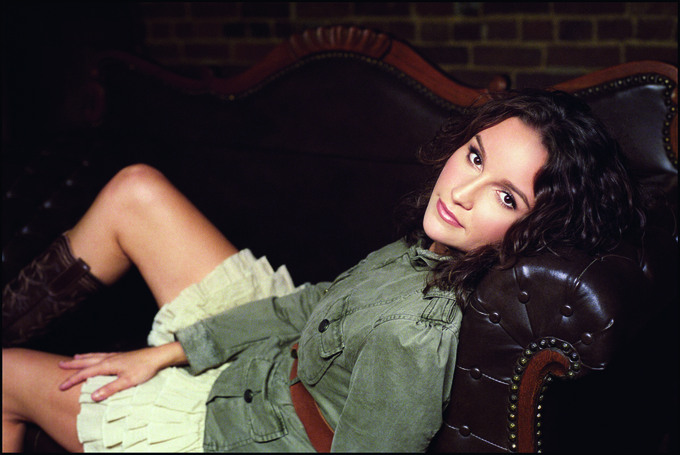
Ashton Shepherd was as big a surprise as any 21st Century major label country act. One minute she was a young wife and mother winning a tiny talent contest in Alabama, and the next she had a full-length Buddy Cannon-produced debut showcasing her Loretta Lynn-ish catalog. The making of her new album, Where Country Grows, followed a more typical course—a few years and several co-writers—but still came out sounding more down-to-earth than anything else out there.
Were you conscious of how unique it was for the label to let you do all your songs the first time around?
It was like ‘I’m getting to cut seven one-hundred-percent songs on this eleven-song record. This is insane.’ I’d have never in my dreams thought that Nashville would have liked that many of my songs enough to have… I mean, I believed in my stuff, don’t get me wrong. But I never expected that. I was pretty shocked to be able to have that opportunity.
The only co-writer you had on Sounds So Good was your brother-in-law.
Mmhmm.
Things have taken a lot longer between Sounds So Good and Where Country Grows. What caused that?
It was more of a process, but now I realize that this process is basically what everybody else does. I didn’t realize that ‘til I got involved in it, and I went ‘Oh, this is normal.’ Because I kinda got a little nervous about it personally. Just like ‘Why is this taking so long?’ …But now I look back on the whole process… and understand [it] better. Like, during it you’re wondering what in the world’s going on, and now I look back and go ‘I’m glad we did it that way,’ because it’s really made this record special. It’s made it a very good mixture of showing me writing with Troy Jones to me writing with Bobby Pinson to me writing by myself on material to cutting a few outside songs. And it really shows, I think, that Ashton Shepherd can do all these things, too.
Were you afraid that if you brought somebody you didn’t know into the songwriting equation it wouldn’t be as much you anymore?
Well, I was scared. If I had any fear it was that I wouldn’t be comfortable enough to write like I would write by myself. Because when you’re by yourself, you’re just by yourself. There’s no having to show your flaws or show your ‘Oh, I said this line but I’m going to change it to this’—your little glitches in how you write. And I thought ‘Would I be able to write the same in a room with somebody else?’ And I was able to.
It sounds like you were kind of relieved to find that you didn’t get lost in that process.
Yeah. I was just a little scared of it. It’s just like going to school for the first time, or being part of anything that you don’t know. You don’t know what to do or what to say or how does this work or anything. And writing by yourself and then co-writing is totally different—so I thought. But then I get in there and I’m like ‘This isn’t as different as I thought it was!’ And also, too, when you enter the room with people that know you’re writing songs that are for your record, they lean your direction anyway. You know what I mean? They know me, they know my old record, they know my music, they know the kind of music I sing, they know what kind of singer I am. So they’re not trying to do anything that sounds like a pop song. They already know kind of how to work with you on it. So it really ended up being a really fun process. I was walking away everyday with these new songs. And it’s really cool, too, to set up like a week’s worth of writing and have writing two times a day. And you come home that week and you’ve got ten songs in your pocket. Actually making yourself sit down and write, which is something I’d never really done either. I just wrote when I wanted to.
A couple that you wrote solo—‘I’m Just a Woman” and “That All Leads To One Thing”—are some of the strongest songs on the album.
Thank you!
They’re heart-wrenching ballads. Do you feel like that’s where you naturally head with your songwriting?
I do tend to write more ballads. Especially whenever I first started writing songs. I’ve been writing since I was a little girl, but really keeping up with my catalog probably since I was 13 or 14 years old. And I’ve always had ballad-heavy material.
Why do you think that is?
I don’t know. I think it’s just because of being a deeper thinker. And I tend to really think things out, and I feel a lot of feelings about a lot of things. To me, maybe it’s not the best word to use, but sometimes [uptempo songs] can just kind of seem shallow. You know, it’s just something simple, and I’m a deeper person. That may sound silly, because you would think the uptempos are easier to write, but I have more of a hard time writin’ uptempos because… I’m a big fan of traditional country music—ballad, heart-wrenching, Keith Whitley, George Jones, “He Stopped Loving Her Today” kind of stuff.
A lot of the time songs that have a more driving tempo are meant to get people out on the dance floor.
Absolutely. And that’s something you learn, too, as an artist and a writer is… is to look at songs that way, and to not look at it like every song has got to be this heart-wrenching story-song. You can have a few of them, but you also need something like “More Cows Than People” that’s just something fun… and it’s not a big deep meaning. It’s just something for people to smile to or clap their hands to, get ‘em into it, you know.
When did you first think about your songs speaking to or for women listeners?
You know, it’s really funny, because I’ve never sat down like intentionally thinking ‘I’m gonna write a song for the women.’ I’m writing a song about myself, and then I play it back or hear it and it sort of turns into everybody’s song. I’m writing it for myself not realizing that I’m not the only one that feels like this. And that sounds really weird, because it’s probably the exact reverse of when they hear it; they’re probably thinking ‘Wow, Ashton Shepherd feels like this. I’m not the only one that feels like this.’ That’s how I feel when they respond to it.
With a title like “I’m Just a Woman”, I was wondering where that song would go. It feels like it speaks to women’s experiences—especially women who are wives or mothers—and the unsung burdens that they bear. And a plea to be met in the middle by a partner.
And that’s exactly kind of what I was feeling at that moment when I wrote that song, was ‘You don’t understand, but I need you to. I really want you to understand that I just don’t feel like I can take it all sometimes. I don’t think you understand what I’m doing.’ …Even being a stay-at-home mom, people want to make fun of that, and there’s no reason—ever—for anybody to make light of stay-at-home moms. It is a job, because you are so invested in your children and how they feel, if they’re sick or if they’re hungry, or what they have on that day, or if their mouths are wiped. Then all the sudden you’re also [realizing] ‘Golly, I’ve got to pay this note because it’s 15 days behind,’ or ‘Oh, I spent too much on my credit card this month,’ and you’re trying to figure out how you’re gonna pay that. You’re mind is just constantly spinning, and then you’re thinking in the back of your mind ‘Am I even paying my husband any attention at all?’ You want to and you try to, but then you really feel like he’s not seeing you or paying attention to you, because he’s just kind of off in left field in his own land all the time. ‘Do you get it at all, what I’m doing? Do you understand? I think you might, but you don’t tell me you do.’ You know what I mean?
Who would you say you identify with most—contemporary or in the past—as far as singers and songwriters?
Dolly was always somebody that I just couldn’t say enough about as far as being able to sing like she does, and write the songs. I mean “I Will Always Love You” and “Jolene”, “Two Doors Down”—and [she was] a hundred-percent writer on these songs. And I just always noticed people that could write by themselves. I think co-writing’s great. I want to co-write again for my third record and my fourth. I enjoy it. It’s fun. But I think you need to be able to write by yourself. I think that’s you’re best co-write, is when you put people together that can write by themselves. Toby Keith was somebody, and Alan Jackson, that I really paid attention to as a little girl, knowing they wrote their own material. And that was just always real fascinating to me. …And I love Patty Loveless. When I was a little girl I covered a lot like “How Can I Help You Say Goodbye” and “He Don’t Even Know Who I Am”. A lot of those records, when they come out in the early ‘90s, I was about eight years old. And that’s what I learned to sing on, was that kind of stuff.
More Interviews
-

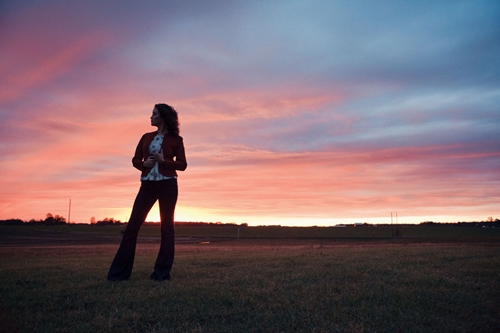
Photo by Stephen Dillon