John Prine’s eponymous 1971 debut is a masterclass in songwriting, and “Hello in There” is no exception. The song showcases Prine’s ability to paint a scene with just enough detail that the listener can picture it (but not so much that people can’t envision themselves in the image). It describes the way older people can often become overlooked, introverted, and lonely as they age, something Prine describes beautifully in the chorus.
As John Prine would later recall in an interview with Paul Zollo, he had The Beatles to thank for the idea of “Hello in There”.
Videos by American Songwriter
From “Across the Universe” to “Hello in There”
John Prine played The Beatles’ track “Across the Universe” countless times upon its 1969 release. During his interview with Paul Zollo, the songwriter said that John Lennon’s voice was particularly striking to him. “He was already putting a lot of echo on his voice on different songs, you know, experimenting with his voice. It sounded to me like somebody talking to a hollow log or a lead pipe with that echo. I was thinking of reaching somebody, communicating with somebody, like, ‘Hello…hello, in there…’”
As a child, Prine always felt a kindred connection to older people. While helping his friend with a paper route, Prine would deliver newspapers to residents of the Baptist Old People’s Home. “Some of the people, I guess, they didn’t have many visitors,” Prine said. “And to their other friends in the home, you were like a nephew or a grandson. I picked up on that, and it always stuck in my mind. I guess that’s what it’s like inside any kind of institution.”
While thinking about the residents he met on his paper route, Prine began contemplating the long lives each of these lonely individuals had lived up to that point. “They’re not writers. But they all have stories to tell. Some are very, very down deeper than others. You gotta dig, you know? That was all going through my mind when I wrote ‘Hello in There’.”
Bob Dylan Helped Influence John Prine, Too
The Beatles’ “Across the Universe” wasn’t the only contemporary song that helped inspire John Prine to write “Hello in There”. Bob Dylan’s early work also played a key role in Prine’s songwriting. “I was a big fan of Bob Dylan early on,” Prine explained. “His song, ‘The Lonesome Death of Hattie Carroll,’ was a big model for me. I modeled ‘Donald & Lydia’ after that song, as far as telling a story and having the chorus be the morale to the story. A wider morale than what the story’s saying.”
Thus, the narrator spends the verses talking about Loretta, John, Linda, Joe, Davy, and Rudy. With each chorus, he reiterates the idea that isolation and loneliness become worse with age. And in doing so, he encourages the listener to call out, “Hello, in there,” to older people they encounter in their lives.
“You know that old trees just grow stronger, and old rivers grow wilder every day. Old people just grow lonesome, waiting for someone to say, ‘Hello, in there, hello.’”
Photo by Michael Ochs Archives/Getty Images
More Did You Know
-

The Rolling Stones in concert, Tour of Europe '76, Earls Court Arena – Mick Jagger and Keith Richards (Photo by Graham Wiltshire/Shutterstock) -

Rock band: The Rolling Stones: – Mick Jagger, Keith Richards (Photo by Roger Bamber/Shutterstock) -

Singer and songwriterJohn Lennon (1940 – 1980) with his wife Yoko Ono, signing copies of her conceptual art book 'Grapefruit' at Selfridges, London, 15th July 1971. (Photo by Jack Kay/Daily Express/Getty Images) -

Despite its fantastical origin story of surviving a shrapnel attack in the Vietnamese jungle, the D-28 met its demise on a flight to Hawaii. Not only did the turbulent flight damage the instrument in storage; someone later stole the guitar from the luggage carousel. Mitchell was never able to find her long-lost instrument, something she’s lamented for years. Aside from the sentimental connection guitarists typically have to their first ax, Mitchell was particularly fond of her Martin for functional reasons. After a bout of childhood polio affected Mitchell’s ability to form chord shapes in standard tuning, the singer-songwriter had to adapt with eccentric tunings that allowed her to create rich harmonic structure with limited mobility. Whether open, an octave below, or otherwise, Mitchell’s unique tunings placed stress on the guitar neck that it wasn’t originally made to endure. Moreover, to ensure the dissonance within her tunings was purposeful and not merely off-pitch, Mitchell needed a guitar with pristine intonation—something she frequently lauded the D-28 for having. “I need really good intonation,” she explained to Acoustic Guitar. “One of the signs of really good intonation is how flashy the harmonics are with a light touch. You should be able to get them to bloom like jewels.” While Mitchell has found other guitars that come close in that department, as she put it in her 1996 magazine interview, “I’ve never found an acoustic that could compare with it.” Photo by Central Press/Hulton Archive/Getty Images -
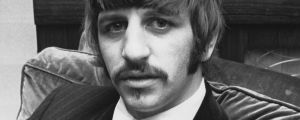
Drummer Ringo Starr of English rock band the Beatles during a reception at the London home of the group's manager Brian Epstein, 20th May 1967. The Beatles' song 'A Day In The Life' had recently been banned by the BBC for its references to drug-taking. (Photo by John Pratt/Keystone/Hulton Archive/Getty Images) -
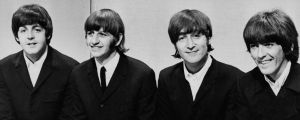
English rock band the Beatles at the BBC television studios in London before leaving for a concert tour of Germany, and afterwards Japan, 16th June 1966. From left to right, they are Paul McCartney, Ringo Starr, John Lennon and George Harrison. (Photo by Central Press/Hulton Archive/Getty Images) -

NEW YORK, NEW YORK – JUNE 11: (L-R) Tommy Thayer, Paul Stanley, Gene Simmons, and Eric Singer of KISS attend the 2021 Tribeca Festival screening of "Biography: KISStory" at The Battery on June 11, 2021 in New York City. (Photo by Monica Schipper/Getty Images)