
Rolling Stones frontman Mick Jagger’s flamboyant and rowdy stage persona is one of the defining attributes of the legendary rock band, and according to one late musical legend, Mick Jagger learned how to dance in her dressing room while she and the Stones toured together in the 1960s.
Jagger later discredited the claim, although he always had great respect for the artist. Nevertheless, inspiration can come from the unlikeliest of places, and it’s easy to see the connection between the two rock stars.
Videos by American Songwriter
Mick Jagger Supposedly Learned How To Dance In A Dressing Room
After starting their careers in St. Louis, Missouri, and London, respectively, Tina Turner and the Rolling Stones’ paths finally crossed in 1966 when Ike & Tina Turner earned an opening slot for the Rolling Stones’ U.K. tour. The R&B duo continued to perform with the Stones throughout the late 1960s, and after Ike & Tina Turner split, Tina opened for the Stones as a solo act.
In a previous interview, Turner recalled meeting Mick Jagger for the first time. “I didn’t really know Mick because…I didn’t really notice people a lot when I was working. But there was this guy that always stood in the wing, and then I found out that it was Mick. He wasn’t dancing on stage. Occasionally, I’d go out and watch them, and he’d just sort of do the tambourine on stage, you know?”
“He always said to us, ‘I like to watch girls dance,’” Turner continued. “I guess, maybe, not guys, he just liked to watch girls dance about on the stage. We were in the dressing rooms together, really having a ball, just kidding around. So, Mick says to me, ‘Teach me how to do the popcorn.’ That’s when I said to him, ‘So, that’s what you were doing in the wings all this time? Learning some of the dances that we do?”
The Rolling Stones Frontman Tells A Different Story
Tina Turner might have claimed that she was the one who taught Mick Jagger some of his most famous moves, but the Rolling Stones frontman politely disagreed in his 2009 book According to the Rolling Stones. “I didn’t consciously copy any moves from her,” he wrote. “She always said I did, but she’s a woman, and the movement involved is totally different. However, I would be out dancing all the time off stage, going to clubs, and picking up whatever moves were going on in there.”
Years later, Turner pushed back on Jagger’s claims yet again. “Mick wanted to dance,” she told the Daily Mail in 2017, “and I was a dancer. But he never gave me the credit! He said his mother taught him how to dance. But we worked with him in the dressing room, me and the girls, and we taught him how to Pony.” She added that musicians like Jagger and David Bowie were “like the brothers that I never had. They never came on to me because I think they saw me as a role model in some kind of way.”
On this, it would seem, Jagger and Turner could agree. Following the news of her passing in May 2023, Jagger posted a tribute to Turner on his Instagram, writing, “I’m so saddened by the passing of my wonderful friend Tina Turner. She was truly an enormously talented performer and singer. She was inspiring, warm, funny, and generous. She helped me so much when I was young, and I will never forget her.”
Photo by Roger Bamber/Shutterstock
More Did You Know
-

Willie Mae “Big Mama” Thornton performing, Photo by GBH Archives/YouTube -

The Rolling Stones in concert, Tour of Europe '76, Earls Court Arena – Mick Jagger and Keith Richards (Photo by Graham Wiltshire/Shutterstock) -

Singer and songwriterJohn Lennon (1940 – 1980) with his wife Yoko Ono, signing copies of her conceptual art book 'Grapefruit' at Selfridges, London, 15th July 1971. (Photo by Jack Kay/Daily Express/Getty Images) -

Despite its fantastical origin story of surviving a shrapnel attack in the Vietnamese jungle, the D-28 met its demise on a flight to Hawaii. Not only did the turbulent flight damage the instrument in storage; someone later stole the guitar from the luggage carousel. Mitchell was never able to find her long-lost instrument, something she’s lamented for years. Aside from the sentimental connection guitarists typically have to their first ax, Mitchell was particularly fond of her Martin for functional reasons. After a bout of childhood polio affected Mitchell’s ability to form chord shapes in standard tuning, the singer-songwriter had to adapt with eccentric tunings that allowed her to create rich harmonic structure with limited mobility. Whether open, an octave below, or otherwise, Mitchell’s unique tunings placed stress on the guitar neck that it wasn’t originally made to endure. Moreover, to ensure the dissonance within her tunings was purposeful and not merely off-pitch, Mitchell needed a guitar with pristine intonation—something she frequently lauded the D-28 for having. “I need really good intonation,” she explained to Acoustic Guitar. “One of the signs of really good intonation is how flashy the harmonics are with a light touch. You should be able to get them to bloom like jewels.” While Mitchell has found other guitars that come close in that department, as she put it in her 1996 magazine interview, “I’ve never found an acoustic that could compare with it.” Photo by Central Press/Hulton Archive/Getty Images -

Drummer Ringo Starr of English rock band the Beatles during a reception at the London home of the group's manager Brian Epstein, 20th May 1967. The Beatles' song 'A Day In The Life' had recently been banned by the BBC for its references to drug-taking. (Photo by John Pratt/Keystone/Hulton Archive/Getty Images) -
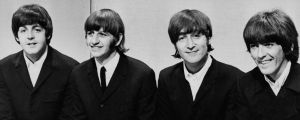
English rock band the Beatles at the BBC television studios in London before leaving for a concert tour of Germany, and afterwards Japan, 16th June 1966. From left to right, they are Paul McCartney, Ringo Starr, John Lennon and George Harrison. (Photo by Central Press/Hulton Archive/Getty Images) -

NEW YORK, NEW YORK – JUNE 11: (L-R) Tommy Thayer, Paul Stanley, Gene Simmons, and Eric Singer of KISS attend the 2021 Tribeca Festival screening of "Biography: KISStory" at The Battery on June 11, 2021 in New York City. (Photo by Monica Schipper/Getty Images)