
Generally speaking, no artist wants to hear that their fans think they’re “selling out.” To sell out is to trade creative integrity for cents to the dollar. Unsurprisingly, most artists passionate about their work would find this idea insulting. When an artist gets labeled a sell-out for an album they didn’t even want to release, we’d imagine that’s like pouring salt in the wound. At least, that’s how it seemed for The Eagles.
Based on commercial performance alone, The Eagles’ first compilation album, Their Greatest Hits (1971-1975), looks like nothing short of a major success. The best-of album created a new RIAA certification when it became the first album to go Platinum. It did it again, another 39 times after that. Just under five decades after its release, Their Greatest Hits hit the 500-week mark of a non-consecutive, years-long tenure on the Billboard 200.
Videos by American Songwriter
But to the band, the album was worse than a flop. It was a bad omen, sent out into the world without their knowledge or consent.
Who Really Released The Eagles’ Record-Breaking Best-Of Album?
When The Eagles’ 1976 compilation album began climbing up the charts, the musicians couldn’t even bear to watch—but not out of giddy excitement. The band didn’t even want the album out in the world in the first place. Speaking to Melody Maker in 1976, Don Henley said no one in the band was an “advocate” of best-of compilations. “They are more or less a ploy by the record company to get free sales.” In this case, that’s exactly what was happening. Asylum Records capitalized on The Eagles’ existing success. And based on those aforementioned stats, we’d say the label accomplished its goal.
Still, that didn’t stop the band (or their fans) from viewing the album with disdain. And as a double-whammy to the musicians, they had to deal with their label releasing an album with their name on it without their approval and an influx of angry letters from fans. “We got a couple of hate letters,” Henley recalled. “But we didn’t have anything to do with it. The record company put it out, and we couldn’t stop them.”
Glenn Frey Said the Imagery for ‘Their Greatest Hits’ Felt Dark
For guitarist Glenn Frey, one of the most disconcerting aspects of Their Greatest Hits was the fact that it felt like they were leaving their loyal fan base for a different, less established one. “It’s a different kind of person that buys ‘Greatest Hits’ albums. People who buy them for gifts for children and not the kind who buy regular albums. I think you reach more people with them. You reach the over 25s and the under 15s a lot.” Gaining fans of any age certainly isn’t a bad thing. But it wasn’t the first impression Frey wanted the band to make.
“The eagle’s skull, which appeared on the sleeve, is not very good karma in terms of the American Indian,” Frey said. “By putting this shiny eagle’s skull on the album, we felt like we knew where the ‘Greatest Hits’ thing was at.” He later said the snowy background reminded him of c******, which, given the musicians’ struggles with addiction, had its own negative quality.
“I never expected it to do five million,” Frey said in 1976. In the 49 years that have passed from then to the time of this writing, the album did 35 million more in the U.S. alone.
Photo by Trevor James Robert Dallen/Fairfax Media via Getty Images
More Behind the Album
-

Photo by Ed Rode/Getty Images -
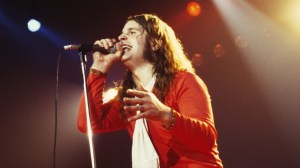
Photo by Chris Walter/WireImage -
Photo by Ed Rode/Getty Images -
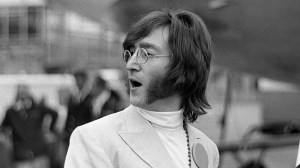
Photo by Murphy/Daily Herald/Mirrorpix via Getty Images -
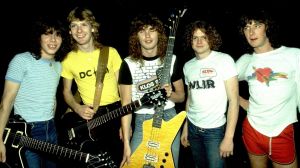
Def Leppard on 8/23/81 in East Troy, Wi. (Photo by Paul Natkin/WireImage) -
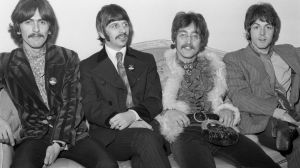
LONDON – MAY 19: (L-R) English musician, singer, songwriter and guitarist George Harrison (1943-2001), English musician, singer and drummer Ringo Starr, English singer, songwriter and guitarist John Lennon (1940-1980), and English singer, songwriter and bassist Paul McCartney of the Beatles attend a press party at the home of manager Brian Epstein supporting the release of Sgt. Pepper's Lonely Hearts Club Band, May 19, 1967 in London, United Kingdom. (Photo by Jeff Hochberg/Getty Images) -
UNITED KINGDOM – JANUARY 01: MARQUEE Photo of VANILLA FUDGE, performing live onstage – L-R: Mark Stein, Vince Martell, Carmine Appice, Tim Bogert (Photo by Estate Of Keith Morris/Redferns) -
CIRCA 1966: Singer Mick Jagger of the rock and roll band "The Rolling Stones" performs onstage in circa 1966. (Photo by Michael Ochs Archives/Getty Images)