
Chart positions and sales numbers can be decent indicators of whether a song is good, but as Glen Campbell and the session musicians who played on his hit records knew all too well, our bodies can tell us when a song is a hit long before Billboard does. Indeed, one of the most rewarding things about music is the visceral reactions we can get from listening to it. Goosebumps, hair standing on end, an emotional tear or two—Campbell experienced all of these when listening to his future hit, written by Jimmy Webb, for the first time.
Webb and Campbell’s first collaboration, “By the Time I Get to Phoenix”, was a massive success. Eager to recreate the sales of this hit record, Campbell asked Webb for another geographical song. Webb responded with “Wichita Lineman”, a song that immediately moved Campbell.
Videos by American Songwriter
“When I first heard it, I cried,” Campbell later recalled, per Dylan Jones’ The Wichita Lineman: Searching in the Sun for the World’s Greatest Unfinished Song. “It made me cry because I was homesick. Every hair follicle stood up on my body. It’s a masterfully written song.”
The narrator of the song is a lineman out in the vast expanse of the Kansas countryside, singing to a faraway lover whom he can “hear singing in the wire.” With lines like, “And I need you more than want you, and I want you for all time,” Webb elevates this story of a blue-collar laborer into an incredibly moving love song, which Billy Joel described as finding beauty in the mundane.
Glen Campbell Wasn’t the Only One Moved by This No. 1 Hit
When Glen Campbell first heard his future No. 1 hit, “Wichita Lineman”, Jimmy Webb’s imagery of linemen scaling telephone poles alongside a quiet highway brought Campbell back to his childhood in rural Arkansas. A long way from home, “Wichita Lineman” was a way for Campbell to reconnect with a slower existence than the one he was experiencing in Hollywood. But Campbell, whom the Wrecking Crew affectionately nicknamed “The Hillbilly,” wasn’t the only one who had an emotional reaction.
Carol Kaye, the iconic bassist of the Wrecking Crew responsible for the song’s instantly recognizable descending melody, felt her body respond to the song long before industry executives classified it as a hit. “I was keeping it very simple,” she recalled in Dylan Jones’ retrospective book. “When you first get the tune rolling, you want to stay in the background as much as possible. Then when he starts singing, the hair kind of stood up on my arms. I thought, ‘This is deep.’”
She added, “I heard ‘Wichita Lineman’ at a drugstore one time, and it just brought tears to my eyes. That tune meant a lot to me.”
Like Campbell, orchestral arranger and producer Al DeLory also felt an instant familial connection to the song. DeLory’s uncle worked as a lineman in California. “As soon as I heard that opening line, I could visualize my uncle up a pole in the middle of nowhere. I loved the song right away,” DeLory said, per the BBC.
With the song peaking at No. 1 on the Billboard Hot Country Songs and Adult Contemporary charts (and a still-impressive No. 3 on the Hot 100), it’s clear the rest of us did, too.
Photo by Michael Ochs Archives/Getty Images
More Behind The Song
-

Jamaican singer Jimmy Cliff performs on stage at Porte de Pantin, in Paris. (Photo by John van Hasselt/Sygma via Getty Images) -
Left to right: Robert Plant, John Paul Jones and Jimmy Page, of British heavy rock group Led Zeppelin, performing at Earl's Court, London, May 1975. The band were initially booked to play three nights at the venue, from 23rd to 25th May, but due to public demand, two more concerts were later added, for 17th and 18th May. Total ticket sales were 85,000. (Photo by Michael Putland/Getty Images) -
Portrait of country singer Eddie Rabbitt in Memphis, Tennessee, May 31, 1981. (Photo by Paul Natkin/Getty Images) -
LOS ANGELES – FEBRUARY 22: 31st Annual Grammy Awards. Broadcast February 22, 1989. Shrine Auditorium, Los Angeles, California. Pictured accepting award is Bobby McFerrin. His song "Don't Worry, Be Happy" won Record of the Year, Song of the Year, and Best Pop Vocal Performance, Male. Also Best Jazz Vocal Performance, Male. (Photo by CBS via Getty Images) -
LAS VEGAS, NEVADA – APRIL 03: Singers Mike McGuire (L) and Marty Raybon of Shenandoah attend the 51st Academy of Country Music Awards at MGM Grand Garden Arena on April 3, 2016 in Las Vegas, Nevada. (Photo by Rick Diamond/ACM2016/Getty Images for dcp) -
Photo by Tim Mosenfelder/Getty Images -
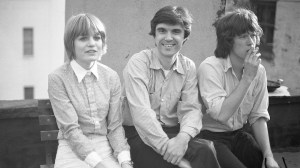
The three founding members of Talking Heads on a Manhattan rooftop, US, 1976. (Jerry Harrison would join the group at the beginning of 1977.) (L-R) Bassist Tina Weymouth, singer-guitarist David Byrne and drummer Chris Frantz. (Photo by Linda D. Robbins/Getty Images) -

Patty Smyth of Scandal at the Poplar Creek Music Theater in Hoffman Estates, Illinois, June 3, 1983. (Photo by Paul Natkin/Getty Images)