
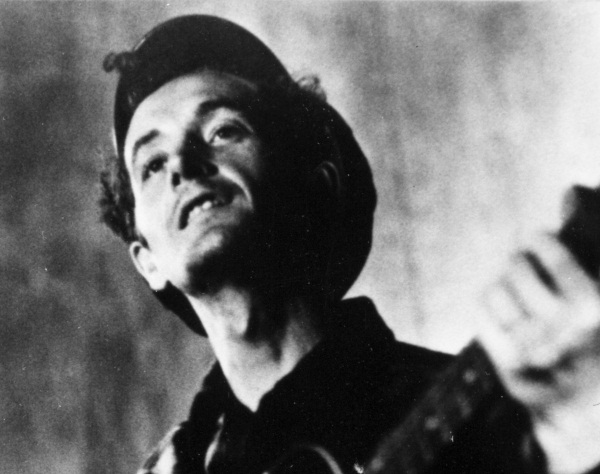
As part of the Americana Festival, Guy Clark and long-time compadre Rodney Crowell discussed the legacy of Woody Guthrie at a panel on Thursday. The two songwriters played a few Woody songs, too. Clark performed “1913 Massacre” (a song he called “spine-tingling”) and Crowell contributed “Oklahoma Hills,” which he said was the first Guthrie song he ever learned. The discussion was moderated by Grammy Museum Executive Director Bob Santelli.
When was the first time you heard Woody Guthrie?
Rodney Crowell: He was gifted in so many ways; he had a vast love of songs. He knew songs from places. I don’t know where he picked them up, having grown up on a sharecropper’s farm, and not really being exposed to radio. But the first time I heard Woody Guthrie music was when my father would sing “Oklahoma Hills.” My dad would sit on the side of the bed, and I’d play on the floor with Carla and Penny, and he’d close his eyes and sing “Oklahoma Hills” as if the song belonged to him. And that melody and the imagery of it stuck with me. And of course in the Sixties I was starting to grow up a little bit. I had gotten into my teenage years. I’d become a Bob Dylan fan; that’s how I was led to understand who Woody Guthrie really was.
Guy Clark: It seems like he’s always been there in my life, you know, playing guitar and singing. I remember early on trying to learn “Do-Re-Mi.” I remember actually learning “Pretty Boy Floyd.”
I remember my mother, she had a sense of humor, telling me she watched Pretty Boy Floyd rob a gas station – and I’m 10. I can’t remember what other songs had first struck me, I mean my favorite of all time, not just for Woody Guthrie songs but by any songwriter, is ”1913 Massacre.” Ramblin’ Jack Elliott was in my house about three days ago. I got him to actually play it for me, and it was just fantastic.
Did you guys hear “This Land Is Your Land” as a sing-a-long song in school as a “patriotic” song?
Guy Clark: It’s hard to remember exactly, but I think it was always there.
Rodney Crowell: I think probably. I still say “Oklahoma Hills” was the first one I heard but “This Land Is Your Land” was certainly part of the landscape. It was a song that just came on, and it was always there. I never really dialed it in as anything … it’s like a national anthem song.
How has Guthrie’s influence shaped both of you as songwriters, as American artists who write about the American landscape in whatever capacity?
Crowell: Well, with any great artist or writer that I admire … admiration is a motivator. If I admire somebody’s work , I don’t want to copy them or emulate them if I can help it … But you do recognize something that you really admire in somebody and then try and find that in yourself, your own version of that in yourself. There was a period when I was studying the craft where I got really deeply into Woody Guthrie … the deeper you go into it as you try to find your own voice and create … it filters back through. As a matter a fact, I wrote a song some years ago called “O King Richard,” and it was after I read Joe Klein’s book, a biography about Woody Guthrie, and I said, ‘I want to write a song about a modern-day folk hero.’ I thought Richard Petty, at the time, was a modern-day folk hero, so I wrote a song about him. And that was directly because I was thinking about how Woody Guthrie found heroes and anti-heroes and wrote about them so eloquently.
Clark: I recently wrote a song with a friend of mine. I didn’t realize ‘till later, but I’m pretty sure I was channeling Woody Guthrie. It was called “Coyote.” There’s a thing going on down on the Mexican border with illegal aliens. The guys that smuggle them across the border are called coyotes. They are brutal and they are cold. Anyway, there was this coyote who was smuggling. For $1,100 a piece he filled up this truck and guaranteed to get them across the border. No problem … said he had been doing it for years … and he drove them across the border and then he turned them into the border patrol for $1,100 a piece. So that’s what they’re dealing with.
More Interviews
-

Photos courtesy of Darryl Worley -
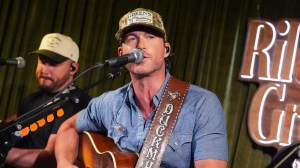
LOS ANGELES, CALIFORNIA – SEPTEMBER 14: Riley Green performs at Spotify & Riley Green's "That's Just Me" Album Release Party at Desert 5 Spot on September 14, 2026 in Los Angeles, California. (Photo by Presley Ann/Getty Images for Spotify) -
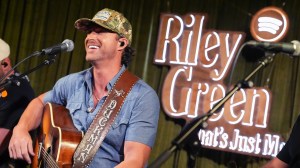
Photo by Presley Ann/Getty Images for Spotify -
Benson Boone Photo by Shayden Schoonover -
Photo by Madison Rensing