
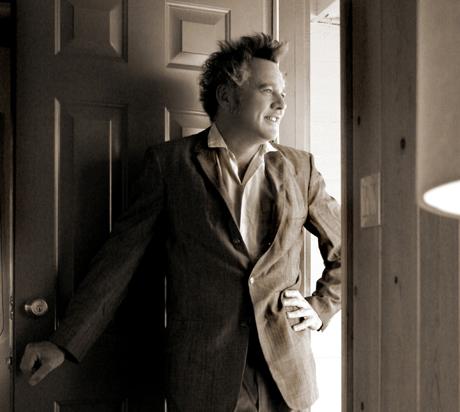
Mark Olson, founding member of the Jayhawks, has the autonomy and musical prowess to defy that unnecessary descriptive clause that often comes after his name. Before a special New York performance to promote Many Colored Kite, his excellent new album, Olson took some time off to discuss a few extremes: an old band and a new record, the desert and New York, as well as birds and snakes.
How’s New York treating you?
Well, it’s New York. You hit the street, it hits you back…I like it for a period of time, but I’m right in the middle of it up here. I like nature.
Do you have anything up you sleeve for these shows coming up?
Yeah, I made the record with just me, the engineer, Beau Raymond, and this woman from Norway, Ingunn Ringvold. We kinda worked on it the three of us, for the most part, and then we brought in some people at the end to do some overdubs. So she and I have been working together now for four years, and I’ve been over in Norway…we’ve been working up the setlist for quite sometime, the last two or three months. I haven’t done that in a long time, you know? Mostly when I pick up the guitar, I’m working on parts…kind of circles. But I decided this time…well I’ve been at this a long time, I’ve made a lot of records. Let me see which songs I like to play the best and see if we can work them up together.
She plays the djembe and we went out in London and bought this neat little harmonium. Between the two of us, we’re trying to make a real good set. Between the tunings, the capo changes, and the different songs from different eras, that’s kinda been on my mind recently and everyday I’ve been trying to do something to that end. We’re still in that discovery mode. I’ve always felt like after you play a month on the road, that’s when you really got it. Until that point, you’re looking around, trying to find different things in different songs.
So you’re scripting things a little more than you have in the past?
I was just focused on writing [with prior records]. I never did focus so much on performance. I kind of thought, “Hey, we’ll just get up there and do these songs. It’ll be great.” But I’m finding out that, now that I’ve started to mess around with the capo and the tunings more, I’ve got to be a little more organized on that level. It’s kind of a good challenge. I’m liking it.
Nature is big on this album. There are a lot of birds flying around. Was that intentional?
No, that’s a Nashville thing! No, I lived out in the desert and the birds that are featured…you know there’s not much movement out there, but what is moving are these doves. There’s actually dove hunting season, and that’s not so great. First of September, you wake up at dawn and they’re shooting at the doves. But there are a lot of doves and, over the years, I’ve gotten to know them in song a little bit. They represent various things; they’re historical.
What about the snake in “King Snake”?
Yeah, same thing. Really, there was a snake that was trying to get at the nest. He got all wound up and I tried to get him away from there. So, The animals and creatures and critters out there that I have put in songs — they’re always representative of some kind of historical idea that people have of the animals.
Living in the desert, do you think songwriting thrives on solitude or lots of stimulation?
Well, I think it has both things. I know that I’ve had a lot of solitude and, basically, because of that, I’ve learned how to…make up stories, think about what’s going on… I’m comfortable with that kind of thing. But I also know for songwriting that, when I get around people and situations, stuff comes flying out of the blue. It’s a subtle thing. I’m not gonna say one’s better than the other. But, to have a lot of input coming at you from the outside is good, and to be able to think about it and form it and change it and imagine it is good, too. I think the combination of the two works for songwriting, definitely.
Have you ever read any Edward Abbey?
Yeah! I read the one where he’s trying to do in all these caterpillars and he ends up in the town out there, Green River, Utah. I’ve been around out there; it’s just desolate… He’s kind of a complex guy. I like a lot of things, but he’s just terrible on his girlfriend’s cars. If I’m gonna ruin a car, it’d better be mine. I’ve done that. I’ve gone out in the desert in my car and I’ve bashed it up a bit. But that’s part of why I like to live out there…to have some good adventures.
Are you excited about the hometown Jayhawks reunion coming up?
Yeah, that’s a whole other thing. Just to have been focusing on this whole low volume, every finger picking song kind of sound, and then that [the reunion show] is just full bore. I’ve done the reunion shows in Spain and America and, both times, it was just very natural. Just getting up, it came off right of way.
Where did the songs for Many Colored Kite come from? Are any of them older songs?
These are all current songs. I didn’t sit on any of these. Ingunn and this violin player and I did about 250 shows together, then Ingunn and I went on with Gary for another 50. And we enjoyed it. Going everyday, that’s alright. You travel four to eight hours a day. You get somewhere, you got a place to stay, and you get to play music. And you get that rush from playing every night; it gives you this energy, so you start to get to liking it a lot. And the only way to keep doing it is to keep putting out albums.
I kind of put my mind on how I’m gonna keep doing this now. You know, I’m healthy and I can do this, so let’s do it. At various times when I got off the road, I would crank out a couple songs here and there. I used this little Olympus recorder. Then I actually did some demos when I was on the road. If I had a week off, I’d pop into a studio. The idea with demos would be, “well this might be a record; you never know.” But this time I thought better than that and put all these demos together, went in with an engineer, and tried to make something happen.
How did you manage things differently in the studio this time around?
I went back to the way that I never really did, because I was always just sitting down and playing songs. But I realized I had a weakness…I sing behind the beat. I just can’t help myself. And it’s great when you have a drummer who’s pushing and Ingunn pushes on the djembe and you can do that. It’s this little dramatic thing. You sing behind the beat, you mess up the timing. I just can’t help myself. But recording, I can’t allow myself to do it anymore. So I forced myself to get a click and push it faster than I wanted it to be. I just got in that habit of laying back on things so much. It just comes from playing live and it works real well in that situation, but it doesn’t work on recordings and I learned that doing the demos. So I pretty much laid down my guitar and vocals with the click, and I had never done that before. I would do it with Ingunn, playing the djembe, too, so that we’d have that instrument on there. And then, basically, we just added a couple things on each song. On “Scholastica,” there’s only piano, electric guitar, and bass; we added some drums, and that’s it. Just dubbed in some background vocals. There’s no layering of any instruments. This is really an 8-track album. Except for a couple with the drums, you might get closer to the 12-track range. We were trying to make each track count, and that’s what interested me was trying to do that way.
Fans and journalists have always been fascinated by how great your voice sounds, both with and without Gary Louris. How did you manage the harmonies on this record?
Ingunn and I worked on the harmonies. We sang together through the songs a number of times. We also decided that we weren’t going to overload the harmonies because I’d done quite a bit of that and I wanted to take a shot at singing some songs by myself. Then, we both thought it might be nice to have some other singers come in. I was thinking that maybe we were gonna do a few more background vocals, but we kind of got to the end of the time and it was sounding good, so we left it the way it was. We had Jolie [Holland] do that one song, we had Vashti [Bunyan] do that one song, and Ingunn pretty much covered the rest. Except Beau Raymond did some background on “Scholastica” and “King Snake.” So the backgrounds were kind of in the bag as we went in. We kind of had them and just basically did the parts. We didn’t really go into the world of layering backgrounds and working up things. We kept it pretty simple; that’s economic and sort of my own taste, too. I do love, of course…I absolutely love singing straight two-part harmony. There’s nothing like it in the world if you can nail it with someone and, within those harmonies, to each night be able to change some notes here and there. It’s just something that’s really special about music.
Do you find yourself drawing on any unexpected or special sources of inspiration?
Well, I would say the special thing for me on this record was the perspiration. You know, I did seven Creek Dipper records in seven years. A good way to describe it is that they’re almost examples of field recordings. We would go in, write a song, record it, and just add things as we were going along. It was more an expression of lyrics and changes; we weren’t looking at it in the modern terms. But this time, I thought I’d try to go at this studio thing again. I’ve been lucky to meet some good musicians over the years and have good relations with them. One of them is this drummer on the record, this Danny Frankel. He’s a real talent. He plays with k.d. Lang. This guy’s mind is unbelievable. He hears the song for the first time and he goes in and nails it. That’s just so rare, and he can give you some options, too. He’s got a light feel, but he’s rockin’. I had him on the December’s Child record I did and I’ve always thought the world of his drumming. The things I’ve learned over the years, and the people I met, I tried to pull in. I just tried to call in all the people I was most confidence in. Then Neal Casal on the guitar. He plays really good stuff as far as finding the part for the song. And, to me, that was the idea for the record. I was gonna work hard, I was gonna get my tempos and singing and playing together, and I was going to add these few people that I had faith in, and hopefully it was gonna come out real good.
More Interviews
-

Photo by Kevin Mazur/Getty Images for CMA -

NASHVILLE, TN – OCTOBER 29: Eagles, Timothy B. Schmit, Vince Gill, Don Henley, Decon Frey and Joe Walsh perform during the Eagles in Concert at The Grand Ole Opry on October 29, 2017 in Nashville, Tennessee. (Photo by Rick Diamond/Getty Images) -
NASHVILLE, TENNESSEE – SEPTEMBER 12: Honoree Vince Gill attends CMT Giants: Vince Gill at The Fisher Center for the Performing Arts on September 12, 2022 in Nashville, Tennessee. (Photo by Jason Davis/Getty Images for CMT) -
Photo by Ingrid Fortenberry