Toward the end of the nineteenth century, in a fertile floodplain in northwestern Mississippi, a hardscrabble crew of guitar players crafted a unique form of the blues. With wailing voices over infectious shuffle and boogie-woogie rhythms, they sang with raw passion and honesty about love and loneliness, sex and death. They were the Delta bluesmen. When the world finally heard them, it altered the course of music history.
This column tells the story of the music revolution they created through two artists and 14 songs you can find on YouTube.
The word “blues” first appeared in print in 1908 with the publication of a ragtime number called “I Got The Blues” by New Orleans pianist Anthony Maggio. “The Father of the Blues,” W.C. Handy, followed with “The Memphis Blues.” Both composers claimed they were inspired by unknown black guitarists. By 1920, the blues craze was on and Bessie Smith was its Empress.
Handy and Maggio had their day, but ultimately it was the guitarists who inspired them who stole the show. You can hear this in the raw emotion of a second “I Got The Blues,” which debuted on The Rolling Stones’ Sticky Fingers album (1971). Then again, the Stones tipped their hand when they took their name from a song by Delta bluesman Muddy Waters.
Notable Delta blues guitarists include Son House (“Death Letter Blues”), Charley Patton (“Going To Move To Alabama”), and Mississippi Fred McDowell (“Baby Please Don’t Go”). But the name on everyone’s short list is Robert Johnson (1911 – 1938).
In 1961, Brian Jones introduced Keith Richards and Mick Jagger to Johnson via the album King Of The Delta Blues Singers. Keith says, “You want to know how good the blues can get? Well, this is it.”
Eric Clapton: “After a few listenings I realized that, on some level, I had found the master, and that following this man’s example would be my life’s work.”
Bob Dylan: “When Johnson started singing, he seemed like a guy who could have sprung from the head of Zeus in full armor.”
Johnson’s short, sketchy life is the stuff of legend. Even his pal Johnny Shines, who traveled from town to town with him for seven years, never knew for sure what he was up to when he would vanish for days. Johnson used eight different surnames during his travels and three different locations are given for his grave. There is even debate over whether his 29 recorded songs match the true pitch of his voice.
Then there’s the “Devil legend,” according to which Johnson sold his soul to the Devil for musical fame. Son House used it to explain how Johnson went from bungling amateur to guitar guru in eight short months. Johnson’s songs, such as “Hell Hound On My Trail” and “Me And The Devil Blues,” nourished the myth. However, these may more accurately reflect guilt over the death of his first wife during childbirth and his resolve to become a professional musician, which by community standards was a “deal with the Devil.”
Johnson died penniless in 1938 at the age of 27, reputedly poisoned at a juke joint by a jealous husband. In 1986, he was inducted into the Rock and Roll Hall of Fame, and the 1990 compilation album, Robert Johnson– The Complete Recordings, has sold over a million copies.
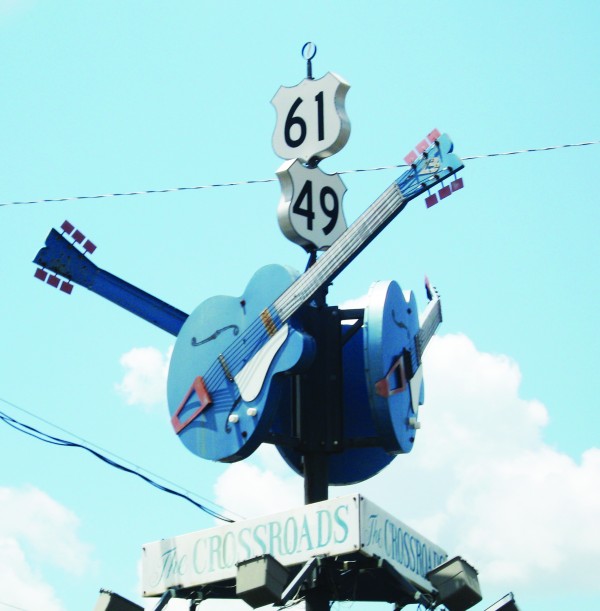
Listen to “I Believe I’ll Dust My Broom,” “Love In Vain,” and “Cross Road Blues” – just three of many songs covered by contemporary artists.
In July, 1954, nineteen-year-old truck driver Elvis Presley recorded “That’s All Right” at Sun Records in Memphis. Some critics call it the first rock and roll record. The label gives songwriting credit to Delta blues guitarist Arthur “Big Boy” Crudup, who recorded the song in 1946 (see YouTube). In 1956, Elvis recorded blues-based “Heartbreak Hotel,” and in 1957, the boogie-woogie-based hit “All Shook Up” hit the airwaves.
To grasp the scale of the revolution launched by these songs, just listen to three number-one hits from 1953: “Don’t Let The Stars Get In Your Eyes” (Perry Como), “Till I Waltz Again With You” (Teresa Brewer), and “The Song From Moulin Rouge” (Percy Faith). They come from different worlds.
While Elvis is sometimes criticized as “the white boy who stole the blues,” he gave back much, for there can be no doubt that he brought black music into the mainstream and laid the groundwork for The British Invasion, the birth of rock, and the preeminent stature of the blues in American music today. When The Beatles stipulated in 1965 that they would not play to racially segregated audiences, part of the credit must go to Elvis, Johnson, and the rest of the Delta blues players.
Johnson and Presley had more than a little in common: Both came by their blues honestly. Both were born in shotgun shacks on the edge of the Delta. Both experienced tragedy early in life. Both were poor boys who sought freedom through fame. Both altered the course of music history, and both died tragically young as a result of their success.
If their stories have anything to teach us, it’s simply this: There’s room enough for all of us in Heartbreak Hotel.
More Features
-
LONDON, UNITED KINGDOM – JUNE 01: Willie Nelson performs on stage at the Hammersmith Odeon in London, England in June 1982. (Photo by David Redfern/Redferns) -
NEW YORK, NY – CIRCA 1985: Roland Orzabal and Curt Smith of Tears For Fears circa 1985 in New York City. (Photo by Robin Platzer/IMAGES/Getty Images) -

UNITED KINGDOM – APRIL 19: ROYAL FESTIVAL HALL Photo of Vashti BUNYAN (Photo by James Emmett/Redferns) -
CIRCA 1975: Country musician Waylon Jennings performs onstage in circa 1975. (Photo by Michael Ochs Archives/Getty Images) -
Taylor Swift and Kanye West at the 2009 VMAs -
CLARKSTON – JULY 14: Guitarist Porl Thompson, bass player Simon Gallup, musician, songwriter and lead singer Robert Smith, drummer Boris Williams and keyboard player Laurence 'Lol' Tolhurst, all members of the English rock band The Cure, pose for a portrait backstage at the Pine Knob Music Theatre on July 14, 1986, in Clarkston, Michigan. (Photo by Ross Marino/Getty Images)