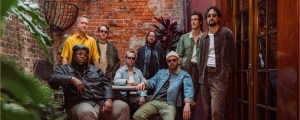
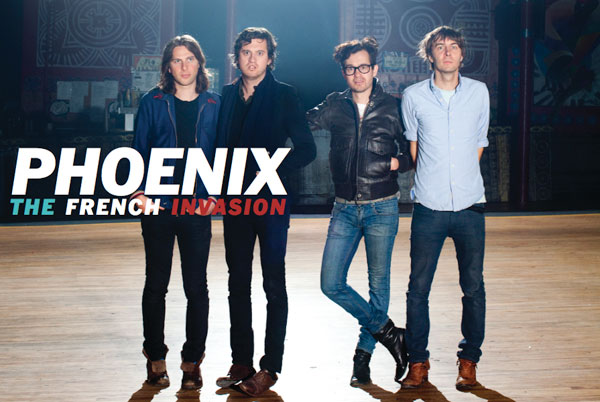
photos by Julia Davis
For the full text of this interview, please go to Drinks With: Phoenix.
During the past 12 months, the band Phoenix has made one of the more proper, and satisfying, foreign invasions on American music in recent memory. With their fourth studio album, Wolfgang Amadeus Phoenix, these four childhood friends from Versailles, France, provide a near perfect example of a group getting exponentially better at what they do with every record. They were the most-blogged-about-band of 2009, and captured the Grammy for best alternative album. Their particular brand of indie pop/rock has given discerning hipsters, soccer moms, frat guys, and kindergarteners the opportunity to dance to the same record. Sitting down with Phoenix in Atlanta to talk about their writing process, I was surprised to see just how much of a band they are. I’ve listened to them for years, but never once thought of them as four individuals who seem to make almost every musical decision as a unit.
Band Members
TM: Thomas Mars [vocals]
CM: Christian Mazzalai [guitar]
DD: Deck D’Arcy [bass]
LB: Laurent Brancowitz [guitar]
Do you typically write songs with a more stripped-down instrumentation and then fill out the rest in the studio?
CM: Yeah. We use very cheap keyboards and acoustic guitars and tape recorders—a Dictaphone. We record for hours and hours.
TM: It is always with cheap instruments—very, very cheap, like 20 dollars—or something rare and expensive. No in-between. I guess it helps us, you know, with the keyboards. If you try something different and it breaks—it doesn’t matter because it’s not valuable. So you have this freedom to use them the wrong way.
LB: When they are really cheap, they breathe, you know? They have this hum. You know the children’s samplers? We use them a lot. They almost sound like a very expensive Mellotron. We also have very good synthesizers, and they breathe too.
DD: We like everything that alters or filters your original idea. That’s why we work with very cheap equipment. We also work with cheap recorders when we compose. [Even though] it’s not supposed to sound like this on the record, it kind of fantasizes everything. So when you listen back to it, it gives you a very new vision of what you did.
Are there any particular songs that have inspired you to create music?
TM: There are so many songs. Maybe The Ronettes’ “Be My Baby” in a way is the ultimate. I listened to it again yesterday. I’m always asked, “What’s your number one?” If there was a number one, that would be it. Because of the second verse. The confidence and the smile, backed up with this incredibly nostalgic atmosphere.
LB: I always wanted to create things. I remember jokes in kindergarten—I realized that someone created that. I loved this idea. We love music because it is powerful. Black magic. It’s really mysterious, yet it works on almost everyone. It just reaches people, and nobody really knows how it works. I think that every form of creation is equal—even if it’s building a chair. But the act of creation is the same.
As for songs, we were ten years old when Thriller was released. And Thriller was a shock for the world, for everybody –even now I don’t really understand how it works. It’s like all the seams have been removed, and it’s this mysterious sphere or monolith. You can also feel that it’s the result of a tradition. A tradition of secrets and a tradition of expertise. When you have that, of course there is this desire to create something new, but there is a tension between creating something new and this form [that is passed down].
Who are some other artists you listen to that you think are aware of this type of tradition?
LB: Bob Dylan is a good example, because he knows the rules. But then he knows how to destroy the rules. He knows how to talk to peoples’ subconscious—the secret language of the subconscious. He knows the traditions—and then he tries to hide the fact that he knows. He is a very good guitar player, but he plays it as if he was bad. [Smiles] Which is cool.
BL: When you listen to his early recordings, he is really, really good. He knows what he is doing and he is 18 or something. Which is really weird—because he knows the secrets of the old people. The Velvet Underground is a good example. When you listen carefully it’s just country and western licks, but it doesn’t sound like country and western. [Laughs]
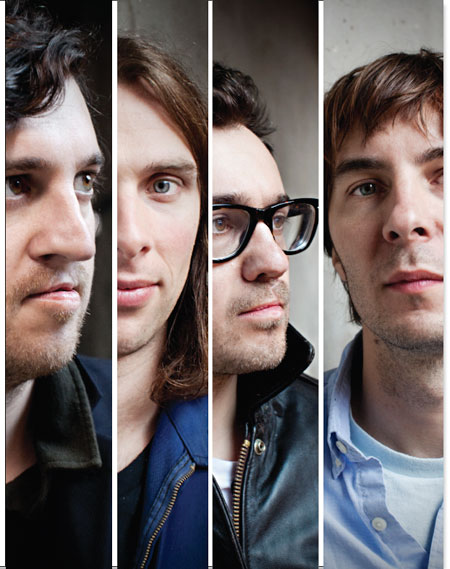
Often, bands have primary songwriters and they bring songs for the group to translate. Listening to your demo collections The Wolfgang Diaries, I didn’t get the sense that these sketches were coming from one person’s brain.
TM: I think that is what’s different about us; it’s really the four of us. It’s a mystery to us because it’s all about this chemistry, so it’s really hard to point out when a song comes out, or when the inspiration is there or…
CM: …Or who begins a song. We have forgotten everything—I don’t remember who wrote the verse of it or thought up the beginning of the song. It’s sort of blurry. We are all together and then [snaps his fingers], there is a moment. And I think that’s how we write, really. The recipe is blurry, and when we don’t understand things, that’s when the creation begins.
More Interviews
-

Photo by Kevin Mazur/Getty Images for CMA -

NASHVILLE, TN – OCTOBER 29: Eagles, Timothy B. Schmit, Vince Gill, Don Henley, Decon Frey and Joe Walsh perform during the Eagles in Concert at The Grand Ole Opry on October 29, 2017 in Nashville, Tennessee. (Photo by Rick Diamond/Getty Images) -

NASHVILLE, TENNESSEE – SEPTEMBER 12: Honoree Vince Gill attends CMT Giants: Vince Gill at The Fisher Center for the Performing Arts on September 12, 2022 in Nashville, Tennessee. (Photo by Jason Davis/Getty Images for CMT) -
Photo by Ingrid Fortenberry