
We might commonly associate classic 1950s and 60s cuts like “Hound Dog” and “Ball and Chain” with superstars Elvis Presley and Janis Joplin, respectively, but there was a different blues legend responsible for both of these iconic tracks. Yet, despite her profound influence on rock n’ roll, the originator of these tunes would die penniless in a Los Angeles boarding home three decades after her first big hit.
We revisit the legacy of Willie Mae “Big Mama” Thornton on the 40th anniversary of her untimely death in 1984.
Videos by American Songwriter
Before There Was Elvis, There Was Big Mama
Willie Mae “Big Mama” Thornton was the second-youngest of seven siblings born in Alabama on December 11, 1926. Growing up, Thornton watched female blues legends like Bessie Smith and Memphis Minnie (the latter of whom wrote Led Zeppelin’s future hit track, “When The Levee Breaks”) and eventually began teaching herself how to sing and play harmonica.
“My singing comes from my experience,” Thornton once said (via Far Out Magazine). “I never had no one teach me nothing; I never went to school for music; I taught myself to sing and to blow harmonica and even to play drums by watching other people. I can’t read music. But I know what I’m singing! I don’t sing like nobody but myself.”
Bessie Smith’s half-sister, Diamond Teeth Mary, heard Thornton singing to herself while working for a garbage company and encouraged the young teenager to audition for a traveling musical revue called Sammy’s Green Hot Harlem Revue. Thornton said the organizers planned to audition 25 potential vocalists. She was the 26th, and the revue ultimately chose Thornton as their singer.
“Big Mama” Thornton’s popularity grew as she continued to perform across the country, wowing audiences and venues alike with her larger-than-life voice and equally sizable frame.
The Blues Legend and Real Meaning Behind Elvis Presley and Janis Joplin’s Hits
In 1952, “Big Mama” Thornton was performing at the Apollo Theatre in Harlem when songwriters Jerry Leiber and Mike Stoller commissioned her to record “Hound Dog.” Thornton’s version of the song, a female empowerment anthem about leaving a cheating partner, spent seven weeks at the top of the U.S. R&B charts, making it her only hit. She received one $500 check for her studio time.
Elvis Presley recorded his version of the track three years later, removing the references to an unfaithful relationship. His version proved far more palatable to a pre-Civil Rights Act music industry and sold ten million copies. Thornton received no compensation. She once told Rolling Stone, “Didn’t get no money from them at all. Everybody livin’ in a house but me. I’m just livin’” (via Nashville Mediator).
Almost a decade later, Thornton wrote and recorded “Ball and Chain,” but a bad copyright deal caused the blues singer to inadvertently forfeit her rights to future compensation yet again. She eventually began receiving payments for “Ball and Chain” after San Francisco’s Big Brother and the Holding Company, fronted by Janis Joplin, started to cover and later record Thornton’s track. “It’s all right,” Thornton later said of the cover. “It made me money. At least I got paid for it.”
The Godmother of Rock and Roll’s Tragic Ending
Despite being the original voice behind some of the mid-20th century’s greatest hits, Willie Mae Thornton was never able to achieve the same success as artists like Elvis Presley and Janis Joplin. Although she continued to tour across the country, her ongoing alcohol addiction began to overtake her ability to perform. By her late 50s, Thornton was broke, living in a Los Angeles boarding home.
Thornton was found dead in the boarding home on July 25, 1984. The city interred her remains with two other anonymous individuals in a pauper’s grave in Inglewood Park Cemetery. Although her final years proved to be an anti-climactic end for a woman who had helped shape rock and roll as we know it today, the music community has since given her posthumous recognition for her profound impact on modern music. The Rock and Roll Hall of Fame plans to induct Thornton on October 19, 2024.
Photo by GBH Archives/YouTube
More Did You Know
-

The Rolling Stones in concert, Tour of Europe '76, Earls Court Arena – Mick Jagger and Keith Richards (Photo by Graham Wiltshire/Shutterstock) -
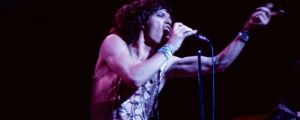
Rock band: The Rolling Stones: – Mick Jagger, Keith Richards (Photo by Roger Bamber/Shutterstock) -

Singer and songwriterJohn Lennon (1940 – 1980) with his wife Yoko Ono, signing copies of her conceptual art book 'Grapefruit' at Selfridges, London, 15th July 1971. (Photo by Jack Kay/Daily Express/Getty Images) -
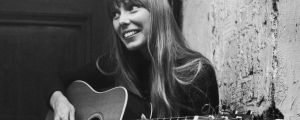
Despite its fantastical origin story of surviving a shrapnel attack in the Vietnamese jungle, the D-28 met its demise on a flight to Hawaii. Not only did the turbulent flight damage the instrument in storage; someone later stole the guitar from the luggage carousel. Mitchell was never able to find her long-lost instrument, something she’s lamented for years. Aside from the sentimental connection guitarists typically have to their first ax, Mitchell was particularly fond of her Martin for functional reasons. After a bout of childhood polio affected Mitchell’s ability to form chord shapes in standard tuning, the singer-songwriter had to adapt with eccentric tunings that allowed her to create rich harmonic structure with limited mobility. Whether open, an octave below, or otherwise, Mitchell’s unique tunings placed stress on the guitar neck that it wasn’t originally made to endure. Moreover, to ensure the dissonance within her tunings was purposeful and not merely off-pitch, Mitchell needed a guitar with pristine intonation—something she frequently lauded the D-28 for having. “I need really good intonation,” she explained to Acoustic Guitar. “One of the signs of really good intonation is how flashy the harmonics are with a light touch. You should be able to get them to bloom like jewels.” While Mitchell has found other guitars that come close in that department, as she put it in her 1996 magazine interview, “I’ve never found an acoustic that could compare with it.” Photo by Central Press/Hulton Archive/Getty Images -
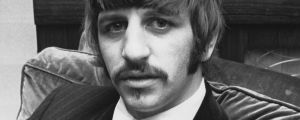
Drummer Ringo Starr of English rock band the Beatles during a reception at the London home of the group's manager Brian Epstein, 20th May 1967. The Beatles' song 'A Day In The Life' had recently been banned by the BBC for its references to drug-taking. (Photo by John Pratt/Keystone/Hulton Archive/Getty Images) -
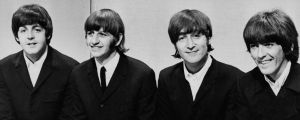
English rock band the Beatles at the BBC television studios in London before leaving for a concert tour of Germany, and afterwards Japan, 16th June 1966. From left to right, they are Paul McCartney, Ringo Starr, John Lennon and George Harrison. (Photo by Central Press/Hulton Archive/Getty Images) -

NEW YORK, NEW YORK – JUNE 11: (L-R) Tommy Thayer, Paul Stanley, Gene Simmons, and Eric Singer of KISS attend the 2021 Tribeca Festival screening of "Biography: KISStory" at The Battery on June 11, 2021 in New York City. (Photo by Monica Schipper/Getty Images)