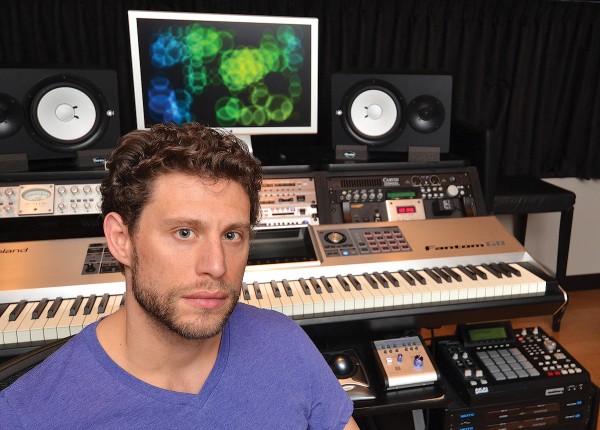
J.R. Rotem has had an intriguing career in music to say the least. Born in South Africa, Rotem got his start as a renowned jazz pianist, then shifted gears to producing radio friendly pop and rap hits for the likes of Leonna Lewis, Rihanna, Maroon 5 and Nicki Minaj. In addition, Rotem runs his own record label, where he and his team discovered and fostered such acts as Jason Derulo, Sean Kingston, and Iyaz. Here, Rotem speaks about his humble industry beginnings, what it’s like to run a record label, and the stories behind his biggest hits.
Thanks for chatting with me, J.R. To start off, you attended Berklee College of Music, and stood out by becoming a pretty big time jazz pianist, right?
Right. I’d say, objectively speaking, what made me stand out is that I learned jazz pretty quickly. Prior to Berklee, I had a lot of classical piano training, so that’s really what I did mostly. I was also into composing with keyboards, and when I went to Berklee after high school, I wanted to study film scoring. However when I got there, right off the bat I found wasn’t into the film scoring; I took some introductory courses, and somehow just didn’t connect with it. But I did get exposed to jazz, so I just kind of immersed myself in jazz piano and ended up graduating with a duel major in arranging and jazz composition. By the end of graduating there, my goal was to be a jazz pianist and composer. I then changed my mind and transitioned into initially producing just hip/hop.
That’s a pretty big jump. I’m sure there aren’t a lot of jazz musicians who make that change. How did it happen?
It was a pretty conscious decision. I was getting better and better at jazz and had a lot of gigs, so when I moved back to the San Francisco Bay Area, I was playing 7 nights a week and was becoming one of the top pianists in that scene… However, I wanted to set my sights on more than being an in-demand jazz pianist just in San Francisco. So I decided to cancel all my jazz gigs and took an entire summer off and really practiced, I’m talking like 8 to 12 hours a day, to try to innovate a jazz sound that’s even more personal… something bigger than what I was doing. After all that time, I realized I connected more with composing and making tracks than being at the jazz clubs, and beyond that I felt like as much as I love jazz, it felt to me like it peaked in its innovatevness in the 1950’s; I wanted to make music that was more relevant and worldwide. So I changed my focus and switched, and it’s not like I had any connections to the music industry. I started from the ground up, making beats and sending them out to anyone I could. After awhile, I’d go to urban music conventions and pass out beat CD’s and that’s how I got my start. At that time, I was primarily producing hip hop. Through luck, some beats got to Dwayne Wiggins who signed Destiny’s Child, and my first major label placement was on their album Survivor.
How old were you then?
I was in my early 20’s.
Was that a track that you made for Destiny’s Child, or was it just a random beat?
At that time, I was making random beats. I knew I wanted to work with someone major, but it was sort of luck how it happened.
Do you think your jazz background influences your songs?
I do. To be honest with you, at first my tracks had way too many melodies and complicated chords to be mainstream. The beats didn’t even leave all that much room for to write lyrics to. When these beats started selling, I had to start to dumb them down to a certain degree. So I’d refine and had to strip things down and use less chords and melodies. For me, I almost had too much musical theory. I think I have a lot of versatility thanks to my background; I’m just as comfortable making a trap sort of a beat, and the same day getting on the piano and creating something from the ground up with a full chord structure.
Then, in 2006, you have your first big single with Rihanna’s “SOS.” That was a great start.
Yes, correct, that was my first real single and my first number one. Before that, I had a lot of placements in the hip hop world- really, a lot, but they were more album cuts.
How did “S.O.S.” get linked up with Rihanna?
Well, I knew of her as far the song “Pon De Replay,” but to be honest with you I didn’t make it for her in mind. That track started out as just what it was; I decided to sample (80’s hit) “Tainted Love” and made that beat a year before lyrics were written to it. At the time, me and my good friend Evan Bogart were trying to put together a girl group, and that song was one of a few that was on their demo we put together. What happened was, we shopped the girl group to Def Jam, among other labels, with the demo and there was no real interest in them. Then, Def Jam’s Jay Brown, who was an executive with Jay-Z, called and said “I don’t like the group, but I love the song “S.O.S.” Can we buy it?” It seemed like, at that point we didn’t have anything to lose, so we sold it to them. At the time, he intended it for Christian Millian, another artist, but from what I heard she passed, though I may be wrong. Then it went to Rihanna, and she decided to cut it. It was one of those things that just came together.
I think one of your most popular tracks that I still always hear on the radio is Leonna Lewis’ “Better in Time.” With that song, I feel like your jazz background comes through because it’s so piano driven and has such a strong melody. What was the process behind it?
That was another one of those tracks where, I just have to say, there was a lot of luck involved. That happened to be a song where one night I went home to the piano and played that riff, then the next day in the studio recorded it and beefed it up and made a full song out of it. Then I got into a random writing session with Andrea Martin, and she ended up writing the entire topline to it. You’d think that maybe we got into a room and put lyrics and music at once, but it was totally separate. We sent it to the record company and they really liked it. There was some talk that it would go to Whitney Houston, who I think was signed to the same label. But they played it for Leona, and she loved it, so she came to my studio in LA and I cut the vocals for her, and it came together pretty quickly; she obviously has an incredible voice. The thing that took awhile with that song was that I had to make two different versions- one for American radio and one for British radio, because if I’m recalling correctly, British radio wanted the drums to sound slightly different than American radio. I think I did about 15 different versions with slight drum variations, and they went with the original one in the end.
At a certain point throughout all of these early successes, you start-up this record label called Beluga Heights. What was the impetus behind that?
My business partner Zach Katz and my brother Tommy both thought our next step was to develop our own artists. I was always reluctant to the idea, because it’s a sacrifice and there’s a lot of time and development that goes into it, whereas with an established artist, they already have a budget, I’m going to get a front end, I know the song is going to be on their album; it’s a little more of a sure thing. On the other hand, with my own artists while it’s a higher risk, it’s also a higher reward. It was around that time Tommy found Sean Kingston, and when I met him I was so blown away by our musical chemistry that I thought it seemed like an appropriate time to start something up. The next two artists my brother found were Jason Derulo and Iyaz, so there was a period there we were on a roll; Tommy found enough people that it became worth it to take myself out of the game of producing for outside artists and developing my own artists on my label.
Like you said, these artists could come out and you don’t know how they’re going to do- and it’s all on you for better or worse.
Yes, definitely. It is, it’s true. I think we were just incredibly blessed and lucky to have those guys. However, people only know about the ones that work as opposed to the ones that didn’t, so I know first hand that it doesn’t always work, and when it doesn’t it’s frustrating because it’s lost time I could have spent working with outside artists.
What goes into fostering these artists and getting their careers started?
With everyone that we signed, I always ask myself “Do I love this music and would I want to produce an entire album with them?” For me, I grew up listening to and modeling myself after producers like George Martin who did an entire Beatles Album or Quincy Jones who did an entire Michael Jackson album. For me, sometimes it seems overly patrolling or outdated, but I can only get so passionate about having somebody signed to me if I don’t personally do the music. So I completely produce the artist’s first album. We’ve always signed underdogs- they have a lot of talent and very humble, and it’s not like they have every other executive and producer banging on their door. So when I’m in the studio with them, they’re at their most open; it’s all about their hunger and the music and the fire.
So you had some great placements last year — from Maroon 5 to Nicki Minaj. So how do you know artists like them are even looking for tracks? And if you do know, are you just tailor-making songs for them and submitting?
That’s a very good question. As you probably know, the industry is big but it’s not that big. It’s getting smaller and smaller- there are less and less artists and labels are merging, so it’s not the most exclusive information. The industry sort of knows and A&R’s will tell us what they’re focusing on. It’s common knowledge. Take Rihanna for example, she puts out an album at least once a year, so in general they’re always stacking up records for her. If a record company hears a hit song or a great song, they’ll save it. When I collaborate with a songwriter, in the case of Maroon five’s “Wipe Your Eyes” which I did with Ross Golan, there’s a weird balance of sort of thinking for a specific group, but not being too specific.
I loved your work on Skylar Grey’s new album, including that song “Wear Me Out.” I’m so familiar with all of your work, and when I first heard that song I had no idea it was you, since I feel like you don’t have a signature sound. Do you find it difficult, or do you set out to make different kinds of music on purpose; going from Nicki Minaj to Maroon 5 to Skylar Grey who are all totally different artists.
In general, there is something in me that leans more urban, but I do like a ton of different music, and have a ton of different influences inside me. When I make these beats and songs, it naturally comes out of me. With “Wear Me Out,” we had just gotten an acoustic grand piano in our studio and I sat down and thought of that chord progression, maybe influence by Alicia Keys’ “Fallin’.” I was doing a bunch of stuff with Skylar, and I gave her that track, and she wrote the lyrics but was almost reluctant to even sing it to me. When she did, I was blown away and it turned out to be one of our favorite songs. However, the perception of my sound is out of my control, and as any producer or artist will tell you, it’s a numbers game. You make tons of beats and tons of songs and a small ratio are the ones that become successful. People make songs every day, but no one has 365 hits in a year. So obviously, you’re doing tons of stuff that never sees the light of day. It’s whittled down, and the sound of the tracks that become successful is what you’re associated with. So much of it is out of your control. For me, I just want the music that I make from my heart to touch the world, so I ultimately don’t care what kind of genre it is. As long as it makes people feel something, that’s what fulfills me.
Rob LeDonne is a writer of comedy, articles, and songs. He’s currently a contributing joke writer for Saturday Night Live’s Weekend Update and has also written material for MTV’s Video Music Awards and the Onion News Network. On the journalism side, LeDonne has also written for the New York Times, Rolling Stone, and Nylon Guys. Follow him on Twitter: @RobLeDonne.
More Interviews
-

Photo by Stephen Dillon