
It’s hard to imagine Tom Petty’s musical legacy without hits like “Runnin’ Down A Dream” and “Free Fallin’”. But Petty’s bandmates didn’t necessarily feel the same way. In fact, in the years following these tracks’ release on Petty’s solo debut, Full Moon Fever, tensions between the singer-songwriter and his band, The Heartbreakers, threatened to dismantle the group completely.
Although Full Moon Fever was technically a solo album, many of The Heartbreakers contributed parts to the record—everyone, that is, except for drummer Stan Lynch. And unsurprisingly, Lynch was the one most at odds with Petty’s solo venture. In the years that followed Full Moon Fever’s release in 1989, Lynch often complained about playing those songs in concert, saying he felt like he was in a cover band since he didn’t play them on the album.
Videos by American Songwriter
According to Petty, this was par for the course. “We fought a lot,” Petty said of Lynch in a conversation with Paul Zollo. “Everyone fought with Stan, really. Over anything. Over what we were eating. Stan was as big as life and very confused about a lot of things. He could be really passionate in two directions. You just didn’t know really where you were with Stan.”
Stan Lynch Made His Feelings Known in October 1994
If Tom Petty wasn’t sure where he stood with his drummer, Stan Lynch, following the release of Full Moon Fever, Lynch likely cleared that up when he walked away from the band immediately following a gig at the Bridge School Benefit Concert in Mountain View, California, on October 2, 1994. Although history would show that Petty and The Heartbreakers would survive Lynch’s departure, the switch-up certainly had the potential to derail things completely. Lynch and Petty’s onstage connection was exceptional, something even Petty could attest to following their contentious split.
In hindsight, though, both men realized where they fell short. “I wasn’t always an easy person to deal with,” Petty confessed to Paul Zollo. “I could be very, very demanding of people. Onstage, offstage, in the studio with people. I was pretty turbulent, looking back at it. I don’t think I was an a**hole. But I think I was intense. Very intense. So, I don’t think it was always somebody else’s fault. I’ll take the blame as much as anyone else for what went on.”
Lynch, for his part, seemed to give Petty grace in this regard. During an interview with Lee Flier in the early 2000s, Lynch said, “Working in a band is a chop. Some bands that have been together for ten minutes, it’s ten minutes too long. And some bands that have been together for twenty years are just right. Very few go forever. Somebody dies, or somebody hates it. To get a run, a creative run, is amazing, period. That’s how I see it now. So, I think a smart band leader has gotta be a good casting agent and a benevolent dictator.”
Photo by Aaron Rapoport/Corbis/Getty Images
More Behind the Album
-
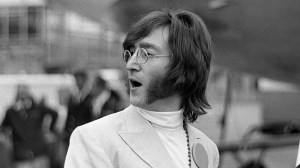
Photo by Murphy/Daily Herald/Mirrorpix via Getty Images -
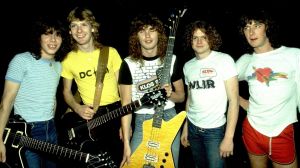
Def Leppard on 8/23/81 in East Troy, Wi. (Photo by Paul Natkin/WireImage) -
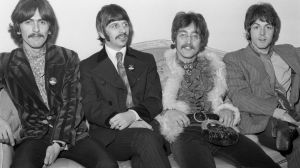
LONDON – MAY 19: (L-R) English musician, singer, songwriter and guitarist George Harrison (1943-2001), English musician, singer and drummer Ringo Starr, English singer, songwriter and guitarist John Lennon (1940-1980), and English singer, songwriter and bassist Paul McCartney of the Beatles attend a press party at the home of manager Brian Epstein supporting the release of Sgt. Pepper's Lonely Hearts Club Band, May 19, 1967 in London, United Kingdom. (Photo by Jeff Hochberg/Getty Images) -
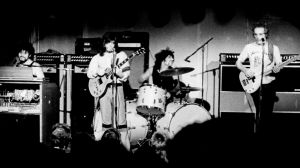
UNITED KINGDOM – JANUARY 01: MARQUEE Photo of VANILLA FUDGE, performing live onstage – L-R: Mark Stein, Vince Martell, Carmine Appice, Tim Bogert (Photo by Estate Of Keith Morris/Redferns) -
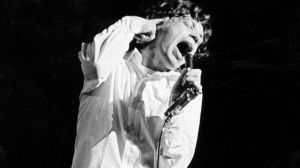
CIRCA 1966: Singer Mick Jagger of the rock and roll band "The Rolling Stones" performs onstage in circa 1966. (Photo by Michael Ochs Archives/Getty Images) -
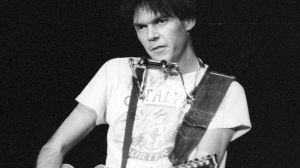
Musician Neil Young performing onstage in 1978 in Los Angeles. (Photo by Michael Ochs Archives/Getty Images) -
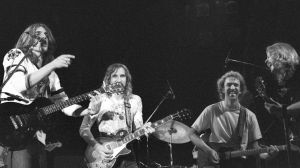
The Eagles perform on stage in Amsterdam, Netherlands, 1975. (L-R) Glenn Frey, Joe Walsh, Bernie Leadon, Don Felder. (Photo by Gijsbert Hanekroot/Redferns) -

English rock group the Beatles hold a press conference at the Capitol Records Tower in Los Angeles before their live performance at the Dodger Stadium, California, 28th August 1966. From left to right, George Harrison, John Lennon, Paul McCartney and Ringo Starr. (Photo by Archive Photos/Getty Images)