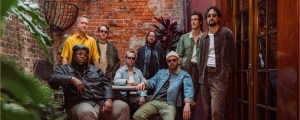
Over the years, Stephin Merritt, best known as the songsmith behind The Magnetic Fields, has taken on some ambitious side projects. Since the success of 1999’s three-disc masterpiece 69 Love Songs (which he originally envisioned staging as a musical revue complete with drag queens), he released his second album with the 6ths, for which he writes the songs and others sing them; an album with singer Claudia Gonson and instrumentalist Chris Ewen as creepy electro-pop trio Future Bible Heroes; and another album with his grim, bubblegum band the Gothic Archies (The Tragic Treasury: Songs from a Series of Unfortunate Events) to accompany Daniel Handler’s Lemony Snicket series.

Over the years, Stephin Merritt, best known as the songsmith behind The Magnetic Fields, has taken on some ambitious side projects. Since the success of 1999’s three-disc masterpiece 69 Love Songs (which he originally envisioned staging as a musical revue complete with drag queens), he released his second album with the 6ths, for which he writes the songs and others sing them; an album with singer Claudia Gonson and instrumentalist Chris Ewen as creepy electro-pop trio Future Bible Heroes; and another album with his grim, bubblegum band the Gothic Archies (The Tragic Treasury: Songs from a Series of Unfortunate Events) to accompany Daniel Handler’s Lemony Snicket series.
With The Magnetic Fields, he managed to put out i (a record containing song titles beginning with the aforementioned vowel), Showtunes (with Chinese theatre director Chen Shi-Zeng), and he even penned a commercial jingle for Volvo. He shows no signs of slowing down. Last month saw the release of Distortion—the unruly eighth album by The Magnetic Fields—and by working quickly using the same instrumentation on every song, Merritt emulated the sound of the Jesus and Mary Chain’s Psychocandy, eliciting feedback on nearly everything (guitars, vocals, piano, accordion, cello, etc.). Only the drums were left alone, as they were tracked in the cavernous stairwell of Merritt’s Manhattan, apartment which, at the time, he was vacating. “Since I was moving out, it was suddenly OK to make more noise,” he says. Underneath the construction site-like noise is Merritt’s brooding baritone, something he says he has no control over. (Call him up—his speaking voice is just as solemn.) Merritt had anticipated singing all of the songs himself and did, but after he was finished, he enlisted vocalist Shirley Simms—who performed on 69 Love Songs—to add variety. “My singing wasn’t pop enough,” Merritt says, “so I decided to have Shirley sing half the record. Her voice is as pop as it gets.” The material is all his own and all too familiar, thematically. Much like the group’s previous work, Distortion is pop-rock par excellence, a dreamy, often nightmarish meditation on love and loss riddled, with self-deprecation and disillusionment—this time, submerged in sonic drone. Apart from the album opener, “Three-Way,” an exuberant pop-rocker with a chorus consisting of the title shouted three times with glee, his songs are dirty little ditties with delightful melodies and frightful lyrics, seemingly inspired by a David Lynch movie. Take, for instance, the cheerfully perverse “California Girls,” which opens innocently enough: “See them on their big bright screen/tan and blonde and seventeen.” Just when he starts channeling Springsteen’s “Girls in Their Summer Clothes,” Merritt mocks them: “They come on like squares, then get off like squirrels/I hate California girls.” Then he goes for the battle-axe, imagining himself wielding his wrath upon them. Funny? Sure. Sick, yep. And we’re only two songs in. Merritt’s dark humor is sometimes difficult to digest. To have fun here, you have to accept it—or at least try to stomach it. Attempt to relate to it, and Merritt scoffs: “Why would you want to do that?! They all live terrible lives.” This is especially true on the maudlin “Mr. Mistletoe” (“Oh, Mr. Mistletoe/wither and die/you useless weed/for no one have I”) and the over-emotional “Old Fools” (“Old lines who’d have thought/they would ever reuse/like I love you/Surprise!/I love you”). It’s all too sad to be true, and that’s the thing. Merritt purposefully drops pathetic characters into ridiculous situations, because, he says coolly, “Drama is more entertaining than resolution.” There’s a lot of drama on Distortion. “Xavier Says” stars a tacky drag queen slurring her fighting words. A nun entertains the idea of indulging her desires to be a “Playboy bunny,” to wear a “Little Willy” and to “learn S and M” in “The Nun’s Litany.” Merritt gets macabre on “Zombie Boy,” which he, himself, calls “horrifying” for good reason. A boy, who was once paraded around town in silk slips, high heels and mink stoles, dies of smallpox and becomes a blue-skinned, white-haired zombie bride (“No blood ever drips when I widen your holes”). The best moments can be found in the middle of the album. Simms’ spot-on delivery makes “Drive on Driver,” a song about leaving a female lover behind, a gem that gleams long after her dust trail has settled. Merritt’s drunken confessional, “Too Drunk to Dream” (“Sober, life is a prison/Shitfaced, it is a blessing/Sober, nobody wants you/Shitfaced, they’re all undressing”), keeps us entertained despite his down-and-out demeanor. Theatrical and absurd, Distortion is all over the place lyrically, and Merritt probably knows it, which is why he relies on the record’s buzz-saw sound to hold it all together. Like a kid who insists on falling asleep with the TV on, the album’s unsettling static becomes comforting in the end. There’s no telling what Merritt’s got in mind for his next album, but it’s surely something wild at heart and weird on top. We’re likely to go along for the ride, if we can stomach it.
More Interviews
-
Photo by Kevin Mazur/Getty Images for CMA -
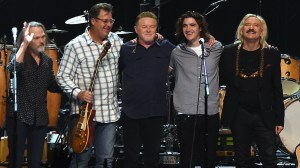
NASHVILLE, TN – OCTOBER 29: Eagles, Timothy B. Schmit, Vince Gill, Don Henley, Decon Frey and Joe Walsh perform during the Eagles in Concert at The Grand Ole Opry on October 29, 2017 in Nashville, Tennessee. (Photo by Rick Diamond/Getty Images) -
NASHVILLE, TENNESSEE – SEPTEMBER 12: Honoree Vince Gill attends CMT Giants: Vince Gill at The Fisher Center for the Performing Arts on September 12, 2022 in Nashville, Tennessee. (Photo by Jason Davis/Getty Images for CMT) -
Photo by Ingrid Fortenberry