
On September 11, 2001, Bob Dylan released his 31st studio album, Love And Theft. The album peaked at No. 5 on the Billboard 200 and topped the charts elsewhere around the world. Dylan approved of promotional commercials that began airing before the release date. But by the time the album was officially out, the world had its eyes squarely fixed on the empty hole in the sky where the World Trade Center had once punctuated the New York City skyline.
Dylan’s album release, along with most other aspects of daily life, became secondary, third, and fourth on our list of priorities as the country processed the deadliest terrorist attack on American soil. Just a thirty-minute subway ride from Clinton Recording, the Midtown studio where Dylan recorded his album with engineer Chris Shaw, the city was covered in a layer of white dust that would continue to wreak havoc on those lucky enough to have survived that day.
Videos by American Songwriter
Like most people, Dylan had no problem shifting his attention to the aftermath of the terror attacks. In an interview with Rolling Stone in November of that year, he took no responsibility for helping guide the country through the situation with his music. He did so as a matter of humility as an entertainer, not indifference. “My mind would go to young people at a time like this,” Dylan said.
Bob Dylan’s ‘Love And Theft’ Would Live Up to Its Name
The unfortunate coinciding of Bob Dylan’s pre-scheduled release date and the unexpected attack on the World Trade Center is where the connection between these two moments ends. No one could have anticipated the events to come, certainly not a singer-songwriter outside the realm of classified global politics. But this strange coincidence is not the only uncanny aspect to Dylan’s 31st studio album. This would come years later, in 2003.
Rumors of plagiarism began swirling around Bob Dylan’s Love And Theft after eagle-eyed listeners noticed similarities between Dylan’s lyrics and lines from a Japanese doctor and author’s book Confessions Of A Yakuza. In the song “Floater”, Dylan sings, “I’m not quite as cool or forgiving as I sound.” In Junichi Saga’s book, he writes, “I’m not as cool or as forgiving as I might have sounded.” There are other seemingly verbatim references to “feudal lords” elsewhere, too.
As a sardonically ironic allegation on an album called Love And Theft, the plagiarism accusations were short-lived. That was largely due to the fact that Saga didn’t seem to mind. Speaking to The Wall Street Journal in 2003, Saga said, “Bob Dylan is a very famous American country singer, yes? I’m not familiar with these things.” He added, “Please say hello to Bob Dylan for me because I am very flattered and very happy to hear this news.”
Photo by Bernd Muller/Redferns
More Behind the Album
-
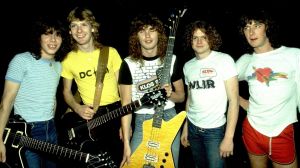
Def Leppard on 8/23/81 in East Troy, Wi. (Photo by Paul Natkin/WireImage) -
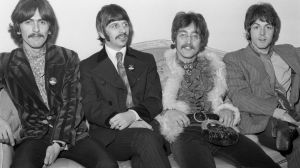
LONDON – MAY 19: (L-R) English musician, singer, songwriter and guitarist George Harrison (1943-2001), English musician, singer and drummer Ringo Starr, English singer, songwriter and guitarist John Lennon (1940-1980), and English singer, songwriter and bassist Paul McCartney of the Beatles attend a press party at the home of manager Brian Epstein supporting the release of Sgt. Pepper's Lonely Hearts Club Band, May 19, 1967 in London, United Kingdom. (Photo by Jeff Hochberg/Getty Images) -
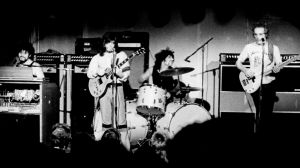
UNITED KINGDOM – JANUARY 01: MARQUEE Photo of VANILLA FUDGE, performing live onstage – L-R: Mark Stein, Vince Martell, Carmine Appice, Tim Bogert (Photo by Estate Of Keith Morris/Redferns) -
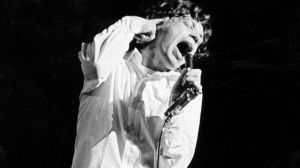
CIRCA 1966: Singer Mick Jagger of the rock and roll band "The Rolling Stones" performs onstage in circa 1966. (Photo by Michael Ochs Archives/Getty Images) -
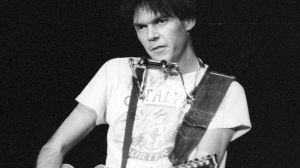
Musician Neil Young performing onstage in 1978 in Los Angeles. (Photo by Michael Ochs Archives/Getty Images) -
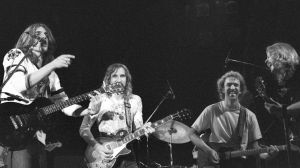
The Eagles perform on stage in Amsterdam, Netherlands, 1975. (L-R) Glenn Frey, Joe Walsh, Bernie Leadon, Don Felder. (Photo by Gijsbert Hanekroot/Redferns) -

English rock group the Beatles hold a press conference at the Capitol Records Tower in Los Angeles before their live performance at the Dodger Stadium, California, 28th August 1966. From left to right, George Harrison, John Lennon, Paul McCartney and Ringo Starr. (Photo by Archive Photos/Getty Images) -
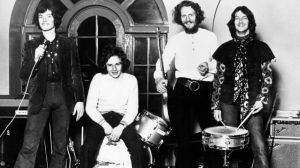
1969: Rock band "Blind Faith" pose for a portrait in 1969. (L-R): Steve Winwood, Ric Grech, Ginger Baker, Eric Clapton. Photo by Bob Seidemann. (Photo by Michael Ochs Archives/Getty Images)